
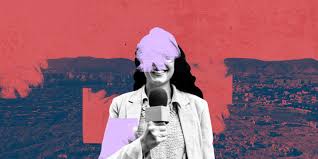
While women in Syrian media are expected to maintain composure and professionalism on air, male media figures are often given wide latitude to engage in inflammatory rhetoric off it. Social media posts by certain journalists have labelled women as “harlots” or made degrading insinuations about their personal lives, creating a hostile environment that undermines their presence in the media landscape.
There is a growing void in Syrian media—an intangible yet palpable absence, akin to the ghostly fears that encircle women, slipping just beyond reach as they question their own perceptions. Many find themselves circling these shadows until exhaustion sets in. Branded overly sensitive or irrational, they retreat quietly from public life—a slow, deliberate withdrawal that leaves behind the muted echo of their voices.
Where are the platforms that once claimed to champion women’s participation? Where are the international agreements advocating gender parity? Where are the donor stipulations requiring women’s inclusion? No Syrian outlet explicitly bars women from appearing in written, visual, or broadcast content. Yet increasingly, these platforms resemble traps—spaces that covertly test women’s endurance: how many slurs must they withstand? How many falsehoods must they publicly deny before hesitating to return?
Most Syrian media institutions have never truly been allies to either women or men. So what has changed in the moralising discourse and vilification directed at women? The shift lies in a descent from sermonising to personal defamation, from satire to outright abuse. It is no longer surprising when a woman is insulted after an interview—it has become routine. The hosting outlet continues as if nothing occurred, treating incitement as external to its editorial remit, though it is the very stage from which this abuse emanates. Consequently, women’s absence deepens. Their voices are silenced by an arena too brittle to carry them, while media institutions remain too indifferent or unprofessional to defend them. Staying becomes a form of quiet death—while the earth can bear no further loss.
Tragically, most Syrian media has become a façade filled with voices skilled in navigating the narrow margins of acceptability—voices that exclude anyone who dares ask uncomfortable questions. Women are often pushed out because they arrive bearing inquiries the system cannot tolerate: questions about justice, accountability, patriarchy, and feminist identity.
To appear “gender-conscious,” microphones are occasionally extended to women, but they are left to face the backlash alone. There are no protective frameworks, no protocols to counter digital abuse, no platform intervention when an interview devolves into a public execution. Women are abandoned to a hostile crowd, and those who criticise this complicity are quietly ostracised. A covert system of expulsion takes shape—not through formal bans, but by making participation untenable. One by one, women slip away, unnoticed and unacknowledged.
The Physical and Digital Public Sphere: Spaces Where Women Are Seen and Judged
The public sphere, in essence, encompasses any space where individuals interact beyond the confines of private life. Physically, it is the square, the street, the neighbourhood café, the workplace, or the community hall. Digitally, it spans a Facebook page, a Twitter account, a comment thread, a Zoom meeting, or a livestream bridging continents. For women, however, these arenas are never truly “public.” Though intended to facilitate expression and participation, they are often encircled by invisible wires of threat and restriction. Their boundaries shift with societal whims—opened conditionally, closed with incitement, and filtered through an unyielding patriarchal gaze.
In Syria, women have carried both their bodies and their questions into these realms, believing the doors to participation had been opened. Instead, they found trials awaiting them. Every public appearance is scrutinised; every opinion judged not by content, but by the speaker’s ability to endure. The digital space, despite claims of freedom, often becomes a theatre of violence: women’s bodies are dissected before their ideas are heard, their intentions vilified before their arguments unfold. In the physical realm, women are advised to remain silent “for their safety.”
A symbolic scene is that of male demonstrators forming a “protective” circle around women—offered in the name of safety but also serving as soft segregation, a visible boundary signalling who may speak and who must stay quiet. Or the rallying cry, “Hara’ir to the back!”—shunting women to the periphery, away from decision-making and presence.
Yet women entered the public sphere as if unshackled, stepping into spaces where they had no inherited claim but wielded the keys. They came with the desire to shape the future, believing the revolution would redistribute not only power but also voice. Syrian women emerged as activists in the squares, photographers behind the lens, writers crafting narratives, and analysts making sense of the chaos. Initially, they believed the revolution had redrawn the map and broken the old chains. But it soon became clear that this space was only partially theirs, circumscribed by unwritten rules: speak, but do not challenge the structure; appear, but do not disrupt the patriarchal script; exist, but only as the “silent struggler.”
Over time, media platforms began to replicate the same exclusion—albeit more subtly. Women were invited to complete the picture, not to reshape it. They were positioned as token voices and left unshielded when attacked. When their personal lives were weaponised in public commentary—under the guise of “editorial independence” or “free speech”—media outlets offered no protection. Platforms would allow torrents of abuse in comment sections: thousands of posts branding a guest a “whore,” attacking her family, mocking her appearance, or targeting her relatives. These comments often remain, even when flagged or deletion is requested. Platforms claim a commitment to free expression or cite policies forbidding interference. Hate speech festers, and victims are told to be resilient.
Thus, the insult remains archived. The violence is recycled, not resolved. Each woman’s appearance becomes a renewed test—of her tolerance for public shaming and psychological harm.
Syrian media, under the illusion of neutrality, becomes an active participant in exclusion. By doing nothing, it enables everything.
This article was translated and edited by The Syrian Observer. The Syrian Observer has not verified the content of this story. Responsibility for the information and views set out in this article lies entirely with the author.