
As Syrians mark the first anniversary of their liberation and the fall of the former regime, significant developments are unfolding in Washington regarding an imminent vote in the United States Congress to repeal the Caesar Act. Mohammad Alaa Ghanem, Director of Political Affairs at the Syrian American Council, has revealed advanced efforts within Congress to include a provision repealing the Caesar Act in the defence appropriations bill. According to Ghanem, the vote is scheduled for Wednesday, 10 December.
In parallel, Wall Street Journal correspondent Jared Malsin confirmed on the platform X that the US Congress has “just approved” the lifting of sanctions imposed under the Caesar Act, adding that the final text, incorporated into amendments to the National Defense Authorization Act, would be published later that evening.
Despite the significance of this development, the diplomatic efforts that brought it about, and the accompanying support from Arab and regional allies, such declarations prompt a fundamental question: Will the anticipated repeal of the Caesar Act be sufficient to set Syria’s reconstruction in motion, or do obstacles remain that go beyond American sanctions?
Crumbling Institutions
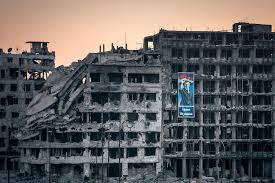
The Syrian state’s institutional structure represents one of the most daunting challenges facing the new government in the post-liberation era. Fourteen years of conflict saw the nation’s resources diverted almost entirely to sustain the former regime’s military machine, leaving civilian sectors deprived of basic development. Coupled with European and American sanctions that inhibited institutional adaptation to global progress, this has resulted in a debilitated administrative framework now burdening prospects for reconstruction.
A World Bank report issued last October estimates Syria’s reconstruction cost at $216 billion, with $141 billion required to rehabilitate government institutions and public infrastructure, including roads, electricity, water, and administrative networks.
Economist Younis al-Karim attributes the roots of this institutional decline to the previous regime but notes that the current administration has yet to launch a concrete programme for institutional reform. He told Syria Television that recruitment processes remain weak due to the departure of numerous civil servants, further weakening the state’s ability to coordinate reconstruction efforts.
This analysis aligns with comments made by Syrian Finance Minister Mohammed Yisr Barnieh following former US President Donald Trump’s announcement in Riyadh of his intention to lift sanctions on Syria. Barnieh stated that the government is pursuing “comprehensive reform of public financial management, encompassing the tax system, customs, and the banking sector” as part of wider efforts to modernise an economy long burdened by an inflated public sector. However, he emphasised that lifting sanctions represents only the first step on a long road to recovery.
Frailty of Governance and Legislation
The weakness of governance and the absence of a robust legislative and oversight framework are among the principal barriers to reconstruction in Syria, even if American sanctions are fully lifted.
A study by the Omran Center for Strategic Studies argues that no reconstruction plan can succeed without independent and effective oversight and judicial institutions. These bodies are essential for ensuring that resources reach their intended recipients and for preventing the re-emergence of corruption and favouritism entrenched by the previous regime over decades.
This perspective is shared by Mohammad Alaa Ghanem, who told Syria Television that the repeal of the Caesar Act alone will not attract investment or initiate reconstruction. He explained that raising incomes, improving exports, and drawing international companies require sound economic planning supported by an impartial judiciary. Foreign firms, he noted, are deterred by the risk of disputes and the absence of reliable courts and legal systems to resolve them.
Ghanem stressed that a healthy investment environment relies not just on incentives but also on full transparency in contract awards and economic procedures. A unified and coherent planning infrastructure, he said, is as critical as the repeal of the Caesar Act itself.
Research from international institutions supports this view. An analysis by the Carnegie Middle East Center, dated 31 October, warns that reconstruction efforts are vulnerable to capture by powerful political interests unless governance deficiencies are addressed. It noted that in the immediate aftermath of the regime’s fall, some state assets were privatised without adequate transparency, raising concerns about a resurgence of the cronyism and corruption that have long plagued Syria’s economy.
Fragmented Zones of Control
The absence of unified political control over Syrian territory poses one of the most serious threats to launching a national reconstruction strategy. In addition to administrative and economic constraints, Syria remains territorially fragmented — with some regions under government authority, others under the control of the SDF east of the Euphrates, and the Suwayda area operating independently in the south.
This fragmentation hampers the development of a cohesive reconstruction vision and undermines the state’s capacity to implement national policies or undertake major infrastructure projects that require centralised authority and a stable legal environment.
Analysts note that this incomplete political stability is the main factor influencing the decisions of international donors. Many view Syria as still being in transition, lacking a settled governance structure. This uncertainty makes foreign governments and financial institutions reluctant to commit to long-term investment in a context viewed as unstable and politically unresolved.
Ayman al-Dasouki, senior researcher at the Omran Center, pointed out to Syria Television that although the Caesar Act’s impact on reconstruction is substantial, it represents only one among many hurdles to rebuilding Syria in a secure and stable manner. He added that the success of reconstruction depends on the restoration of national supply chains vital to Syria’s economy. This goal remains unachievable while large swathes of territory remain outside state control, making the integrated revival of productive sectors and internal trade networks nearly impossible.
Israel and the Obstruction of Reconstruction
Israel’s role has emerged as one of the most influential external factors obstructing Syria’s reconstruction prospects. Beyond regular military assaults and efforts to exploit ethnic and sectarian divisions, Israel’s actions continue to destabilise the political and economic environment required for lasting investment.
Despite a year having passed since liberation, Israel continues to carry out intense airstrikes and incursions into Syrian territory. More than 1,000 air raids and 400 incursions have taken place since the fall of the previous regime. The latest attack occurred in Beit Jann, near Damascus, claiming dozens of lives.
This volatile security situation directly affects investor confidence. Economist Younis al-Karim stated that ongoing Israeli aggression, combined with the risk of further sanctions being imposed under pressure from Tel Aviv, discourages foreign capital from entering Syria. He argued that even if the Caesar Act is repealed, this factor alone could stall reconstruction.
Politically, the Syrian government acknowledges the severity of the Israeli challenge. During his appearance at the 2025 Doha Forum, President Ahmed al-Sharaa stated: “We are working with major international powers to compel Israel’s withdrawal from territories occupied since 8 December 2024. The international community supports our legitimate claim. Negotiations with Israel are ongoing, with the United States participating. There is unanimous agreement on Syria’s right to reclaim its land.”
This article was translated and edited by The Syrian Observer. The Syrian Observer has not verified the content of this story. Responsibility for the information and views set out in this article lies entirely with the author.