
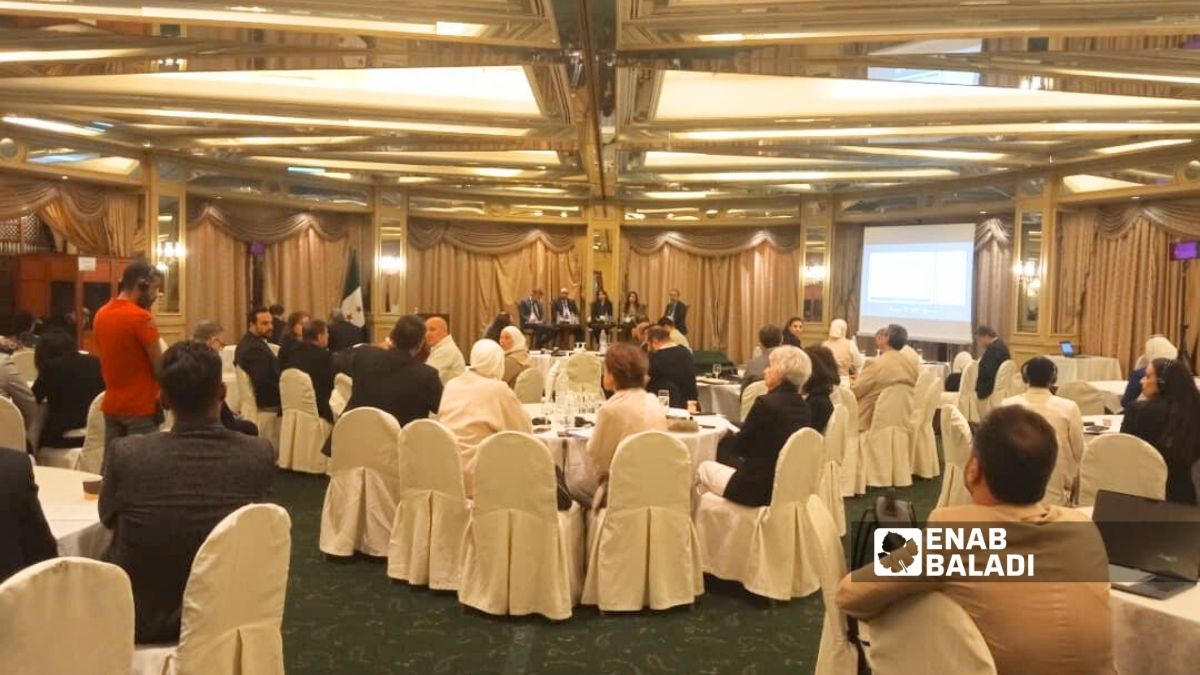
On Sunday 2 November, three Syrian civil society organizations convened a symposium in Damascus under the title “From the Rubble to Responsibility: Human Rights, Business, and the Future of Syria.” Organized by the Syrian Legal Development Program, the Global Syrian Business Association, and Syria Report, the conference brought together representatives from government ministries, civil society, the business community, UN agencies, and donor states—all aiming to shape a shared vision for a more sustainable and accountable future.
Development Inseparable from Human Rights
Saad Baroud, Director of International Organizations and Conferences at the Syrian Ministry of Foreign Affairs, asserted that development and human rights are fundamentally linked. Recalling the 2011 Syrian revolution, he noted its calls for dignity and national unity made the question of rights central to Syria’s post-conflict discourse.
“Reconstruction cannot proceed on goodwill alone,” Baroud said. It requires clear public policy and legal frameworks that balance individual freedoms with the protection of human rights. He stressed that reconstruction is not merely about rebuilding structures, but is intrinsic to transitional justice. While buildings can be quickly restored, trust and rights take far longer to repair.
Housing and property rights, he argued, are pivotal to any serious redress of the seizures, forced displacements, and disappearances that have marked both the revolution and the preceding decades.
Citing international experiences, Baroud identified three essential pillars for sustainable economic recovery: sound governance, a responsible private sector, and an engaged civil society.
He praised Syrian civil society’s leadership during the revolution in advocating for rights, pursuing accountability, and exposing violations. It now adapts to shifting priorities with notable agility. “No development can be allowed to come at the cost of human dignity,” he concluded.
Averting the Return of Violations
Sana Keikhia, Executive Director of the Syrian Legal Development Program, described the Syrian tragedy not only as a political and military crisis but as a failure of institutions. Key sectors of Syria’s economy—construction, finance, telecommunications, and industry—she said, were complicit in the regime’s repression.
Over fourteen years of war, following decades of authoritarian rule, some businesses did more than survive under state coercion—they thrived by directly profiting from rights abuses, including the systematic expropriation of property from detainees and displaced persons.
Keikhia criticized many post-conflict “reconstruction” projects as thinly veiled attempts to entrench these illicit gains. Telecommunications and tech services were repurposed into surveillance tools used to monitor activists, transforming infrastructure into weapons of fear. She alleged that domestic and foreign companies contributed to the regime’s chemical weapons capabilities—tools of civilian terror that could not have been developed without external support.
These abuses, she argued, were enabled by legal loopholes and the absence of accountability mechanisms, allowing regime-aligned profiteers to enrich themselves with impunity. In Syria, commerce became inseparable from coercion.
“No economic project built on the suffering of Syrians can be legitimized in the future Syria,” Keikhia stated.
Without robust legal structures and rights protections, such violations could be repeated. “We Syrians in the new Syria will not allow that,” she pledged.
Rebuilding, she stressed, requires more than physical infrastructure—it demands a complete reimagining of Syria’s economic and legal systems, anchored in the principle of “do no harm.” Economic growth must never be traded for human rights.
The conference sought to highlight the importance of accountability, secure justice for victims, and shift Syria’s path from recovery to responsible stewardship. Its aim was not to vilify business, but to advocate for enterprises that respect human dignity.
“The Syrian voice,” Keikhia concluded, “must be heard—insistent on justice and determined to ensure that commerce becomes a partner in restoration, not repression.”
Reconstruction Is More Than Commerce
Nasser Youssef, board member of the Global Syrian Business Association, told Enab Baladi that human rights are the foundation not only of reconstruction, but of any modern economy. No country, he said, can expect deep economic relations with Western democracies without embracing policies that uphold human rights, environmental protections, and the rights of women and children.
Youssef acknowledged that reconstruction is fundamentally an economic process, governed by financial logic. While states and donors may set the framework, actual implementation lies with profit-driven companies. These companies, he insisted, must be aware of the social and human impacts of their operations—their legacy will depend on their ethical compass.
He also pointed to the present opportunity to revive trade unions and professional syndicates—provided that workers and professionals organise with clarity and purpose.
With greater freedoms now available, Youssef encouraged renewed advocacy for rights. Rights, he said, are not freely granted—they must be claimed. But the law, he added, obliges fairness to all parties.
Ayman al-Mulawi, President of the Damascus and Countryside Chamber of Industry, affirmed the centrality of justice and human rights. Forums like this one, he said, bring to light the abuses of the former regime—particularly those inflicted on workers and citizens.
Investors, he warned, must ensure that their projects are legally and ethically sound, built on land that is free from claims of usurpation.
He stressed the need to respect labour rights and environmental standards. Violations, he cautioned, could lead to legal consequences in Syria or abroad, where foreign jurisdictions are increasingly enforcing accountability for illicit business practices.
Mulawi acknowledged that certain business elites aligned with the previous regime benefited from tailored privileges. Although the Chamber of Industry is not a judicial body, he said, it stands ready to cooperate with legitimate legal investigations.
Participants at the conference also highlighted the lack of a national housing authority as a key obstacle to investment in the sector. A coherent housing policy, they argued, would unlock opportunities, drive construction, and support economic growth.
Speakers called for a fair and transparent approach to reconstruction, warning that premature or opaque announcements could lead to serious disputes.
They also emphasized the need to revise over 190 laws to bring Syria’s legal system in line with the demands of reconstruction and development. The private sector must play a genuine role in this process—particularly across the seven regions devastated by displacement and destruction—even as questions remain over how reconstruction will be financed.
This article was translated and edited by The Syrian Observer. The Syrian Observer has not verified the content of this story. Responsibility for the information and views set out in this article lies entirely with the author.