
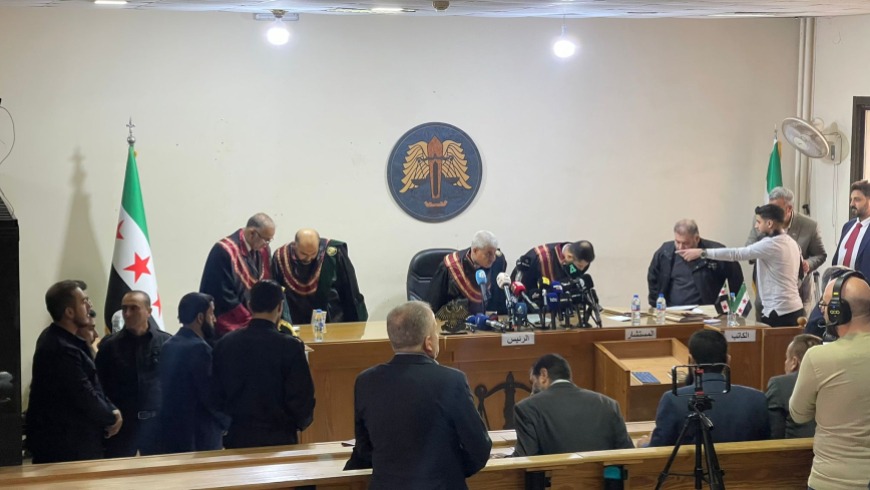
In a landmark moment for Syria’s emerging judicial reckoning, the inaugural public session of trials concerning serious violations committed during the March 2025 coastal unrest concluded at noon on Tuesday at Aleppo’s Palace of Justice. It marks the first occasion on which individuals linked to state institutions have appeared in open court for such offences.
Fourteen defendants stood before the bench, including former regime loyalists and current personnel from the Ministry of Defence. The presiding judge affirmed that proceedings would remain strictly national, impartial and independent, governed exclusively by the provisions of the Syrian Penal Code. The charges include incitement to sedition, fomenting civil war, leading armed gangs, assaults on public forces, murder, looting and deliberate destruction.
The court adjourned further hearings until 18 and 25 December to allow investigations and interrogations to continue. No verdicts were delivered during Tuesday’s session, which began at 9:30 a.m. and focused on the preliminary statements of the accused.
Background of the Coastal Atrocities
The Syrian coast witnessed several days of intense violence in March 2025, when armed loyalists of the deposed regime launched attacks on government security forces. Although state troops regained control through a sweeping operation involving irregular factions, the campaign was accompanied by widespread abuses: extrajudicial killings of civilians, looting and the burning of private property. The Syrian Network for Human Rights documented 1,662 deaths between 6 March and 16 April 2025.
In response, President Ahmed al-Sharaa established a National Commission of Inquiry. On 22 July, the commission submitted its findings to the president and confirmed that 563 suspects — 298 accused of attacks on civilians and 265 of assaults on security personnel — had been referred to the judiciary. All upcoming trials, the commission stated, would be held publicly.
A Significant Yet Imperfect Step Toward Accountability
Fadel Abdul Ghani, director of the Syrian Network for Human Rights, described Tuesday’s proceedings as a serious step along the path to accountability and a clear signal of change in the handling of violations. Speaking to Syria Television, he noted that, because the crimes occurred under the current authorities, the process of acknowledgement, independent investigation and now open trial sends a powerful message to Syrian society that impunity is no longer guaranteed.
However, Abdul Ghani cautioned that these trials do not yet represent transitional justice in its full sense. Syria, still emerging from prolonged conflict, needs time to reform its state institutions, especially the judiciary. He highlighted the continuing link between the judiciary and the executive — a legacy of the previous regime — and called for the restructuring of the Supreme Judicial Council and the creation of a truly independent constitutional court to ensure credibility.
“Public hearings, the presence of both defence and prosecution, and the use of evidence — including material from an international commission of inquiry — provide the judge with the basis to issue binding rulings in full independence,” he said. He added that, if conducted transparently and fairly, these trials could help mend the social rupture left by the March events and offer a degree of justice to victims.
An Unprecedented Precedent
For the first time in modern Syrian history, individuals associated with the security services and the former regime are being publicly prosecuted by a sitting government. Observers view the openness of the proceedings and the state’s readiness to pursue charges against its own ranks as a potential turning point, one that could redefine the relationship between authority and citizen in a country long scarred by unchecked violence.
As silence returned to Aleppo’s courthouse on Tuesday afternoon, the adjourned sessions in December now loom as the next test in Syria’s long and complex journey toward justice, reconciliation and the re-establishment of the rule of law.
This article was translated and edited by The Syrian Observer. The Syrian Observer has not verified the content of this story. Responsibility for the information and views set out in this article lies entirely with the author.