
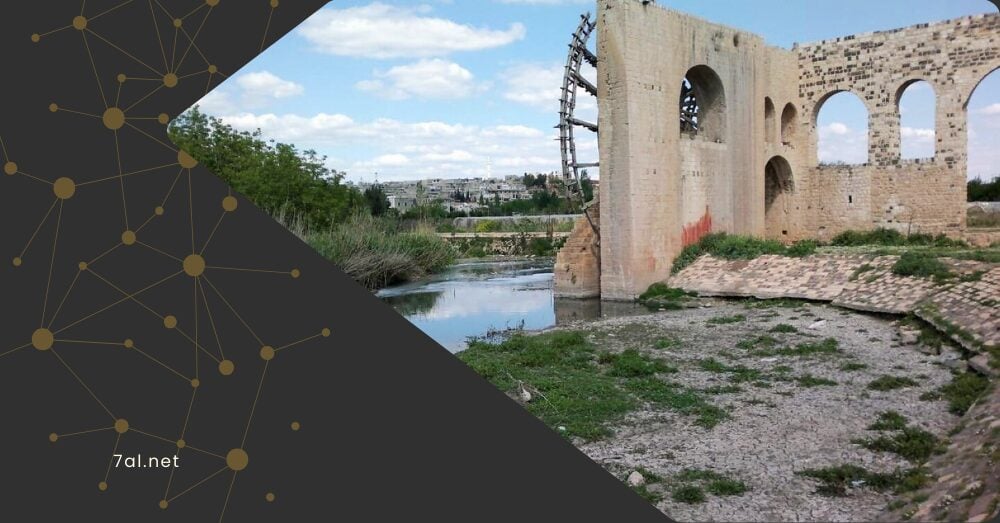
For the first time in recorded history, the Orontes River—Syria’s ancient artery of sustenance, known in Arabic as Nahr al-Asi—has shriveled into a parched scar across the western landscape. Its 571-kilometer course lies fractured into cracked earth and stagnant pools where once surged the waters of life. This unprecedented desiccation, unfolding amid the nation’s tentative post-war recovery, signals not only ecological collapse but a cascade of existential threats to food security and economic survival. The river that defies convention by flowing northward from Lebanon’s Bekaa Valley through Homs, Hama, and Idlib before reaching the Turkish Mediterranean has irrigated Syria’s agricultural heartlands for millennia. Its sudden betrayal reveals a deeper malaise: the convergence of climate upheaval, infrastructural decay, and geopolitical neglect that now threatens to unravel fragile threads of renewal.
The crisis erupted into stark visibility earlier this month, when viral videos swept social media showing the riverbed’s barren expanse near Jisr al-Shughur and Hama—scenes of exposed boulders, withered reeds, and livestock grazing aimlessly where fish once darted. Fishermen, whose livelihoods once pulsed with the river’s rhythm, now mourn what one villager called “the death of an entire way of life.” Production in the Ghab Plain has collapsed from 40 percent capacity to under 10. The immediate culprits are clear: rainfall in winter 2025, the lowest since 1956 at barely 30 percent of norms; depleted springs that once fed the river; and critically diminished reserves at the Rustan Dam, Syria’s linchpin for Orontes flow. This marks a grim escalation from the river’s last severe ebb 54 years ago, when flows dipped perilously but never vanished entirely.
At the epicenter lies agriculture, the Orontes’ most faithful ward. The river irrigates vast swaths of the central and western provinces—Hama’s orchards, Homs’ grain belts, Idlib’s vegetable fields—sustaining up to 70 percent of cultivation in some districts. Its abrupt halt has severed lifelines to irrigation canals, forcing farmers into desperate improvisation. In rural Hama, some now resort to sewage effluent for watering crops, a perilous gamble that risks contaminating produce with pathogens and heavy metals, imperiling public health and export viability. The toll is immediate and arithmetic: yields of wheat, barley, cotton, and summer vegetables have cratered by 50 to 70 percent in affected zones, according to farmer testimonies and early harvest data. With Syria’s arable land already halved by war and displacement, this drought deepens a pre-existing shortfall, pushing the nation toward 80 percent import reliance for grains by 2026.
The ripple effect on food security is seismic. Syria, where 12 million people—half the population—already grapple with acute malnutrition, now faces a harvest apocalypse that could drive staple prices up by 30 to 50 percent in the coming months. The Ghab Plain, once a breadbasket yielding one-fifth of national vegetables, now lies fallow, its 100,000 farmers confronting bankruptcy as groundwater pumps, strained by overuse, fail to bridge the void. Vulnerable cohorts bear the brunt: rural women, who comprise 60 percent of the agricultural workforce post-conflict, and displaced families in Idlib camps, already rationing meals, risk tipping into famine thresholds. A September report from the Middle East Institute underscored the peril, branding eastern Mediterranean droughts—fueled by a 1.2°C temperature surge—as “one-in-10-year” cataclysms, with Syria’s institutional frailties amplifying the human cost. Cholera outbreaks, simmering since 2022, loom larger as untreated wastewater pools in the riverbed, breeding vectors in a land where 40 percent lack clean water access.
Economically, the haemorrhage is no less acute. Agriculture, employing a quarter of Syria’s workforce and contributing one-fifth of GDP despite wartime erosion, now bleeds livelihoods. An estimated 200,000 jobs in the Orontes basin alone teeter on the brink, from farmhands to millers and transporters. Alternative irrigation through diesel pumps balloons costs by 300 percent, pricing out smallholders and consolidating land in fewer, wealthier hands—a recipe for rural unrest in a nation scarred by 14 years of upheaval. Broader knock-on effects compound the woe: fisheries, a $50 million subsector pre-war, have collapsed with mass fish die-offs; tourism in Hama’s iconic norias, those medieval waterwheels, has evaporated; downstream industries such as food processing grind to a halt, idling factories in Homs and inflating import bills by hundreds of millions amid sanctions’ thaw. The World Bank, in a preliminary 2025 assessment, projects a 2 to 3 percent GDP contraction from this drought alone, piling atop hyperinflation and unemployment rates hovering near 50 percent.
Yet amid the aridity, glimmers of resolve emerge. Basil Ghaffari, director of water resources in Damascus, has convened urgent talks with Lebanese counterparts to rehabilitate upstream canals ravaged by recent conflicts, invoking the dormant Syrian-Lebanese committee on shared basins. Turkey, as downstream steward, engages peripherally on the Orontes but pivots to Euphrates equity, where flows have dipped 60 percent below treaty norms. Domestically, Damascus touts strategic blueprints: reviving the Barada River, expanding treated wastewater for Ghouta irrigation, and piloting desalination projects inspired by Saudi models to offset 20 percent of deficits by 2027. Groundwater buffers averted total collapse this season, Ghaffari notes, but warns of unsustainability without $2 billion in infrastructure rehabilitation—dams, springs, and aqueducts pulverized since 2011.
This is no isolated tragedy but a harbinger of the Anthropocene’s wrath on a war-weary land. As PAX geospatial analysts map the Orontes basin’s “thirst for peace,” revealing conflict’s scars on 80 percent of water infrastructure, the imperative crystallizes: regional compacts for equitable flow, climate-adaptive farming with drip technology and drought-resistant seeds, and transitional justice to reclaim polluted aquifers. Without them, Syria’s pivot from Assad’s ashes risks foundering not on political fault lines but on the inexorable advance of a drying earth. The Orontes, once the “rebel river,” now whispers a stark ultimatum: adapt, or perish.
This article was translated and edited by The Syrian Observer. The Syrian Observer has not verified the content of this story. Responsibility for the information and views set out in this article lies entirely with the author.