
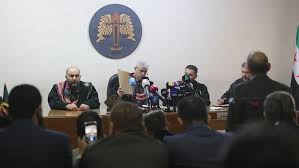
On 18 November 2025, the Palace of Justice in Aleppo witnessed a historic moment with the opening of proceedings against fourteen individuals implicated in the coastal massacres. This unprecedented trial marks a turning point in Syrian legal history—not merely because it is the first public, televised session in decades, but because it targets figures affiliated with the new ruling authority. For the first time, it signals an official acknowledgment that no one, including members of the current regime, is above the law and that violations committed by state actors will face judicial scrutiny.
The trial attracted considerable attention from local, regional, and international media, as well as human rights organisations. The authorities clearly intended to project an image of transparency and to bolster public confidence in the state’s ability to hold perpetrators accountable. Yet the media spectacle exposed a troubling dissonance between appearance and legal substance. Public proceedings alone cannot compensate for the absence of fundamental guarantees of a fair trial, nor for weak investigative oversight, nor for the structural flaws entrenched in Syria’s legal system.
This legal ambiguity became evident when the presiding judge declared that the court was a “national and independent tribunal,” applying the Military Penal Code, the General Penal Code, and the Code of Criminal Procedure. The military code permits only two stages—investigation and trial before a criminal court—with appeals allowed before the Court of Cassation. By contrast, the civilian Code of Criminal Procedure mandates a full sequence: investigative judge, referral judge, criminal court, and finally the Court of Cassation, thus ensuring procedural oversight. This raises a critical question: if the court is operating under military law, why cite Law No. 112 of 1950, a civilian criminal code? Such contradictions undermine the trial’s credibility and highlight deeper dysfunctions in Syria’s judicial framework.
Syrians have long awaited accountability for the grave crimes committed by the Assad regime since 2011—mass killings, systematic torture, and acts of genocide. Yet justice now begins with the coastal massacres alone. This prompts a fundamental question: can this trial truly be considered a step towards transitional justice, as claimed by the Ministry of Justice in a recent statement describing it as “part of the effort to achieve transitional justice and uphold the law, reinforcing principles of accountability and justice within the state”?
That characterisation is misleading. The trial is taking place before a regular military criminal court in Aleppo, based on military and general penal codes, with no legislative framework specific to transitional justice. As such, it is not equipped to address major international crimes such as war crimes, crimes against humanity, and genocide.
One might expect the trial to be welcomed, particularly by the families of victims. Instead, it has provoked frustration and discontent. Many questioned why the judiciary chose to begin with the coastal massacres rather than prosecuting those responsible for the regime’s most egregious crimes. This scepticism is understandable, given the scale and severity of atrocities committed under Assad.
The legal rationale is that crimes such as war crimes, crimes against humanity, and genocide are not codified in Syrian law and therefore cannot be prosecuted under the principle of legality: “no crime and no punishment without a legal provision.” These crimes fall outside the remit of Syria’s conventional criminal justice system.
Addressing them would require a legislative body capable of incorporating such crimes into domestic law, a judiciary trained to handle complex international cases, and specialised transitional justice courts able to adjudicate serious violations. It would also necessitate harmonising military and civilian legal frameworks to eliminate contradictions and ensure equal treatment before the law, criminalising hate speech and sectarian incitement to deter discrimination and abuse, and establishing an independent judicial environment that safeguards victims and witnesses while ensuring transparency and public access to proceedings.
These are not procedural formalities—they are essential preconditions for legitimising any judicial process and for ensuring that transitional justice becomes a reality rather than a rhetorical slogan. Without such reforms, any trial under Syria’s current legal system will remain partial and insufficient for holding perpetrators of serious crimes to account.
This trial carries both political and social weight. Politically, it sends a message—domestically and internationally—that even those aligned with the current regime are not beyond the reach of prosecution. Yet it also reminds society that beginnings do not guarantee outcomes, and that this step alone cannot establish genuine transitional justice.
Socially, the trial holds significance for victims and for Syrian society at large. It seeks to restore dignity to those who suffered, to recognise their pain, and to initiate a process of national reconciliation. But it also reveals a sobering truth: without comprehensive legislative and political reform, justice will remain incomplete—perhaps even merely performative.
In essence, this trial is a test of Syria’s national project. The country has a rare opportunity to write a new chapter in its history—one grounded in justice, dignity, and accountability rather than impunity. Success will require genuine political and judicial will to translate these principles into action and to ensure that transitional justice serves as a real instrument of reconciliation and redress, not just a televised gesture.
This article was translated and edited by The Syrian Observer. The Syrian Observer has not verified the content of this story. Responsibility for the information and views set out in this article lies entirely with the author.