
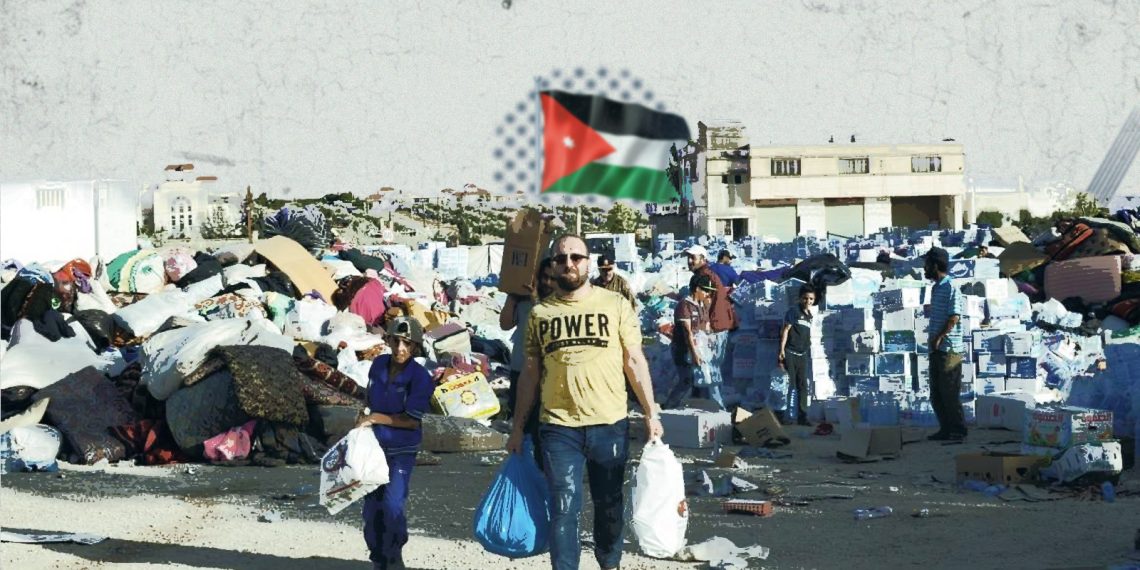
As 2026 approaches, hundreds of thousands of Syrian refugees in Jordan face the looming threat of hunger following the United Nations World Food Programme’s (WFP) announcement that it will halt food assistance—support many rely on to meet their basic needs. While the decision has been officially attributed to funding shortages, observers are questioning whether the suspension is purely financial, or part of a broader strategy to pressure refugees into returning to Syria, effectively closing the refugee file without offering safe or dignified solutions.
The Decision and Its Justifications
In a recent report, the WFP warned of the consequences of ending food aid for Syrian refugees in Jordan at the start of next year, citing a funding shortfall of $258 million and a reduced number of beneficiaries.
The report noted that more than 144,000 Syrian refugees had returned from Jordan to Syria between December 2024 and August 2025, contributing to the shrinking support lists. As of August, the number of beneficiaries had fallen to around 248,000, following the removal of approximately 62,000 individuals from aid rolls.
According to the report, current resources can only sustain monthly cash assistance until January 2026. A further $65 million is required to maintain food programmes through to the end of the year.
Youssef Taha, spokesperson for the UNHCR in Jordan, explained that the budget cuts are linked to the decline in registered refugee numbers. He stressed, however, that the needs remain high and that the agency’s strategy going forward will focus on voluntary return, while continuing to serve those who choose to remain in Jordan.
Taha stated that the 2025 budget stood at $372.8 million, yet by the end of August, only $115 million had been secured—just 31% of the total—leaving a shortfall of $257.8 million. As a result, the UNHCR has been forced to reprioritise its resources to ensure aid reaches the greatest number of refugees possible.
As of August 2025, the UNHCR had registered approximately 506,000 refugees in Jordan from various nationalities, including 462,000 Syrians—around 91% of the total. Of these, about 18% live in the Zaatari and Azraq camps, with the rest residing in urban and rural communities.
Humanitarian and Social Repercussions
Speaking to “963+,” Jordan-based human rights activist Dima al-Kharabsheh warned that halting food assistance would have severe consequences for many refugees, threatening their food security and stability, while exacerbating poverty and malnutrition.
“Children will be the most affected,” said Kharabsheh. “Many families rely heavily on this assistance. Socially, the decision could lead to increased school dropouts, child labour and early marriages—undermining the future of entire generations.”
She added that the repercussions would not be limited to refugees alone, but would also place additional economic and social pressure on Jordanian host communities, many of which are already under strain. “This crisis,” she said, “will have a double impact.”
Syrian journalist and political analyst Nabil Shoufan described the situation as catastrophic. “The funding shortfall could result in severe cuts, potentially ending both cash and food assistance for thousands,” he said. “Many families, who depend entirely on this aid, will face serious food insecurity.”
Shoufan told “963+” that families might be forced to reduce meals, sell belongings, or withdraw children from school to work. He also cited reports of cuts to non-cash assistance, including psychological, social and legal support, warning that this could dismantle essential protection mechanisms in camps and refugee communities.
He noted that both food and non-food assistance had served as a buffer against gender-based violence and exploitation. Its removal, he argued, would increase the risks of abuse—ranging from harassment and coercion to forced marriage and human trafficking. Previous investigative reports have documented such consequences following earlier aid reductions.
Shoufan also warned of the broader economic fallout: “Local markets and small businesses in Jordanian neighbourhoods will suffer as demand drops and shopkeepers lose key customers, potentially straining relations between host communities and refugees.”
Are Refugees Being Pressured into ‘Forced Return’?
This deepening humanitarian crisis raises a pressing question: are political motives driving a push for the forced return of refugees to Syria, despite ongoing insecurity and inadequate living conditions?
“This situation implants the notion of return in refugees’ minds—not as a voluntary decision, but as an inevitable one,” Shoufan said. “Most human rights organisations agree that return is not yet safe. Large parts of Syria remain unstable and lack basic services. Under such circumstances, return becomes a step driven by economic desperation rather than genuine choice.”
He added that many families may be consumed by anxiety, fear and depression as they consider leaving relatively safe environments for ones fraught with danger. “This will gradually erode the refugee community’s resilience,” he warned.
Shoufan observed that host governments, including Jordan, face mounting internal pressures that may incentivise them to reduce refugee populations in order to ease the burden on public services and budgets.
“But organisations like Human Rights Watch,” he said, “have warned against so-called ‘fake voluntary return’—a disguised form of forced repatriation. When the WFP talks about reprioritising aid in ways that make staying in a high-cost country like Jordan untenable, that’s a clear red flag.”
According to Shoufan, the UN appears caught between two conflicting imperatives: on one hand, its agencies warn of the dangers of mass, unsafe return; on the other, internal documents for 2026 indicate a budgetary shift towards supporting organised repatriation.
“This ambiguity,” he said, “raises questions over whether the UN is facing political and financial pressure from countries that now view other global crises as more urgent.”
Kharabsheh concurred, stating that separating humanitarian decisions from political motives is increasingly difficult. “Decisions like this, especially when made during critical periods, are often seen as indirect pressure on refugees,” she said, “and open the door to discussions of forced return—which is prohibited under international law.”
Bridging the Gap: What Are the Alternatives?
As warnings grow of an impending humanitarian disaster threatening the lives of hundreds of thousands of Syrian refugees in Jordan, attention is turning to possible alternatives that might help avert a deepening crisis.
“No single actor can fill the gap left by the World Food Programme,” said Kharabsheh. “The Jordanian government cannot shoulder this responsibility alone—it is already dealing with a budget deficit and significant economic challenges, which severely limit its ability to compensate for the loss of international assistance.”
She stressed that donor countries must revisit their funding priorities and renew their commitments to refugee support. International and regional organisations should scale up alternative mechanisms such as cash transfers and targeted assistance. Local communities and the private sector also have a role in bridging the shortfall.
Kharabsheh concluded: “The real alternative lies in effective international pressure to keep the Syrian refugee issue at the forefront—and to prevent it from becoming a bargaining chip in geopolitical negotiations.”