
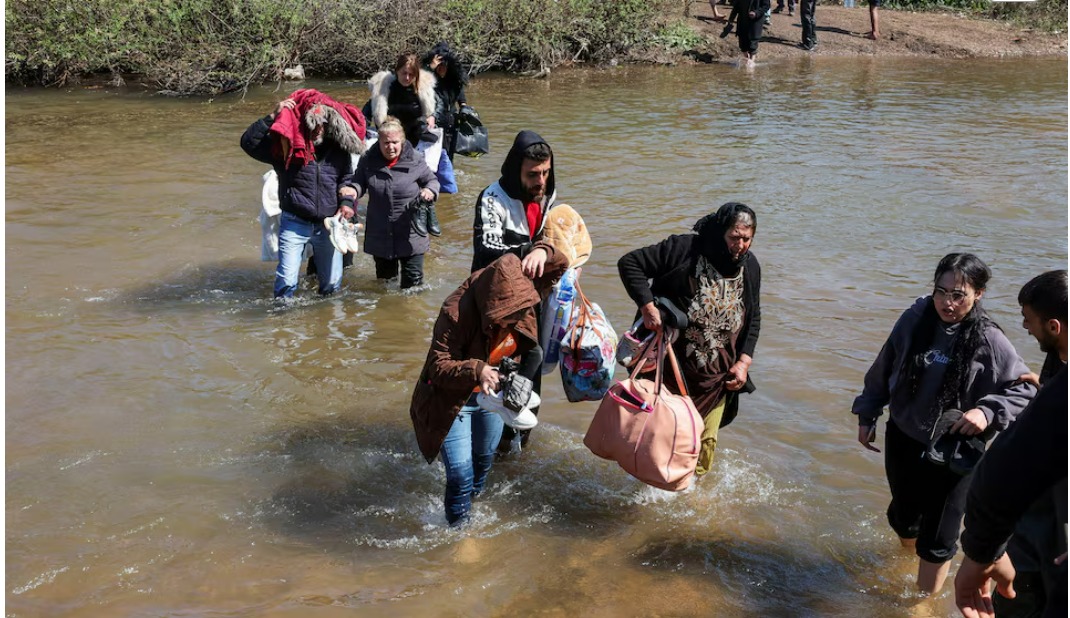
Amid the rise of the European right, growing global tensions, and mounting wars across the Global South, the EU’s new Pact on Migration and Asylum arrives with markedly tougher policies under the banner of reforming the Common European Asylum System.
Amnesty International described 10 February, the day the European Parliament approved a list of “safe countries”, as a “black day for human rights in the European Union”. The move formed part of new legislation allowing migrants to be transferred to designated “safe” third countries outside the EU. It falls within the broader migration pact proposed by the European Commission in September 2020 and due to enter into force in June 2026.
The pact is presented as a comprehensive reform of asylum and border management after the failure of the Dublin III system, especially since the 2015 refugee influx, when more than half a million Syrians reached Europe.
Europe’s gates
For fourteen years, Syrians have been among those travelling one of the world’s most dangerous asylum routes: the Eastern Mediterranean corridor through Turkey to Greece. Geography has made Greece, Italy, and Spain Europe’s principal entry points, while the Mediterranean crossing remains a deadly gamble.
Since 2014, the International Organization for Migration’s Missing Migrants Project has recorded 81,540 deaths during migration, with the remains of 33,174 people still unrecovered. By early 2026, 6,361 people had already reached the EU by sea, making the opening weeks of the year among the deadliest on record in the Mediterranean.
At the same time, asylum applications in the EU fell in late 2025, due in part to the fact that Syrians were no longer the largest nationality among applicants after the fall of the Assad regime in late 2024. Yet the political pressure around asylum has grown, fuelled by the rise of the far right in countries such as Italy and Greece and by fears of new refugee waves tied to ongoing wars.
The contrast with Europe’s response to Ukrainian refugees remains striking. More than four million Ukrainians were received under temporary protection, suggesting that the so-called crisis of 2015 reflected a crisis of political will more than one of actual capacity.
Reform or fortification?
The new pact rests on four pillars: securing external borders, speeding procedures, embedding migration in international partnerships, and introducing a system of solidarity among member states.
Its first step is “screening”, under which irregular arrivals undergo identity, security, health, and vulnerability checks within seven days, usually in border centres. Their biometric data, including fingerprints and facial images from the age of six, are stored in the revised Eurodac database.
Following screening, some asylum seekers may be channelled into accelerated border procedures, particularly if they come from countries with low recognition rates or are deemed security risks. Others go through regular or fast-tracked asylum procedures. Rejected applicants can then be placed in border return procedures designed to expedite removal.
Alongside this, the new system is meant to replace Dublin III with a supposedly fairer mechanism for sharing responsibility. In practice, however, the dominant logic appears less concerned with solidarity than with deterrence and externalisation.
Is Syria ‘safe’?
This becomes clearest in the expanded use of the concepts of the “safe third country” and the “safe country of origin”. The first allows EU states to reject an asylum claim as inadmissible if the applicant could have sought protection in another country outside the Union. The second assumes that nationals of certain countries generally do not require international protection unless they can prove otherwise individually.
For Syrians, the question is immediate: is Syria now considered safe? For the Syrian transitional authorities, the question is slightly different: is it politically advantageous for Syria to be treated as safe?
So far, Syria has not been added to the EU list of safe countries, even though more than 1.3 million Syrian refugees and displaced persons have returned and several EU states have frozen Syrian asylum applications since the fall of the regime. The European Parliament expanded the safe-country list to include states such as Egypt, Morocco, Tunisia, India, and Colombia, but not Syria.
That omission carries a double meaning. Politically, it undermines efforts by the transitional government, backed by some European capitals, to present Syria as stable. Administratively, however, it spares Damascus the burden of large-scale returns at a time when the country remains unprepared to absorb them because of devastated infrastructure and limited reconstruction capacity.
The EU Agency for Asylum’s December 2025 update on Syria confirmed that several groups remain at risk and may still qualify for refugee protection, including LGBTQ persons, those linked to the former government, religious and ethnic minorities such as Alawites, Christians, Kurds, and Druze, as well as women, children, and media workers.
Return hubs and a harder Europe
Even if Syria is not officially deemed safe, that does not mean Syrians will retain meaningful access to asylum in Europe. Several European states are advancing agreements with “safe third countries” to host asylum seekers or deportees. Italy has moved in this direction with Albania, while other states have explored similar arrangements with African countries through so-called return hubs.
This approach exposes asylum seekers, Syrians among them, to forced transfer to third countries such as Turkey or Egypt. Proposed revisions to EU return rules would further entrench this trend by broadening the use of safe third countries, allowing longer detention, and facilitating re-entry bans for those who do not comply with return decisions.
At the same time, the EU is reinforcing its border regime. Frontex is expected by 2027 to command a standing corps of 10,000 officers, including 3,000 armed personnel. Human rights advocates warn that accelerated border procedures, closed screening centres, and the legal fiction of “non-entry” risk turning border management into a system of de facto detention and curtailed legal access.
Taken together, these measures suggest that the new pact is less a technical reform than a political reordering of priorities. Its central concern is border control, while refugee protection is increasingly pushed into the background. In the Syrian case, this leaves a troubling reality: the country is still unsafe for many, yet Europe is steadily building a system designed to keep even vulnerable asylum seekers as far from its territory as possible.
This article was translated and edited by The Syrian Observer. The Syrian Observer has not verified the content of this story. Responsibility for the information and views set out in this article lies entirely with the author.