
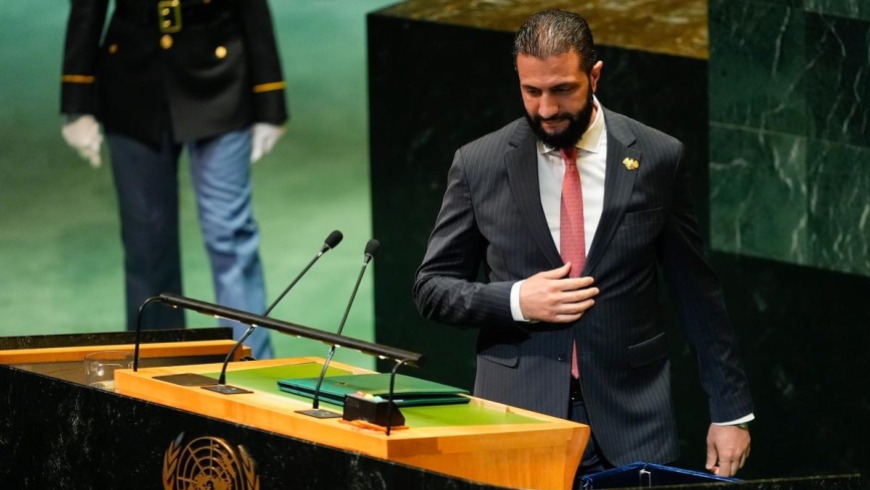
The UN Security Council on Thursday evening adopted a resolution — drafted by the United States — removing the names of Syrian President Ahmad al-Sharaa and Interior Minister Anas Khattab from the United Nations sanctions lists.
The resolution was approved by 14 out of the Council’s 15 members, with China abstaining from the vote and not using its veto power.
The text of the resolution, adopted under Chapter VII of the UN Charter, reaffirms the Council’s strong commitment to respecting Syria’s sovereignty, independence, territorial integrity, and national unity, as well as its continued support for the Syrian people. It also expresses the Council’s determination to promote reconstruction, stability, and long-term economic development in Syria.
The resolution welcomes the Syrian government’s commitments to facilitate humanitarian access and combat terrorism, while noting that Damascus must take “firm measures” to confront foreign fighters, protect human rights, combat narcotics, advance transitional justice, eliminate any remnants of chemical weapons, and pursue a comprehensive, Syrian-led and Syrian-owned political process.
Washington: “Syria has entered a new era”
The United States submitted the draft resolution just days before President Sharaa’s upcoming visit to the White House to meet with U.S. President Donald Trump, marking the first visit by a Syrian president to the White House in more than eight decades.
For months, Washington has pushed for easing sanctions on Syria and its leadership, viewing this step as “a prelude to broader political and humanitarian cooperation with the new government.”
Speaking before the Security Council after the vote, U.S. Ambassador to the United Nations Mike Waltz said that adopting this resolution “sends a strong political signal that Syria has entered a new era since the fall of Assad and his associates in December 2024.”
He added that the new Syrian government, led by Sharaa, “is working diligently to fulfill its commitments to counter terrorism and narcotics, eliminate any remaining chemical weapons, and strengthen regional security.”
Waltz noted that “removing the names of Sharaa and his interior minister gives the Syrian people a genuine opportunity for renewal.”
Damascus welcomes the decision: “A legal and political confirmation”
Syria’s Permanent Representative to the UN, Ibrahim Olabi, welcomed the Security Council’s decision, describing it as “evidence of growing confidence in the new Syria.”
In his address to the Council, Olabi stated that “the new Syria seeks to be a state of peace and partnership, not a battleground for conflicts and score-settling.” He added: “We aspire to be a platform for development and prosperity, extending a hand to all countries in search of partnerships and shared success.”
The Syrian Foreign Ministry also issued a statement welcoming the resolution, calling it “the first unanimous decision since the fall of the deposed regime,” and saying that it reflects “the international community’s unified stance in support of Syria’s stability, territorial integrity, and sovereignty.”
The statement added that the resolution “represents a victory for Syrian diplomacy and reflects growing confidence in President Sharaa’s leadership.” It reaffirmed Syria’s commitment to working jointly with the international community to fulfill the Syrian people’s aspirations for peace, development, reconstruction, and the building of a new Syria.”
The ministry further emphasized that lifting the sanctions listing constitutes “a legal and political confirmation of the Syrian state’s steadfast approach to safeguarding the rights of Syrians, maintaining civil peace, promoting international peace and security, and combating drug trafficking and terrorism.”
China: “The resolution did not properly address our concerns”
By contrast, China abstained from voting on the draft resolution, though it did not use its veto, arguing that the measure “does not meet the principles Beijing considers essential for achieving stability in Syria and combating terrorism.”
China’s Permanent Representative to the UN, Fu Cong, said that “China’s position on sanctions has been clear from the start: any modification must take into account the security situation, counterterrorism efforts, and the potential complex consequences of such changes.”
The Chinese diplomat added that the draft resolution “did not reflect these principles, despite our active participation in consultations and our constructive proposals.” He expressed regret that the resolution’s sponsor, the United States, “pushed for a vote despite significant disagreements among members.”
This article was translated and edited by The Syrian Observer. The Syrian Observer has not verified the content of this story. Responsibility for the information and views set out in this article lies entirely with the author.