
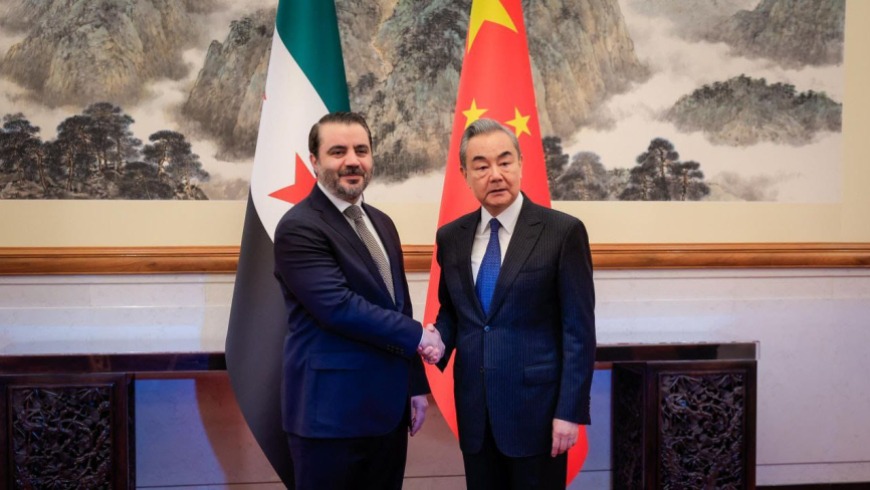
On Monday, within the grand ceremonial halls of Beijing, Syria’s Minister of Foreign Affairs and Expatriates, Asaad al-Shibani, held his first official meeting with his Chinese counterpart, Wang Yi. The encounter marked the culmination of a carefully cultivated and long-anticipated diplomatic rapprochement between two nations bound by history.
The Syrian Foreign Ministry, in its typically restrained statement, reported only that the two ministers had reviewed bilateral relations and explored means to enhance them, offering no additional detail.
China’s statement, by contrast, was rich in historical allusion and forward-looking optimism. Minister Wang Yi spoke of the enduring friendship between China and Syria, “deep-rooted in history,” recalling how the ancient Silk Road had linked their peoples for centuries. He noted that Syria was among the first Arab nations to establish diplomatic relations with the People’s Republic of China.
He emphasised the strong convergence of interests between the two states, reaffirmed China’s unwavering commitment to the equality of nations “great and small alike,” and reiterated Beijing’s solidarity with the developing world. China, he stressed, respects the sovereignty of the Syrian people in all their diversity, supports their independent choices, and calls for mutual respect of core interests and non-interference in internal affairs. It was time, he declared, for the bilateral relationship to be restored to its natural path.
Sovereignty and the Fight Against Terrorism
Wang Yi praised Syria’s consistent commitment to the One-China principle and expressed hope that Damascus would continue to oppose “Taiwan independence” while supporting China’s mission of national reunification.
With solemn emphasis, he reminded his counterpart that the East Turkestan Islamic Movement remains listed by the United Nations Security Council as an international terrorist organisation. He commended Syria’s pledge never to permit its territory to be used in any manner detrimental to Chinese interests and expressed Beijing’s hope that Damascus would implement concrete measures to remove remaining security challenges that could hinder future cooperation.
As the two nations approach the seventieth anniversary of their diplomatic ties next year, Wang Yi called for the swift resumption of exchanges at all levels. He also extended an open invitation for Syria to deepen its participation in the Belt and Road Initiative. China, he affirmed, is ready to contribute to Syria’s reconstruction, support its economic development, and assist in improving the daily lives of its people.
Wang reiterated China’s unwavering support for a Syrian-led and Syrian-owned peace process rooted in inclusive dialogue, a balanced focus on security and development, and gradual reintegration into the international community in a way that truly reflects the will of the Syrian people.
This visit is part of a sustained process of rapprochement. In June, Minister Shibani met the Chinese ambassador in Damascus. A month earlier, President Ahmad al-Sharaa welcomed a senior delegation led by Chen Weiqing, Director-General for West Asia and North Africa at the Chinese Foreign Ministry.
Only weeks ago, Shibani remarked that relations with Beijing—once aligned firmly with the former regime and frequently exercised through repeated UN vetoes—had now been “set aright.” He stated that the current visit to Beijing would be the first of many, adding with quiet assurance: “All our diplomatic movements are calm, deliberate, and meticulously planned. There is no compromise whatsoever on the rights of the Syrian people… Whether with Russia, China, or Europe, we cultivate these relationships from a position of strength that belongs to Syria and harness them solely for the benefit of its people.”
Thus, behind the composed language of diplomacy, a new chapter begins—one in which the heirs of the Silk Road seek once more to weave threads of commerce, security, and mutual respect, in pursuit of a reborn Syria.
Editor’s Note
A report by Agence France-Presse, citing two Syrian diplomatic sources, has sparked controversy by claiming that Damascus is preparing to extradite around 400 Uyghur fighters currently residing in Syria to China. The alleged handover, said to be requested by Chinese authorities, would reportedly be carried out in phases.
However, shortly after the report began circulating, the official Syrian Arab News Agency (SANA) published a statement from a senior source at the Ministry of Foreign Affairs and Expatriates, firmly and categorically denying that the Syrian government had any intention to extradite the fighters.
This article was translated and edited by The Syrian Observer. The Syrian Observer has not verified the content of this story. Responsibility for the information and views set out in this article lies entirely with the author.