
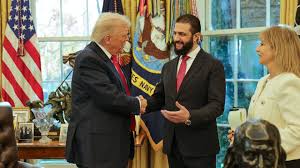
Let us first agree that President Ahmed al-Sharaa’s visit to Washington is, in every sense, a historic event. He is the first Syrian leader since the republic’s founding in 1946 to set foot in the American capital and to meet its president beneath the chandeliers of the White House. In that single gesture lies the seed of a potential reordering of the regional landscape—a profound strategic shift in the Middle East. It carries the prospect that Syria, long a steadfast ally of the Eastern bloc under Soviet and later Russian patronage, a cornerstone of the so-called Axis of Resistance and a strategic partner to Iran, might now pivot towards the West. The country may even join the Abraham Accords in deference to the Trump administration’s vision, standing aligned with the United States in a manner unthinkable during the long years of the Asad era.
The symbolic weight of this moment remains undiminished, regardless of whether President Sharaa entered the White House through its grand front entrance or a discreet side door. The very occurrence of the visit, and the meeting with President Donald Trump, grants Sharaa a renewed mantle of legitimacy as the leader of post-Asad Syria, arming him with fresh political capital in the face of domestic rivals. He had already received an initial American endorsement with a public handshake in Riyadh last May. The White House meeting—reportedly arranged through a joint Gulf-Turkish initiative—crowned that process with a reception of notable warmth, notwithstanding Trump’s reference to his guest’s “difficult past.” Less than a year ago, Sharaa led a jihadi faction that splintered from the group responsible for the 9/11 attacks. Before that, he fought American forces in Iraq and was imprisoned as a member of the Islamic State. Only days before the visit, the UN Security Council lifted sanctions imposed on him and his interior minister for their former ties to al-Qaeda. And now, he arrives in Washington to declare Syria’s readiness to formally join the Global Coalition against Daesh, formed by the United States in 2014, and, according to Reuters and multiple diplomatic sources, potentially to permit the establishment of an American military base near Damascus.
A singular milestone, indeed—yet.
This unprecedented journey marks a qualitative turning point in the evolution of the new Syria and its emerging role in the region, following the nurturing support extended by the Arab Gulf states—chiefly Saudi Arabia, Qatar, and the United Arab Emirates—alongside Turkey. Together, they have served as the political, economic, and security incubator for the fledgling government in Damascus.
Nevertheless, it would be a grave error to assume that this visit will yield its choicest fruits or benefit Syria and its people in full. The implications extend beyond the event itself, shaped as they are by the nature of the actors involved and the intricate network of interactions that may now be triggered across local, regional, and international spheres.
For example, the side meetings during the visit—against a backdrop of President Trump’s clear willingness to delegate much of the Syrian dossier to Ankara—revealed that Turkey has been invited to act as guarantor of the accords reached between Presidents Trump and Sharaa. This was underscored by a joint session at the White House involving the Syrian, Turkish, and American foreign ministers to monitor implementation of these agreements, including the 10 March accord on integrating Kurdish forces into the new Syrian army and state apparatus.
President Sharaa undoubtedly hopes the visit will pave the way for the lifting of American sanctions and Syria’s readmission to the SWIFT banking system, thereby unlocking much-needed aid, investment, and external financing for reconstruction—an endeavour conservatively estimated to cost at least $215 billion. The very mention of Syrian reconstruction appeals to the Trump family, long enamoured with large-scale tourism and real estate ventures. Certain circles in Damascus, sensing opportunity, floated the idea of a “Trump Tower Damascus” as part of the outreach that led to the first Trump–Sharaa meeting during the President’s earlier visit to the Gulf. Yet American legislators remain sceptical, tying any relief to guarantees on minority rights, religious pluralism, and improved relations with Israel. These political hurdles are likely to delay the process, prolong sanctions, and hamper Syria’s economic recovery.
Even the full removal of sanctions, while essential, would be insufficient. True reconstruction requires a stable and secure domestic environment, a legislative framework attractive to foreign investors, modern banking regulations, robust anti-corruption measures, and equitable implementation of national projects.
President Trump has extended the suspension of certain sanctions for another six months—excluding transactions involving Iran or Russia—and has pledged to lobby congressional allies for broader exemptions under the Caesar Act. However, Senate approval remains contingent on the House of Representatives. Notably, Sharaa held a closed-door meeting with Representative Brian Mast, the Republican chairman of the House Foreign Affairs Committee and, alongside Senator Lindsey Graham, one of the most vocal opponents of lifting sanctions on Syria permanently.
Between Ambition and Harsh Reality
Sharaa also seeks American political protection that might shield Syria from ongoing Israeli aggression following the fall of the Asad regime—perhaps through a new security arrangement modelled on the 1974 Disengagement Agreement, compelling Israel to withdraw to pre-8 December 2024 lines. Washington, however, is transparent in its desire to steer any Damascus–Tel Aviv dialogue toward full normalisation under the Abraham Accords. Meanwhile, Israel continues its incursions into Syrian territory, expands its occupations, demands international recognition of its recent seizure of Mount Hermon, insists on a broad demilitarised buffer zone encompassing much of Quneitra, Daraa, and Suwayda provinces, and pressures Damascus to permanently relinquish its claim to the Golan Heights—occupied in 1967, annexed in 1981, and recognised only by Donald Trump during his first presidency. Reports also suggest American efforts to foster an Israeli–Turkish agreement to jointly manage influence over Syrian territory.
Syria’s formal accession to the anti-Daesh coalition and the broader counterterrorism framework obliges the new authorities to sever all remaining ties to their jihadi past—not merely through the necessary, though currently impractical, ideological battle, but by dismantling factions still labelled as terrorist. This task carries the risk of confrontation with groups that believe they played a decisive role in bringing Sharaa and his circle to power. It also requires preventing extremist infiltration into the nascent Syrian army, and reaching a workable arrangement with Kurdish forces concerned that the transfer of anti-Daesh responsibilities to Damascus might render them redundant and expose them to abandonment by their American allies.
All of this unfolds while the new Syrian leadership remains fragile and lacks broad-based acceptance within large segments of Syrian society—particularly in the wake of sectarian massacres on the coast and in Suwayda, which have intensified minority fears. To many, the new regime has yet to offer convincing signs that it is genuinely committed to building a modern national state grounded in equal citizenship, the rule of law, and impartial institutions that serve all Syrians, regardless of community or confession.
This article was translated and edited by The Syrian Observer. The Syrian Observer has not verified the content of this story. Responsibility for the information and views set out in this article lies entirely with the author.