
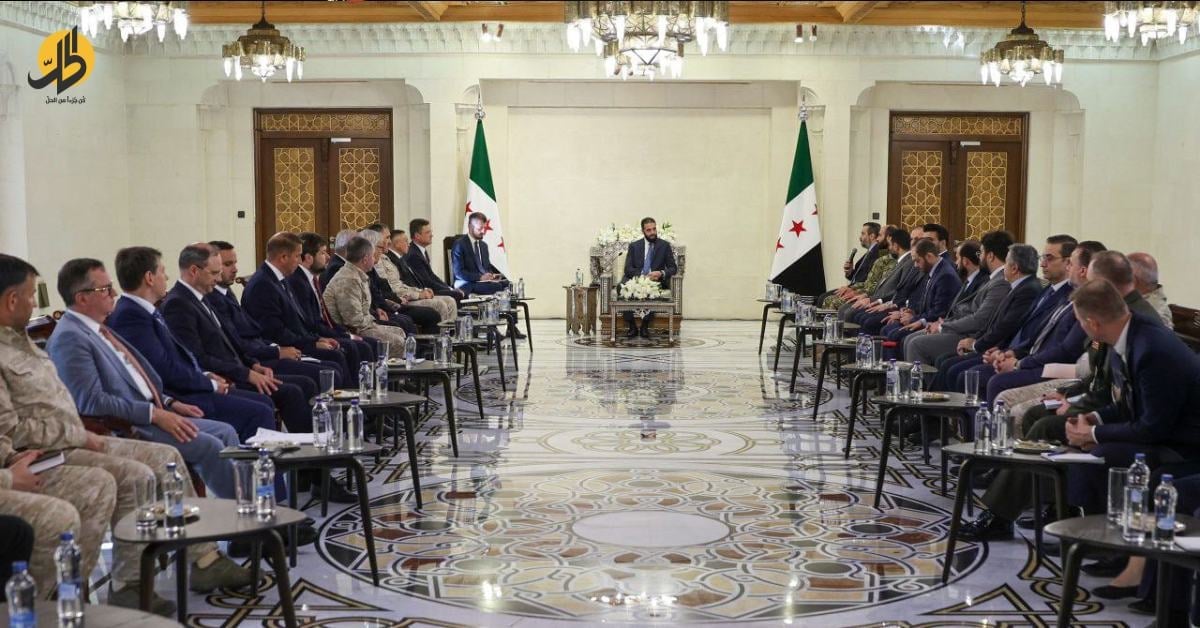
A growing number of signs point to Russia’s eagerness to reassert its influence in Syria—or more precisely, to safeguard its entrenched privileges—particularly in the aftermath of the fall of its ally, Bashar al-Assad. What stands out is the approach of the transitional authority, led by Ahmad Sharaa, which appears open to this interest, albeit cautiously. Unlike the Assad regime, this stance does not seem to be part of a strategy aimed at countering the West or the United States. Instead, it signals the potential for divergent political trajectories.
On one hand, the transitional authority may be seeking space for manoeuvre amid regional and international rivalries, leveraging their contradictions to its benefit—a tactic that could yield substantial political returns. On the other, such positioning cannot be separated from the pressures imposed by the international community and the United States, whose restrictions on engagement with Sharaa have compounded his challenges: the lack of UN recognition, economic fragility, frozen assets, and the ongoing sanctions regime.
Sharaa is not ideologically tied to any global power. His alliances appear to be driven by pragmatic considerations—sources of strength that reinforce his authority and prolong his tenure. As such, it is unlikely he would lean too far toward Moscow at the expense of the West, even if his diplomatic posture remains outwardly flexible and non-threatening to their interests.
UN Resolution 2254: Reference Point or Trial by Fire?
This political pragmatism, however, brings with it serious responsibilities. If the transitional authority cannot decisively dismantle the Russian legacy—particularly its militarisation of the Eastern Mediterranean, its economic entrenchment, and the leasing of strategic assets such as Tartus port—then its negotiating leverage with Western powers may quickly erode.
The Burden of History
Historically, Russia has viewed Syrian rulers not as partners but as instruments for advancing its own interests. This was evident throughout the Assad years, particularly following Moscow’s direct military intervention in 2015.
Russia’s objectives in Syria and the Eastern Mediterranean are not confined to military outposts like Tartus and Hmeimim. They form part of a wider strategy to establish economic and military dominance over regional energy corridors and maritime trade routes, directly challenging Western interests. Any renewed rapprochement between Damascus and Moscow—even framed as political pragmatism—risks reverting to patterns of dependency, with Moscow inevitably pressing for security guarantees and permanent influence.
For Washington and its allies, such a shift will raise concerns. Russia rarely operates through balanced partnerships; rather, it leverages alliances for influence and control. This is particularly true in Syria, where over the past decade, Moscow has embedded itself across military and economic sectors.
Sharaa now finds himself caught between two stark choices: yielding to Moscow’s grip, or addressing domestic and international expectations for reform. These include resolving the internal political deadlock, shifting from centralised rule to inclusive governance, building consensus-based institutions, and drafting a constitution that enables peaceful political transition. Without this foundation, attempts to balance competing powers may strip him of agency—reducing his role to that of a functionary rather than a sovereign leader.
Syria urgently needs international reintegration, economic recovery, and sustainable development. But this cannot be achieved through one-sided alliances or transactional ties that echo the past.
The Eastern Mediterranean: Geopolitics in Motion
The Eastern Mediterranean is no longer a mere geographical zone—it is a contested space that is redefining alliances and shaping regional futures. The visit of Russian Deputy Prime Minister Alexander Novak to Damascus last week underlined Moscow’s intent to reinvigorate its role in Syria through discussions on energy, reconstruction, and security.
Simultaneously, Sharaa revealed that negotiations with Russia took place during the advance of opposition forces in the “Deterrence of Aggression” operation, which culminated in Moscow’s military withdrawal from Homs—under mutual understandings that both sides reportedly honoured. These disclosures recast the potential Moscow-Damascus rapprochement not as a return to subservience, but as a tactical engagement with far-reaching implications.
Sharaa is also preparing to represent Syria at the forthcoming Russian-Arab summit, scheduled for 15 October. This raises difficult questions: Why is the transitional authority aligning itself with Moscow, despite its violent legacy in Syria? And can such an alliance deliver tangible benefits to Syrians, given reports of Russia’s far-reaching influence in cultural, educational, and social spheres?
Legal Vacuums and the Cost of Isolation
Syria’s recovery requires extensive resources to rebuild critical infrastructure—power stations, water systems, and public services—all devastated by years of war. Yet Western and regional partners are hesitant to provide aid absent clear commitments to political reform, foremost among them inclusive governance. In this context, Novak’s visit may be seen as a channel for discussing immediate humanitarian and energy needs—priorities which Sharaa views as non-negotiable.
Moreover, Damascus sees Moscow as a potential counterweight to recurrent Israeli strikes, whether through local agreements or phased de-escalation. Sharaa referred to previous Russian military disengagements—like in Homs—as models for how Moscow could play a stabilising role under the right conditions.
For its part, Russia continues to view Syria as a linchpin of its regional strategy. By maintaining official ties with the transitional government, Moscow preserves its bases, assets, and diplomatic clout.
Damascus, meanwhile, may see this relationship—and Moscow’s mediation—as a means to expand its reach to reluctant regional actors, such as Egypt. Yet even if such ties bring short-term legitimacy, they may also deepen long-term dependencies.
Echoes of the Past: The Cost of Rapprochement
Despite the practical considerations, efforts to restore ties with Moscow will inevitably clash with Syrian public memory. Russian airstrikes, especially in civilian areas, resulted in tens of thousands of deaths and millions displaced. Strategic partnerships with Moscow risk replicating the Assad-era pattern of dependence, exemplified by the 49-year lease of Tartus port and control over Syria’s energy assets.
Novak’s visit and Sharaa’s remarks place Syria at a critical juncture. Renewing ties with Russia may seem pragmatic—necessary for reconstruction and service provision—but it carries significant political risks. The move could undermine the transitional government’s credibility at home and erode the cautious trust it has built with Western partners.
Put simply, Moscow is not a neutral economic partner offering support on fair terms. As Syrian Foreign Minister Asaad al-Shibani himself acknowledged, Russia is a militarised power, whose presence in Syria is stained with bloodshed. The challenge for Sharaa is to walk a fine line: to cooperate without capitulating, to build legitimacy without fostering dependency.
Ultimately, external alliances must serve a vision for Syria free from violence, coercion, and the legacy of foreign tutelage. Only then can the transitional authority claim to be charting a new path—not just restoring old ties.
This article was translated and edited by The Syrian Observer. The Syrian Observer has not verified the content of this story. Responsibility for the information and views set out in this article lies entirely with the author.