
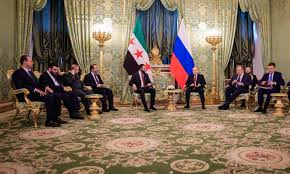
In recent weeks, Damascus has adopted an approach that places its relations with both Moscow and Washington under close scrutiny, following a sequence of high-level engagements that began with talks with Russian President Vladimir Putin and were followed by advanced discussions with U.S. President Donald Trump in Washington, D.C.
This diplomatic sequence suggests a deliberate effort to recalibrate Syria’s emerging position within the network of international relationships shaping the Syrian file. It reflects a more attentive reading of evolving realities inside the country and of what may be constructed in the next phase. It is therefore unsurprising that Damascus treats the Russian and American tracks as simultaneously distinct and interconnected, as each entails different expectations, instruments of leverage, and political costs.
Through this cautious balancing act, Damascus appears to be seeking a margin that allows it to reorganise its foreign policy without resorting to stark choices or full alignment with either camp. The approach points to an experimental model aimed at maximising flexibility, while retaining the capacity to respond to the rapid transformations Syria has witnessed in recent months.
Structuring Damascus’s Relationship with Moscow
The meeting between Syrian President Ahmad al-Sharaa and Vladimir Putin appears to have offered both sides an opportunity to reassess the foundations of their political communication in the previous phase and to open discussions about Syria’s next stage. At the same time, Moscow has likely viewed with concern developments indicating the entry of other international and regional actors into arenas it had previously managed almost exclusively.
Against this backdrop, the measured messages conveyed by Damascus in Moscow reaffirmed the importance of Russia’s role, while advancing a broader vision for managing Syria’s external relations. This posture reflects a desire to absorb shifting international dynamics without provoking confrontation or rupture. It also lays the groundwork for a level of mutual understanding that can be further developed, granting Damascus space to reconsider the scope and limits of Russian influence on the ground.
Here, the concept of “restricted autonomy” becomes useful in interpreting how states operate within spheres of influence that impose varying constraints on national decision-making. Under this framework, a state neither exercises full independence nor submits to total subordination, but instead navigates an intermediate space that combines initiative with imposed calculations.
In Syria’s case, the contours of this model are visible in the margins of manoeuvre embedded in its relations with both Moscow and Washington. Foreign policy choices are managed through a careful assessment of what is feasible, while preserving a degree of political latitude that enables tactical movement. This framework illustrates how Damascus structures its external options within the limits set by international conditions—engaging with constraints without being immobilised by them, and with opportunities without converting them into binding commitments that may later prove difficult to revise.
Engagement with Washington
On the other side of the equation, meetings held in Washington introduce a different dynamic, taking place at a moment when U.S. perceptions of its role in the Middle East are undergoing adjustment. Available indications suggest that Washington is not pursuing a comprehensive agreement, but rather limited forms of diplomatic engagement aimed at partial understandings on issues such as regional security, military presence, and border management.
Damascus may view this channel as a necessary avenue for reassessing its position within the international landscape, offering insight into the parameters of the current political moment—without crossing thresholds that could strain its relationship with Russia. This requires calibrated caution, as any unstructured engagement risks being read in Moscow as a strategic pivot, while Washington itself offers no clear signals regarding the depth or durability of potential involvement.
The literature on small and medium-sized states introduces the concept of “smart positioning” to explain how such actors can amplify their influence despite constrained resources. This approach relies on a nuanced understanding of international contradictions to generate multiple pathways that enhance negotiating leverage. Its relevance is evident in Damascus’s movement between Moscow and Washington, as it constructs parallel channels that diffuse pressure and widen its range of options, without anchoring itself to a single centre of gravity.
Through this positioning, Syria can accumulate a degree of relative influence that exceeds its immediate capacities, as multiple lines of engagement provide additional tools for balancing major powers within a complex web of interests. Foreign policy thus moves beyond traditional axis-based narratives, evolving into a flexible model that diversifies points of contact in line with shifting international contexts.
Syria and Managing Balance Through Parallel Tracks
It is therefore logical for Damascus to seek a space of action grounded in a careful reading of overlapping Russian and American interests. The objective is not to establish a single locus of foreign decision-making, but to maintain parallel tracks that signal continuity to each side, while preserving room for recalibration at successive junctures. This approach enhances Syria’s ability to navigate the international environment, as divergences between Moscow and Washington create manoeuvring opportunities that would not exist under a singular alignment.
That said, such a model demands robust institutional capacity to analyse global political trends, interpret signals from both capitals, and maintain clear communication channels to minimise ambiguity and prevent counterpressures. Its development is necessarily gradual, reflected in the sequencing of meetings, the hierarchy of discourse priorities, and the calibrated limits of responsiveness to external demands.
In this context, the notion of “variable sovereignty” provides an additional lens through which to understand decision-making in states emerging from prolonged conflict or deep structural disruption. Sovereignty, under this view, is not a fixed or absolute condition, but a capacity that fluctuates according to internal cohesion, external influence, and the state’s ability to progressively restore its functions through interim arrangements.
This perspective sheds further light on Damascus’s current trajectory: managing the presence of international actors while attempting to consolidate core state functions. Sovereignty is approached not as a rigid boundary, but as a process shaped through cumulative steps in security, border control, and foreign policy. Such a framework allows for a more realistic assessment of Syria’s room for manoeuvre, linking what the state can assert to what prevailing circumstances allow it to sustain.
Conclusion
The literature on transitional political systems highlights how foreign policy is often shaped during periods when states are rebuilding legitimacy and redistributing power among institutions. In such phases, foreign policy becomes an extension of internal stabilisation, serving to regulate engagement with external actors and define levels of involvement that domestic institutions can absorb. From this perspective, Damascus’s cautious balancing between Moscow and Washington reflects not indecision, but an attempt to align external relations with the slow and uneven process of internal reconstruction.
This article was translated and edited by The Syrian Observer. The Syrian Observer has not verified the content of this story. Responsibility for the information and views set out in this article lies entirely with the author.