
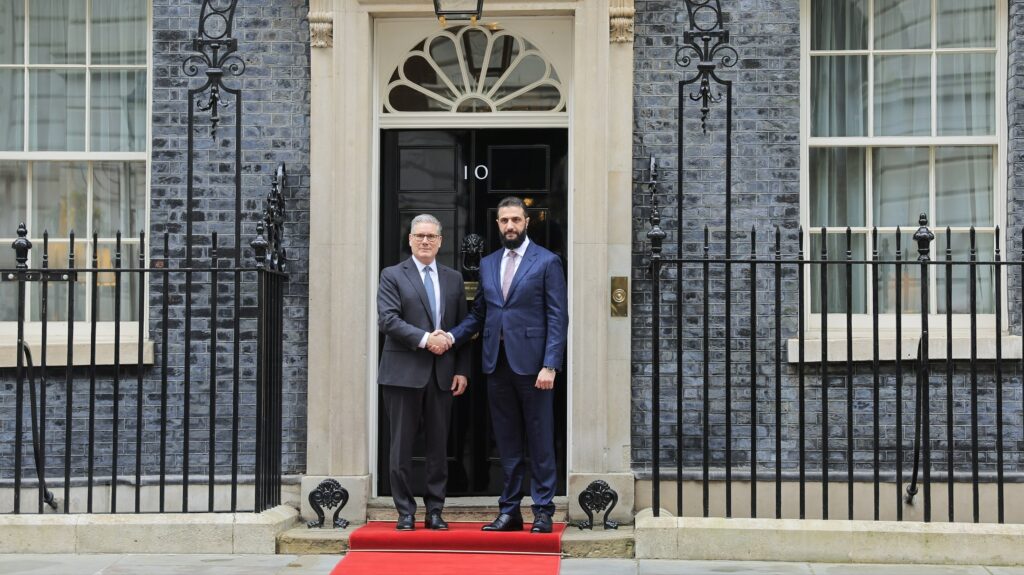
The visit of Syrian President Ahmad al-Sharaa to London, the storied capital of an empire whose influence once circled the globe, cannot be reduced to a simple chapter in Damascus’s evolving relationship with the European Union. Britain’s departure from the bloc in 2016 created a distinct diplomatic landscape. It also revived an older British temperament in world affairs, one marked by an instinctive ability to detect opportunity long before others recognize its contours.
A Partner in Victory
The future of Syrian-British relations becomes clearer when the British position on the “Syrian Question” is traced from the earliest days of the revolution. London adopted a firm political stance against the Bashar al-Assad regime and aligned itself with the Syrian people’s demand for change. As the conflict intensified, British officials maintained that any credible settlement required Assad’s departure.
By 2012, Britain had become a principal supporter of UN Security Council resolutions condemning state violence. It opened formal channels with the emerging Syrian opposition and later recognized the National Coalition for Syrian Revolutionary and Opposition Forces as the sole legitimate representative of the Syrian people. As a leading member of the “Friends of Syria” group, London endorsed the Geneva I Communiqué of 2012, which outlined a political transition through a transitional governing body.
British engagement extended far beyond diplomacy. The United Kingdom provided humanitarian assistance, training for local police in liberated areas, and essential funding for the White Helmets. Studies by the Arab Democratic Center estimate that British humanitarian contributions to Syria and neighboring host countries surpassed £3.8 billion by 2023. These funds sustained food, education, and healthcare programs, supported local councils, and delivered emergency relief after the devastating earthquakes of February 2023.
The Rapid Transformation
The collapse of the Bashar al-Assad regime on December 8, 2024, prompted an exceptionally swift British response. The following day, Foreign Secretary David Lammy addressed the House of Commons and described Assad as “a monster and a criminal.” Diplomatic and intelligence channels were immediately opened with the new Syrian leadership. Within eight days of liberation, senior officials from the Foreign Office arrived in Damascus to meet with the new administration and representatives of civil society.
By early 2025, Britain was participating in international summits on Syria’s future and had pledged an additional £50 million in aid for conflict-affected communities. Most striking was London’s rapid dismantling of the sanctions architecture associated with the Assad era. In March 2025, restrictions were lifted on twenty-four entities, including the Central Bank and major oil companies. By April, sanctions were removed from the Ministries of Defense and Interior, as well as state media and intelligence agencies. The intention was to accelerate reconstruction and reinforce national stability.
A Formal Economic Resumption
Recognizing that political rapprochement requires economic substance, Damascus inaugurated the Syrian-British Business Council on December 1, 2025. The council seeks to cultivate partnerships between companies, universities, and institutions across both countries. Minister of Economy and Industry Nidal al-Shaar described the council as a milestone in Syria’s return to the international arena. Finance Minister Mohammad Yusur Barnieh portrayed it as a platform for investment and growth. John Wilks, an advisor to the council, emphasized its role in reviving economic ties after years of stagnation.
A Historical Turning Point
Economic advisor Dr. Ziad Ayoub Arbache views President Sharaa’s visit to London as a defining moment that aligns with broader regional transformations. The visit represents a strategic shift in bilateral relations following the restoration of diplomatic ties. Dr. Arbache anticipates that reconstruction and the attraction of British investment will dominate the agenda, with an expected announcement concerning an export credit guarantee scheme for British firms.
The timing is significant. The visit follows the President’s trip to Germany, where agreements were signed with industrial giants such as Siemens to modernize Syria’s power grid. This sequence suggests a growing harmony between European and British approaches to Syria. Dr. Arbache argues that the visit carries implications beyond bilateral cooperation. It reaffirms Syria’s geostrategic role as a bridge between the Mediterranean and the heart of Asia, a position that encourages European and British companies to invest in logistics and reconstruction and may draw additional capital from the Gulf.
Investment Horizons
Syria’s new investment law offers fertile ground for foreign capital. It permits full foreign ownership and provides generous tax exemptions. Official projections estimate economic growth at nearly 10 percent in 2026, driven by the resumption of oil exports and the activities of the Joint Business Council. The Syrian diaspora in Britain is expected to play a catalytic role in high-yield ventures. British firms operating in the Gulf and Iraq may also find in Syria a vital commercial corridor, a kind of eastern counterpart to the Channel Tunnel that reshapes the flow of goods between Orient and Occident.
Expected Priorities
According to Dr. Arbache, the British government’s priorities include supporting economic recovery, combating extremist remnants, and reducing irregular migration. The agenda also envisions the full reopening of embassies and the consolidation of President Sharaa’s international legitimacy as a transitional leader. Structural reforms such as digitalization and the integration of Artificial Intelligence, inspired by the Dubai model, are expected to feature prominently.
Energy and construction stand at the forefront of cooperation. Syria’s urgent needs and Britain’s technical expertise create a natural alignment. Potential projects include renewable energy contracts and the transit of Gulf oil through pipelines capable of transporting between four and six million barrels per day. Such infrastructure would strengthen energy independence and increase exports by more than twenty percent.
Agriculture, Technology, and Security
Agriculture and manufacturing are poised for expansion through joint British-Gulf investments supported by tax incentives that encourage export-oriented production. Opportunities also exist for collaboration in knowledge development, artificial intelligence training, and banking modernization to enhance digital efficiency.
On the security front, Dr. Arbache underscores the importance of cooperation in counter-terrorism and the provision of £94.5 million in aid essential for regional stability. Britain’s engagement with post-Assad Syria is guided by a pragmatic convergence of interests. The partnership seeks to balance regional stability and the return of refugees with the legitimate economic ambitions of British enterprises. It unfolds in parallel with broader European efforts to support Syria’s transition.
This article was translated and edited by The Syrian Observer. The Syrian Observer has not verified the content of this story. Responsibility for the information and views set out in this article lies entirely with the author.