
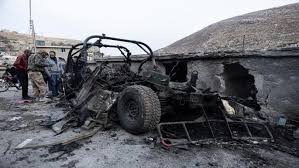
A recent episode of In the Heart of the Nation, broadcast on Syria TV, explored Syria’s strategic options in response to Israel’s latest escalation. The discussion weighed the reliance on regional alliances and diplomatic outreach against the need for unshakeable national unity as the only true deterrent to occupation, in the wake of public outrage following the assault on the village of Beit Jinn, in the Damascus countryside.
Debating the Power of International Law
The programme opened with a pointed exchange between political analyst Hassan Daghim and journalist Udi Fenicher, recently returned from the Golan, on the proposition: “Can Israel be restrained through international law?”
Daghim argued that while international law is not sufficient on its own, it remains “a card that must be played” as part of a broader mobilisation of national strength. “Israel is not just a Syrian issue; it’s an international one,” he said. “It was imposed through the convergence of colonial interests and the Zionist project, and it enjoys unrivalled Western backing, while we face sanctions and desperately need breakthroughs in our relations with the West.” He insisted Syria must confront Netanyahu’s extremist narrative in Western capitals, build international partnerships that enhance security, and prioritise internal unity before any direct confrontation.
Fenicher, in contrast, dismissed legal approaches as “empty romanticism” in the face of ongoing settlement expansion and aggression in Quneitra. “We’re past the stage of air raids,” he said. “This is about settlements and imposing faits accomplis. A cancer patient is not cured with moral support. We are in a fight for existence — we either stand our ground or vanish.” He criticised political elites for not being honest with the public about the limited options available and said Beit Jinn sent a clear message: the Syrian rifle can unite against occupation, regardless of sectarian or ethnic divides.
From Air Strikes to Ground Incursions: A New Phase of Escalation
The programme featured a report by Furat Darobi detailing Israel’s transition, since the fall of the Assad regime in December 2024, from limited air strikes to a broader policy of ground occupation under the codename “Operation Arrow of Bashan.” According to the report, Israeli forces have:
- breached the ceasefire line in the Golan and the demilitarised buffer zone,
- carried out over 400 incursions into the governorates of Daraa and Quneitra — some reaching up to 15 kilometres in depth,
- established around 10 permanent military and observation posts, most prominently on Mount Hermon,
- launched more than 1,000 air strikes, reportedly destroying over 70 per cent of Syria’s remaining military capacity,
- and executed one of the fiercest ground assaults in Beit Jinn, resulting in 20 deaths, 25 injuries, and widespread displacement.
Syria’s UN Envoy: Making Aggression Costly for Israel
Syria’s Permanent Representative to the United Nations, Ambassador Ibrahim al-Ali, said the attack on Beit Jinn exposed “conflicted thinking” within the Israeli leadership — some fear a resurgent, Western-backed Syria, while others prefer its continued weakness. Part of the escalation, he suggested, stems from “Netanyahu’s fear of the new Syrian experiment,” yet insisted that Syria’s diplomatic and alliance-based strategy has “raised the cost of aggression.”
“Netanyahu himself was forced to visit southern Syria to assert his presence,” al-Ali said. “That, in itself, shows the price we’ve imposed — politically and in terms of security.”
He outlined Syria’s approach as resting on three pillars: securing consensus within the Security Council on resolutions related to the Golan and Israeli attacks; combining diplomatic pressure with military restraint to deny Israel pretexts for escalation; and strengthening internal unity as the bedrock of any serious deterrent posture.
Responding to questions about a concrete strategy to halt the attacks, he confirmed the existence of “a written plan with designated responsibilities,” while admitting it had not been adequately communicated to the public. “We work day and night to limit damage and secure gains, but we must also improve how we explain this to the people. What’s happening in Beit Jinn and Quneitra is a top state priority.”
A Far-Right Government and Tensions with Washington
Khaled Khalil, an expert in Israeli affairs, characterised the assault on Beit Jinn as “an Israeli coup” against regional understandings brokered by Washington. He noted that the Israeli press has openly discussed growing divergences between US policy and the Netanyahu government over Syria, positioning Israel as “the only actor swimming against the tide of regional diplomatic shifts.”
He warned that the final ten months of Netanyahu’s tenure could bring “surprises and landmines,” but noted that pressure from US President Donald Trump — following what was described as a tense phone call — had thus far placed limits on the scale of Israeli escalation.
A Kurdish Perspective: Reconciliation Before Resistance
From Bremen, Germany, Kurdish affairs researcher Shorish Darwish said the Kurdish street in north-eastern Syria does not yet feel fully engaged with events in Beit Jinn, due to “the lack of reconciliation and the stalled dialogue between the new authorities in Damascus and the north-east.” Syrian diplomacy, he argued, cannot be complete without Kurds, Druze, Alawites, and Christians, and any global messaging must be based on genuine — not rhetorical — unity. He called for a national conference bringing together political movements, civil society, and representatives of all communities, leading to the creation of “a national army and a new social contract” capable of facing Israeli and other threats.
Beit Jinn as a Symbol of National Unity
The episode included a poignant report from Beit Jinn, where relatives of one of the deceased fighters described his final hours resisting Israeli forces. His mother said: “We are a people of peace, not war, but Israel knows no peace. Hassan is gone, and we count him a martyr before God. All of Syria celebrated his wedding.”
Condolence gatherings in Beit Jinn were attended by members of every Syrian community — a fact presenters and guests highlighted as evidence that, if managed wisely, Israeli aggression could serve as a catalyst for unity.
Poll: Reconciliation a Prerequisite for Confronting Israel
Closing the programme, presenter Zaidoun al-Zoubi shared the results of a viewer poll conducted via QR code, asking: “Is internal reconciliation an absolute necessity for confronting the Israeli threat?” Eighty-six per cent of respondents agreed, while a minority believed confrontation could precede or bypass reconciliation.
Al-Zoubi concluded by recalling the joint history of resistance across Lebanon’s Beqaa, the Golan, and Palestine — a history written by Kurds, Arabs, Druze, Alawites, and Christians alike. He warned that Israel would always seek to exploit internal divisions, and affirmed: “Syrian unity is not just a strategic option — it is a destiny, and the only path to building the Syria of tomorrow.”
This article was translated and edited by The Syrian Observer. The Syrian Observer has not verified the content of this story. Responsibility for the information and views set out in this article lies entirely with the author.