
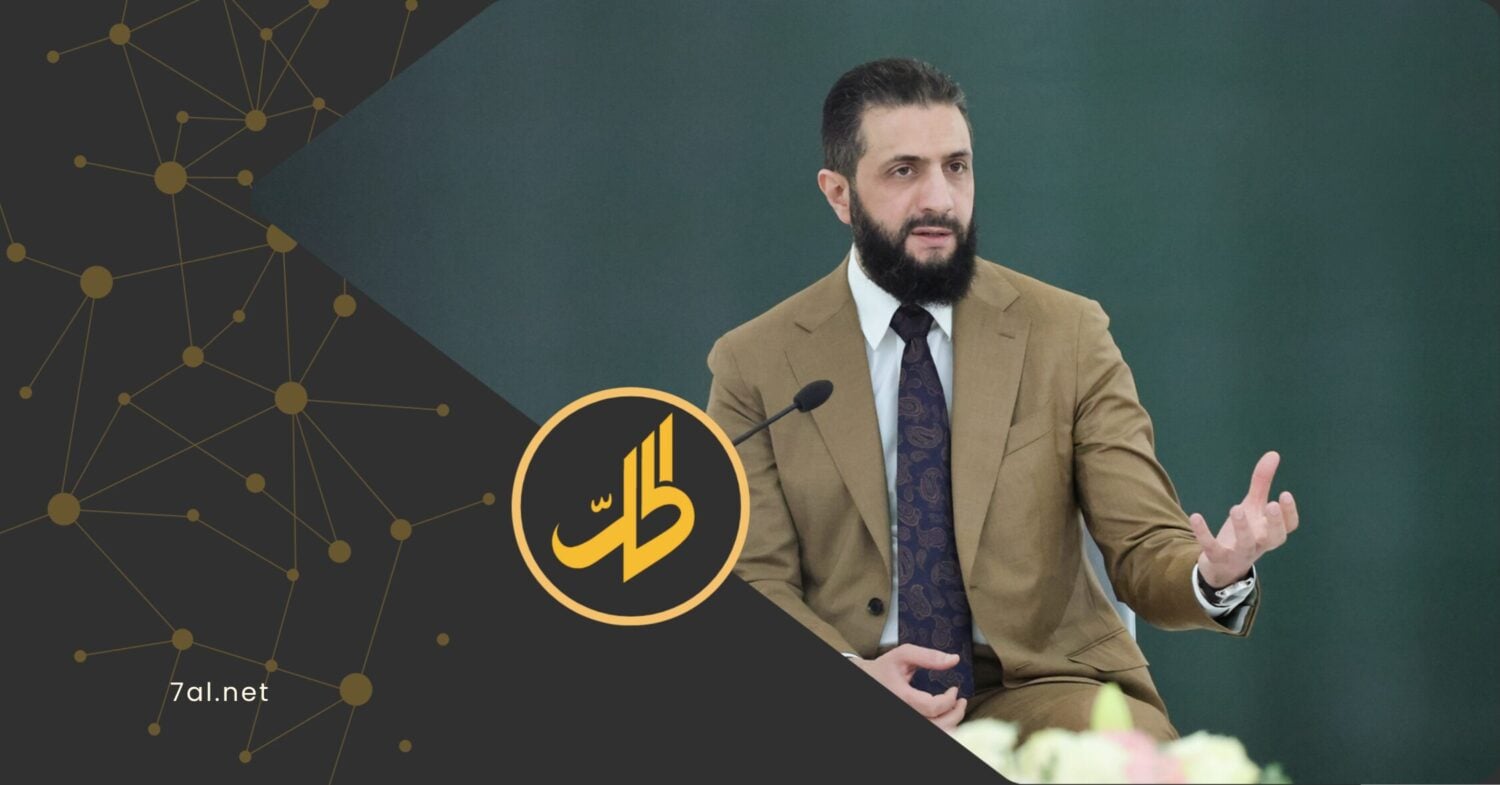
In a televised address following Eid al-Fitr prayers at the Presidential Palace in Damascus, Syria’s transitional leader, Ahmed al-Sharaa, unveiled what he described as a transformative fiscal blueprint for 2026. He announced a national budget of $10.5 billion, projected economic growth of 30–35%, and a Gross Domestic Product expected to reach $65 billion. The speech also promised a 50% salary increase, billions for infrastructure, and a renewed commitment to resolving the long-standing displacement crisis.
The declarations were sweeping, ambitious, and—according to a growing chorus of economists, legal scholars, and policy analysts—deeply problematic. Critics argue that the figures lack methodological grounding, violate constitutional procedure, and risk misleading a population already battered by inflation, unemployment, and institutional fragility.
Constitutional Deviations and the Erosion of Institutional Norms
The first wave of criticism targets the legality of the announcement itself. Academic and researcher Radwan Ziadeh expressed alarm that the President, rather than Parliament, had ratified the budget. In any functioning republic, he noted, a budget is a forward-looking estimate requiring national debate, while a balance sheet reflects past performance. The conflation of these concepts, he argued, signals a disregard for basic fiscal governance.
More troubling is the apparent violation of the 2025 Constitutional Declaration—signed by al-Sharaa—which mandates that the People’s Assembly approve the budget after a national dialogue on reconstruction, transitional justice, and the fate of the disappeared. The absence of funding for transitional institutions, including the Independent High Election Authority, reinforces the perception that the budget is less a governing instrument than a political narrative.
This constitutional slippage reflects a broader pattern: the selective reading of laws and the sidelining of institutional checks during the administrative transition.
The Arithmetic of Implausibility
From an economic standpoint, the gulf between official projections and international data is vast. While the Presidency touts growth exceeding 30%, World Bank estimates place Syria’s 2024–2025 growth at roughly 0.5%. To leap from a GDP of $21.4 billion in 2024 to $65 billion in 2026 would require a growth rate of 111%—a figure without precedent even in post-war reconstruction booms.
Economist Marco Albi described the methodology behind the numbers as “catastrophic,” pointing to internal contradictions. Only two months earlier, the Minister of Finance had estimated the budget at $5 billion. The sudden doubling, Albi suggests, may stem from folding the revenues of previously autonomous regions—Idlib, Northern Syria, and parts of the northeast—into a single ledger to simulate a surplus that does not exist in practice.
Such inconsistencies raise fundamental questions about the credibility of the fiscal narrative.
The Burden of Economic Accuracy
Economic journalist Adnan Abdulrazzaq argues that while a president need not be an economist, he must ensure that the data presented to the public is grounded in verifiable evidence. Announcing wage increases or minimum-salary adjustments without disclosing inflation rates renders such promises meaningless. Without transparency on inflation, exchange-rate stability, and sectoral output, the public cannot assess whether the proposed measures will improve living standards or merely mask deeper structural decay.
Abdulrazzaq stresses that before discussing the 2026 budget, the administration must publish a final account of 2025 expenditures. Syrians deserve clarity on the size of the deficit, how it was financed, and the real contribution of taxation, state-owned enterprises, and natural resources to the treasury.
Structural Imbalances and the Mirage of Prosperity
The composition of the proposed spending further undermines confidence. Allocating 40% to investment and 60% to current expenditures suggests a structural imbalance that could hinder long-term development. Critics warn that the policy of “liquidity drying,” intended to stabilize the Syrian Pound, will suffocate the very investment projects the budget claims to champion.
The promised 50% wage increase has also been dismissed as symbolic. Raising salaries from $20 to $45 offers little relief in a country where inflation erodes purchasing power daily and where 90% of citizens live below the poverty line.
The Perils of Political Intrusion into Technical Domains
The claim of 35% economic growth is, in Abdulrazzaq’s view, an aspiration that even global economic powers would struggle to achieve. For a country emerging from war, burdened by sanctions, and suffering from depleted resources, such projections strain the limits of credibility.
He warns that economic stability depends on insulating technical monetary policy from political interference. Historical examples—from Turkey’s central bank to the Federal Reserve under Alan Greenspan—demonstrate that markets respond to clarity, not political exuberance.
Conclusion: A Crisis of Credibility
The scrutiny surrounding Syria’s 2026 budget reveals a widening gap between the transitional authority’s optimistic rhetoric and the sober assessments of independent experts. The controversy is not merely about numbers; it is about governance, legality, and the integrity of the transition itself.
Unless the administration adopts a more transparent, institutionally compliant, and economically grounded approach, it risks entrenching a system unable to deliver genuine reform or regional integration. Syrians, yearning for stability and dignity, require economic truth—not fiscal mirages.