
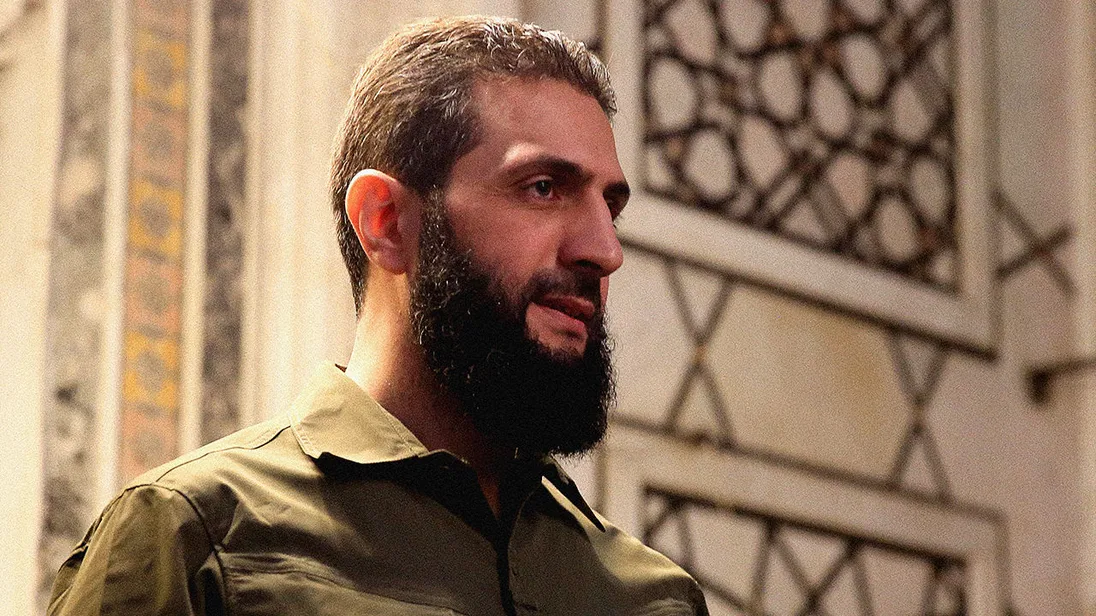
A conference titled “The Unity of Islamic Discourse” was held Monday at the Damascus Conference Palace, with broad official participation and the attendance of a large number of scholars and preachers.
During a dialogue session, President Ahmad Al-Sharaa emphasized that guiding society and elevating public awareness is a shared responsibility among preachers, educational institutions, and the media. He underscored the importance of integrating roles among all relevant sectors.
President Al-Sharaa described the Charter for the Unity of Islamic Discourse as an important step toward reinforcing national cohesion, consolidating moderation, ensuring balance in religious discourse, and steering clear of incitement or sectarian agitation. Such efforts, he said, enhance social harmony and preserve the unity of Syria’s diverse national fabric.
He stressed that the current phase requires clear priorities and scientifically grounded plans that serve citizens’ interests and strengthen the path of state-building.
Challenges of the Current Phase
The President noted that Syria faces numerous and profound challenges, the result of more than sixty years of accumulated administrative and organizational corruption, in addition to the vast destruction inflicted on infrastructure and vital sectors during the years of the revolution. He pointed out that around 1.2 million homes have been completely or partially destroyed, affecting millions of people, alongside the continued presence of internal camps and displaced Syrians abroad.
President Sharaa said that evaluating the government’s performance over the past year is ultimately the responsibility of the people, as they are the true monitors of state institutions. At the same time, he affirmed his duty to present citizens with an honest assessment of the current reality.
“We worked diligently during the past year and achieved significant results,” he said, citing the establishment of key institutional structures, reforms in several ministries — particularly in the justice sector — the development of Arab and international relations, and the formulation of strategic plans for balanced and sustainable economic development.
He stressed the need for precise scientific criteria in evaluating performance, rather than relying on impressions, to ensure the soundness of the steps taken. He noted that citizens’ interests — including security, services, and livelihood — depend on a broad system of reforms spanning education, the judiciary, infrastructure, energy, communications, and more, all of which require gradual implementation based on clear priorities.
On the Charter for the Unity of Islamic Discourse
President Sharaa affirmed that the charter emerging from the conference is “moving in the right direction,” as it strengthens national cohesion and reduces public distraction with secondary disputes. He stressed that Syria is not in a position to engage in historical intellectual debates, given the urgent priorities of the current phase — foremost among them reinforcing community moral discipline.
He noted that the schools of thought referenced in the charter are those recognized by Muslims across centuries, and that Syrian scholars possess significant moral authority enabling them to manage differences without allowing them to turn into discord or hostility. Syrians, he said, are naturally inclined toward solutions rather than conflict.
The President reiterated that shaping public opinion is a shared responsibility among education, higher education, mosque pulpits, and the media. He called for institutional integration so that each sector fulfills its role within an organized framework, free from duplication and friction, in a manner that strengthens trust between the state and society.
A Message to Scholars and Preachers
Addressing religious scholars, President Sharaa said:
“The pulpit — and any platform addressing the public — is a trust. The word is a trust in the mouth of the speaker, and people’s minds are a trust with the preacher.”
He stressed the need for accuracy in conveying information and verifying its authenticity, warning against turning every social-media rumor into a topic for sermons. He called for a discourse aligned with the priorities of state-building, given the influential role of preachers in shaping public opinion and raising future generations.
Regarding the charter’s societal impact, he said its principles help regulate religious discourse, prevent incitement, and curb tensions — all of which enhance stability within Syria’s diverse social landscape.
He emphasized the importance of defining the priorities of religious discourse in a way that supports state-building and social cohesion, noting that work is no longer individual but rather a collective effort involving religious, educational, and media institutions.
Toward an Integrated Institutional Framework
President Sharaa concluded by affirming that institutional integration is essential to rebuilding the state. Every institution — from defense and interior to the economy and religious platforms — must perform its role according to its specialization to achieve a balanced and sound construction of the new Syria and strengthen mutual trust between the state and society.
Earlier on Monday, the Ministry of Awqaf launched the Charter for the Unity of Islamic Discourse, a unifying national covenant for scholars and preachers from various Islamic schools of thought, aimed at harmonizing their positions on major religious issues.
This article was translated and edited by The Syrian Observer. The Syrian Observer has not verified the content of this story. Responsibility for the information and views set out in this article lies entirely with the author.