
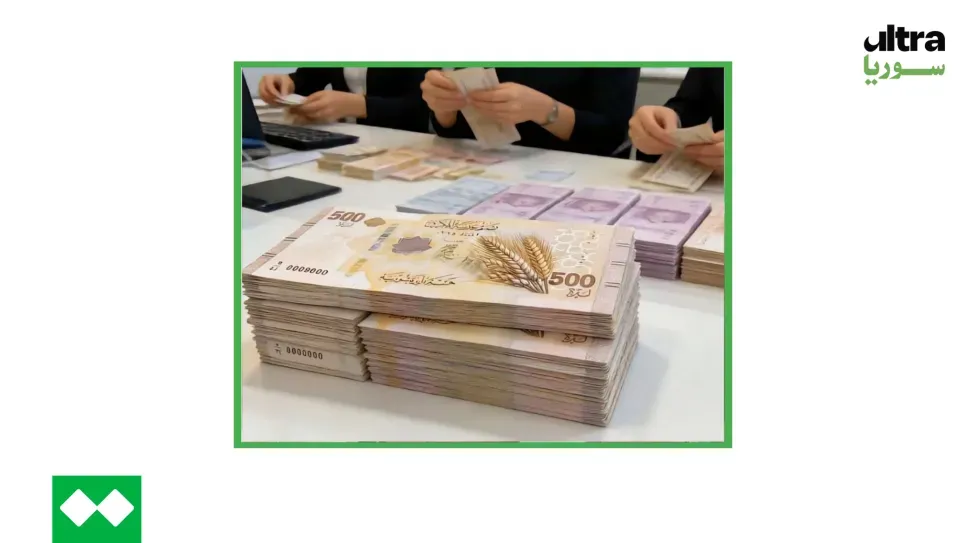
One month into Syria’s sweeping currency replacement campaign, the process has descended into confusion, long queues, and routine breaches of Central Bank regulations. The disarray has stranded citizens and eroded public confidence in a reform billed as a cornerstone of monetary stabilization.
The Central Bank of Syria launched the exchange on January 3, replacing the old 1,000, 2,000, and 5,000 pound notes with new denominations of 10, 25, 50, 100, 200, and 500 pounds. The measure, enacted under Presidential Decree No. 293 of 2025, removes two zeros from the nominal value of the currency and seeks to modernize the financial system.
Officials repeatedly assured the public that the exchange would be free of charge, automatically reflected in bank accounts, and would not amount to an abrupt cancellation of the old notes. “A currency’s value is shaped by economic policy and fiscal discipline, not by the design of the banknote,” the Central Bank declared.
Chaos on the Ground
Reality has diverged sharply from the official narrative. Exchange offices and several banks have disregarded the Central Bank’s daily ceiling of 75 million Syrian pounds per person, while others have imposed their own restrictive caps.
Ahmed, a Damascus resident, told Ultra Syria he spent two days waiting to exchange 10 million old pounds. “What’s happening outside exchange offices is pure chaos, with no oversight at all,” he said. “It bears no resemblance to the talk of an organized process involving 59 financial institutions and more than 1,500 branches.”
Issam, another citizen, said several exchange houses refused to process more than 5 million pounds per person per day, claiming shortages of the new notes. To exchange 25 million pounds, he had to return multiple times.
Scarcity of New Notes and Irregular Practices
More than a month after the launch, the new currency remains scarce in daily transactions. “Where is the new money?” has become a common refrain, despite Central Bank Governor Abdel Qader Hsuriah’s assurances on Facebook that supplies are sufficient and the process is “proceeding in an organized manner, without significant obstacles.”
Dr. Qasim Abu Dost, professor of international economics at Damascus University, told Ultra Syria that the disorder and shortages reveal “a flaw in the distribution mechanism and a lack of transparency regarding the quantities released into circulation.”
Some banks have added their own barriers. Samer, a resident of Al-Mazzah, said a local bank required him to open an account before exchanging his old notes.
Economists note that while ordinary citizens struggle, major speculators with large holdings of old currency have managed to exchange substantial sums with ease.
Economic Consequences
The chaotic rollout has weighed on the pound’s exchange rate. During the first week of the swap, the Syrian pound weakened against the US dollar, trading between 12,100 and 12,300 per dollar. Dr. Abu Dost attributed this to declining confidence: “Concerns about the new pound are pushing people toward the dollar, which increases pressure on the exchange rate.”
He warned that widespread non-compliance with Central Bank instructions “undermines trust in the entire operation” and threatens one of its central aims: restoring confidence in the monetary system. He also suggested that the slow appearance of the new notes raises questions about whether the Central Bank is deliberately restricting liquidity.
Official Position and Timeline
Governor Hsuriah has urged the public not to rush, saying deadlines will be extended if necessary to ensure everyone can complete the exchange. The official window is 90 days, with roughly 60 days remaining.
Meanwhile, the Central Financial Supervision Agency is overseeing the collection, counting, sorting, and destruction of old notes. The currency is transferred from exchange centers to provincial Central Bank branches, then to a facility on the Damascus International Highway.
For now, the new banknotes remain scarce in markets and daily transactions, leaving Syrians to navigate a disorderly transition that contrasts sharply with the orderly reform they were promised.
This article was translated and edited by The Syrian Observer. The Syrian Observer has not verified the content of this story. Responsibility for the information and views set out in this article lies entirely with the author.