
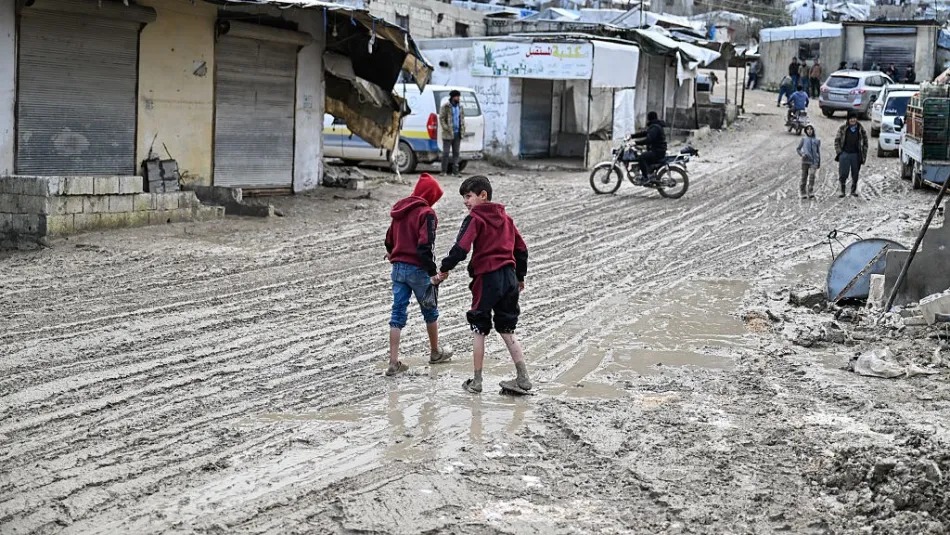
The images coming out of the flooded camps in Idlib were wrenching. Their misery felt even sharper when contrasted with the stream of celebrations and festivals held since Bashar al-Assad’s fall, most recently the Damascus International Book Fair now underway. The point was never to question the fair itself. The criticism focused on the extravagance surrounding it and the money spent bringing in guests whose presence added little. The fair could have fulfilled its mission without the excess. At its core, it is a cultural gathering meant to connect publishers with readers and reestablish ties between publishing houses and Syrian bookstores, just as it did in its earliest years.
Since the fair opened, state media have flooded the airwaves with images of visiting dignitaries and their warm exchanges with officials. What has been missing are images of those same officials standing in the disaster zones of the camps, meeting the displaced, assessing conditions, and looking for solutions. The winter suffering in the camps is neither new nor surprising. It is a chronic crisis that demanded preventive measures long before it reached this point.
Idlib is a telling example. Officials have repeatedly praised the province’s role in the country’s future, noting that Hayat Tahrir al-Sham launched from there the campaign that ultimately toppled Assad. A province with such symbolic weight should receive special attention—or at the very least, not be left to fend for itself. And Idlib is only one case. Many others unfold far from the capital, even as Damascus presents an image of comfort and recovery. Visitors may leave believing the entire country is doing well, an impression that clashes with the deep deterioration of Assad’s final years.
There is no denying that Damascus has seen a surge of visitors since Assad’s fall—foreigners and Syrians abroad who now include the capital in their itineraries even when traveling elsewhere. The city has benefited from this influx and the spending that comes with it, creating a relative improvement in living conditions compared with other regions. The state itself remains a steady source of income. Tens of thousands work in government ministries, especially defense and interior, where entry-level salaries exceed those in other public institutions.
Symbolically, it was clear from the earliest days after Assad’s fall that many newcomers wanted to signal their affiliation with Damascus, either directly or by invoking its Umayyad heritage. This impulse is not new. The elevation of Damascus as the center has long been embedded in official discourse, especially among the second generation of the former regime’s elite. When factions and cameras entered Qardaha, the elder Assad’s hometown, they found living conditions far more modest than the myth of a “presidential” town had suggested. Under the previous regime, power and the most profitable economic sectors were concentrated in the capital. Even cultural life became intensely centralized, to the point that Damascus was an obligatory stop for most Syrian writers.
Such concentration is not unique to Syria. Many countries see financial and symbolic capital cluster in their capitals. But Syria’s current moment carries particular sensitivities. The country remains in a fragile transitional phase widely seen as the foundation of a new era. Treating Damascus as a stand-in for Syria carries risks that would be far less consequential in a stable state. Syria is not stable—whether in the south, along the coast, or in the northeast.
On the eve of the revolution, Damascus itself offered few signs of the upheaval to come. Living standards there had not yet collapsed to the levels later seen across much of the country. Even then, accuracy required distinguishing between the city’s different social layers and neighborhoods. Those who spent their evenings between Rawda Café and the restaurants of Bab Touma and Bab Sharqi belonged to a segment able to afford it. Some may not have known about the informal settlements only a few kilometers away. This does not diminish their political awareness. In the final years before the revolution, some of those café regulars enjoyed a limited freedom to criticize the authorities. The regime paid little attention to a handful of outspoken critics—until they joined demonstrations.
Collapsing Syria into Damascus, and then collapsing Damascus into its relatively affluent neighborhoods, is a serious distortion. This simplification is often made by well-meaning visitors unfamiliar with the country, and also by residents of those very districts who may know little about life beyond them. In both cases, the impulse reflects a desire to believe that conditions across Syria resemble those of a few pockets in the capital. Consciously or not, this reproduces the marginalization of much of the country—this time by denying it moral attention. After material neglect comes the neglect of recognition itself.
Re-entrenching the capital as a privileged enclave may not benefit it in the long run. Privilege often turns a city into a magnet for people from neglected regions within a highly centralized and imbalanced system. For decades, this dynamic fueled the growth of impoverished informal settlements on Damascus’s outskirts. Persistent disparities will only encourage further migration by those seeking even a fraction of the advantages concentrated there.
At first glance, speaking of privilege may seem to invite resentment toward Damascenes who enjoy economic or symbolic advantages. Yet not all residents of Damascus share equally in these benefits. Many gain little from the concentration of power and instead bear the burdens of “capital” status that strain their city. More than once, Damascenes have faced harsh criticism when one of their own dared to complain about the pressures brought by waves of newcomers.
Damascus deserves to be spared the weight of privilege and the relentless politicization that accompanies it. It deserves visitors whose enthusiasm is tempered by open eyes and more compassionate hearts. To assume that Damascus is thriving while Syria remains far from recovery is to commit a quiet injustice against both.
This article was translated and edited by The Syrian Observer. The Syrian Observer has not verified the content of this story. Responsibility for the information and views set out in this article lies entirely with the author.
