
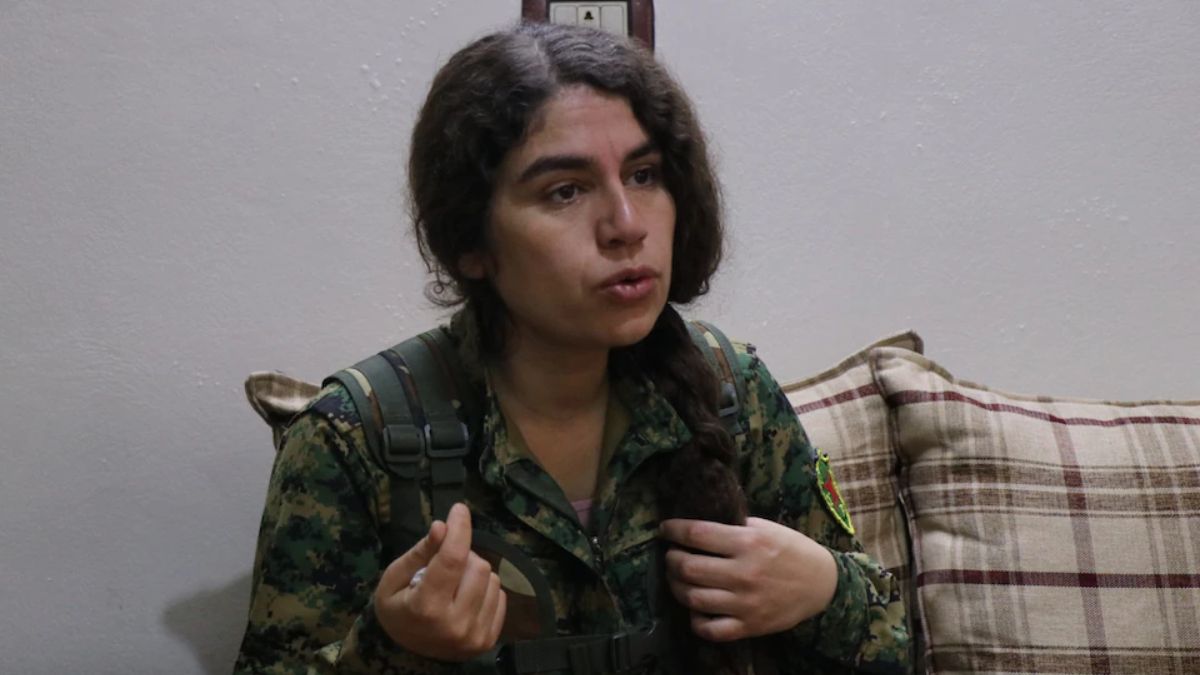
The Women’s Protection Units (YPJ), the all-female militia within the Syrian Democratic Forces (SDF), have declared they will maintain their armed presence despite the recent integration agreement between the Syrian government and the SDF.
In an interview with The Telegraph published Tuesday, YPJ spokesperson Roxana Mohammed said the group’s struggle extends far beyond territorial control. “Our struggle is not just about land; it is a wider battle for Kurdish self-rule and women’s rights,” she stated.
Speaking from Qamishli, Mohammed described the decision to take up arms as a matter of necessity. “As a woman, why did I pick up a weapon? Because I see my community, my independence, and my identity under threat. I may have a father and brothers, but I have to protect myself. No one can do that for me,” she said.
She affirmed that her forces are prepared for war if attacked, while expressing conditional openness to peace. Any agreement, she insisted, must guarantee the protection of the SDF and the Kurdish people. Mohammed criticized the accord for failing to ensure Kurdish factions retain a degree of autonomy that could counterbalance potential overreach by pro-government forces.
She also pointed to differing interpretations of the U.S.-brokered deal between Damascus and Kurdish leaders, insisting the YPJ would remain an independent armed force within Kurdish-held areas.
“Our leaders and fighters played the largest role in the war against ISIS and against Hay’at Tahrir al-Sham on all fronts. Therefore, we cannot accept an armed force without women,” she said.
Government Labeled an “Existential Threat”
Mohammed made controversial claims about Syria’s transitional president, Ahmad Al-Shara, alleging he first entered Syria as a commander of HTS, Al-Qaeda’s former affiliate, and clashed with the YPJ early in the conflict — a claim widely disputed by historical records.
She described Syrian government forces as an “existential threat” to Kurdish women, who she said had not only established a fully female fighting force but also built unique political and civil society institutions across northern Syria.
Mohammed characterized the SDF’s relationship with the United States as purely tactical and said her forces are unconcerned with the timing or manner of a U.S. withdrawal, accusing Washington of pursuing objectives beyond the fight against ISIS.
Regardless of the ceasefire’s durability, she vowed that YPJ units would retain control of their armored vehicles and heavy weapons.
Tightened Security Measures in Hassakeh and Qamishli
Her remarks come amid rapidly escalating security developments in northeastern Syria. The SDF imposed a total curfew in Hassakeh and Qamishli on Tuesday, warning that any movement in the streets would be met with “direct targeting.”
Local reports describe a complete shutdown in Qamishli, with snipers positioned on strategic high points, including water towers and key buildings. A widespread internet blackout — affecting both satellite and local networks — has severely disrupted communication.
Similar disruptions were reported in Hassakeh, where security forces prevented bakeries from operating in the Ghweiran district amid a power outage that began Monday evening.
These measures coincide with the entry of Syrian Interior Ministry units into Hassakeh on Monday, marking the start of the security implementation phase of the government-SDF agreement. The ministry said the deployment paves the way for assuming full security responsibilities.
Background: The Integration Agreement
On January 30, the Syrian government and the SDF announced a comprehensive agreement featuring a full ceasefire and a sequenced process for military and administrative integration.
The joint text outlined the withdrawal of military forces from frontlines and the deployment of Internal Security Forces into Hassakeh and Qamishli to bolster stability and begin integrating local security units.
Militarily, the accord calls for forming a new division incorporating three SDF brigades and establishing a brigade from the Kobani (Ayn al-Arab) forces within an Aleppo-based division.
Administratively, it provides for integrating the civil institutions of the SDF-led Autonomous Administration into Syrian state structures while retaining civil servants, addressing Kurdish civil and educational rights, and facilitating the return of displaced persons.
The agreement’s stated goal is to unify Syrian territory, enforce state law, and achieve full integration in the northeast through coordinated security, political, and reconstruction efforts.
This article was translated and edited by The Syrian Observer. The Syrian Observer has not verified the content of this story. Responsibility for the information and views set out in this article lies entirely with the author.