
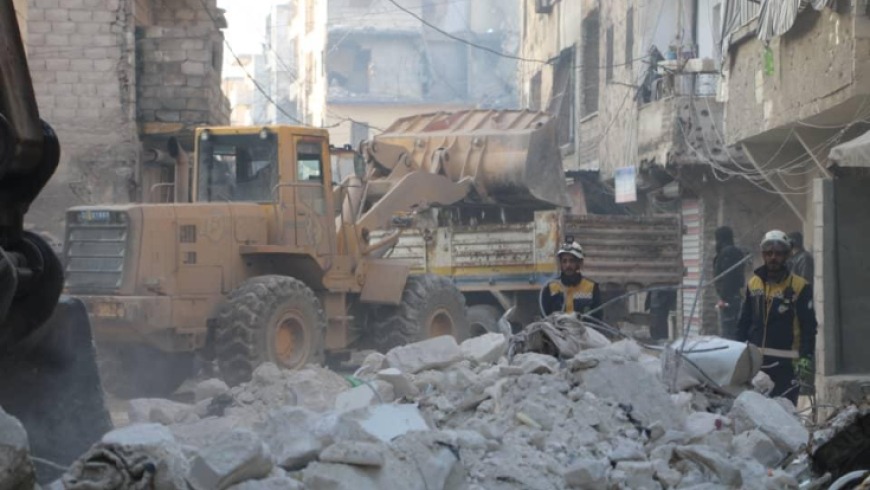
The recent collapse of a residential building in the Al-Amiriyah neighborhood has reopened one of Aleppo’s most urgent and long-deferred service and humanitarian files: structurally damaged buildings that stand on the brink of collapse.
The incident revives memories of a succession of similar tragedies in the city’s eastern districts in the years following the former regime’s takeover of Aleppo in late 2016. Several building collapses claimed dozens of lives and left many residents living under constant threat inside homes stripped of structural safety.
Roots of a Deep Structural Crisis
The crisis traces back to the years of intensive bombardment between 2012 and 2016, when forces of the former regime, supported by Russian and Iranian forces, dropped hundreds, perhaps thousands, of tons of explosives on densely populated residential areas. The assaults left profound structural damage across thousands of buildings.
The destruction extended beyond direct bombardment. Damaged sewage and drinking-water networks, along with chronic leaks, weakened foundations over time. The earthquake that struck Aleppo in 2023 compounded the fragility. Widespread informal construction, new buildings erected without adherence to engineering standards, and substandard repair works carried out in the absence of technical oversight further eroded structural integrity.
Between 2016 and the fall of the former regime in late 2024, allegations of corruption within Aleppo’s city council deepened the problem, as oversight weakened and enforcement faltered.
Following liberation, displaced residents and refugees returned to many of these neighborhoods and resettled in cracked and unstable buildings without comprehensive engineering assessments or coordinated rehabilitation plans. In a city where more than seventy neighborhoods sustained varying degrees of destruction, accurate hazard maps remain scarce, public safety procedures are limited, and preventive intervention capacity remains weak.
The result is a slow-moving crisis that threatens to produce further loss of life unless addressed systematically.
The Al-Amiriyah Incident
Al-Amiriyah lies in southeastern Aleppo, adjacent to the neighborhoods of Al-Mashhad and Salah al-Din, overlooking the Ramouseh roundabout and the industrial zone. Its geography rendered it strategically sensitive throughout the Syrian conflict. The district overlooks the ring road once used by former regime reinforcements and lies near several military academies, including the Air Force Technical College, the Armament College, and the Artillery College. It therefore endured sustained bombardment and some of the fiercest fighting during the war.
Local sources inside Al-Amiriyah confirmed that aerial bombardment by the former regime and Russian forces directly targeted both the neighborhood’s periphery and its interior residential blocks, leaving extensive structural damage. Buildings that did not collapse outright exited the realm of structural safety. Over time, cracks widened and foundations weakened, turning many structures into silent hazards.
The damage extended to sewage and rainwater drainage networks, which have suffered severe degradation since 2012. Persistent leakage has undermined the foundations of numerous buildings.
Despite the former regime’s reassertion of control over Aleppo in late 2016, meaningful rehabilitation in Al-Amiriyah did not follow. Partial returns occurred, yet many buildings remained vacant and deteriorating, with no comprehensive engineering survey to distinguish habitable structures from those at risk of collapse.
Abu Mohammed, a resident who returned to his home several years ago, described living under constant anxiety:
“We live here without feeling safe. The walls are cracked, the ceiling shows clear fissures, and every winter we fear that moisture and water leakage will widen the damage. No one has inspected the building or told us whether it is fit for habitation.”
He added that sewage blockages have persisted for years, with water seeping beneath the building’s foundations.
“We know it is dangerous, but we have no alternative. Either we live here or we are displaced again.”
Regarding the recently collapsed structure, he explained that most families had vacated it years earlier due to severe damage. One family returned after undertaking partial, unlicensed repairs that appear to have worsened the structural instability, culminating in collapse.
A Pattern of Repeated Tragedies
Aleppo has witnessed multiple building collapses since 2016. In neighborhoods such as Al-Kallaseh, Al-Salihin, Al-Maysar, Bustan al-Basha, and Al-Shaar, similar incidents claimed lives.
In late 2019, five civilians were killed when a five-story residential building collapsed in Al-Maadi in the old city. The building had sustained damage from prior bombardment.
In February of the same year, a building collapsed in Salah al-Din, killing eleven residents. In November 2019, a five-story structure in Al-Salihin collapsed entirely, killing a man and a woman and injuring their two children. In March 2018, a five-story building in the Maysaloun district collapsed, killing three people recovered from beneath the rubble.
In January 2023, ten people, including a child, were killed when a residential building collapsed in Sheikh Maqsoud, then under the control of the Syrian Democratic Forces. At the time, the city council of the former regime attributed the collapse to water seepage beneath the building.
Among the most devastating incidents was the collapse of a five-story building in the Al-Firdous neighborhood on 7 September 2022, which killed thirteen people. Local testimonies later attributed the disaster to corruption and regulatory failure within the city council during the former regime period.
According to local sources, a resident named Mohammed Nour Madbas had purchased the second and third floors of the building just three months before its collapse, acquiring a court-validated ownership contract and paying fifty million Syrian pounds. The building stood in a violations zone. A basement had been excavated and reinforced in 2020, and construction was completed thereafter.
In 2021, the municipal safety committee sealed the building pending demolition. The seal was later removed, reportedly through corrupt arrangements, and apartments were sold in mid-2022 before the building collapsed.
Sources stated that the structure had been erected under record number 2702 and that construction materials had been manipulated. Steel reinforcement bars were reportedly poorly integrated with the concrete, and debris analysis showed fragmented structural cohesion. Claims that water leakage caused the collapse were disputed by locals, who insist that material tampering was the primary factor.
An Escalating Urban Risk
The collapse in Al-Amiriyah is neither isolated nor unforeseeable. It reflects the cumulative weight of war damage, neglected infrastructure, informal construction, weak oversight, and systemic corruption that spanned years.
Today, as Aleppo attempts to stabilize and rebuild, the file of structurally unsafe buildings demands urgent, coordinated attention. Without comprehensive engineering surveys, hazard mapping, transparent oversight, and preventive intervention, the city risks further tragedies unfolding not as sudden shocks, but as predictable consequences of deferred action.
Aleppo’s skyline bears the scars of war. Beneath it lie foundations that require more than repair; they require governance, accountability, and a sustained commitment to public safety.
This article was translated and edited by The Syrian Observer. The Syrian Observer has not verified the content of this story. Responsibility for the information and views set out in this article lies entirely with the author.