
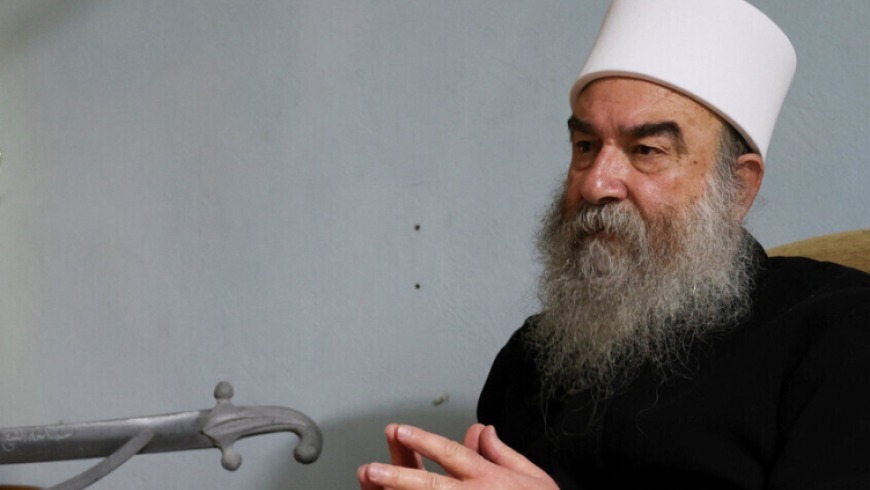
Hikmat al-Hijri, one of the Druze community’s senior spiritual leaders in Suweida, declared that his group may be willing to enter a transitional phase, provided that a guarantor exists. He asserted that Israel is the only party capable of assuming such a role.
His remarks came in an interview published Monday by the Hebrew daily Yedioth Ahronoth, in which Hijri explained that their principal demand is “complete independence,” although current circumstances may necessitate accepting temporary transitional arrangements.
Hijri added that any future agreement, as he envisions it, requires a “competent and authorized guarantor,” insisting that Israel is the party capable of fulfilling this function. He went further, saying that his community regards itself as “an inseparable part of the fabric of the State of Israel’s existence,” describing the relationship as an established alliance and asserting that they consider themselves “an arm” within that framework.
He noted that the relationship with Israel is not a product of the present moment but predates the fall of the deposed Bashar al-Assad’s regime. He pointed to longstanding blood ties and extended family connections with the Druze of the occupied Golan.
In a related context, Hijri stated that “the absence of a direct humanitarian corridor with Israel hinders the delivery of aid and deepens the humanitarian and living crisis in Suweida.”
“A Continued Demand for an Independent Entity”
Hijri has long called for the establishment of an independent entity that guarantees the right to self-determination for the people of Suweida. His most recent appeal came last September, when he claimed in a speech posted on the Facebook page of the “Spiritual Presidency of the Druze Unitarian Community” that the region’s cadres and experts are ready to administer local affairs in a manner that ensures security, stability, justice, and development.
In that same address, he expressed his gratitude to the Israeli occupation and to Prime Minister Benjamin Netanyahu, as well as to the United States and the European Union, for what he described as supportive positions toward “the cause of the people of Suweida.”
This article was translated and edited by The Syrian Observer. The Syrian Observer has not verified the content of this story. Responsibility for the information and views set out in this article lies entirely with the author.
