
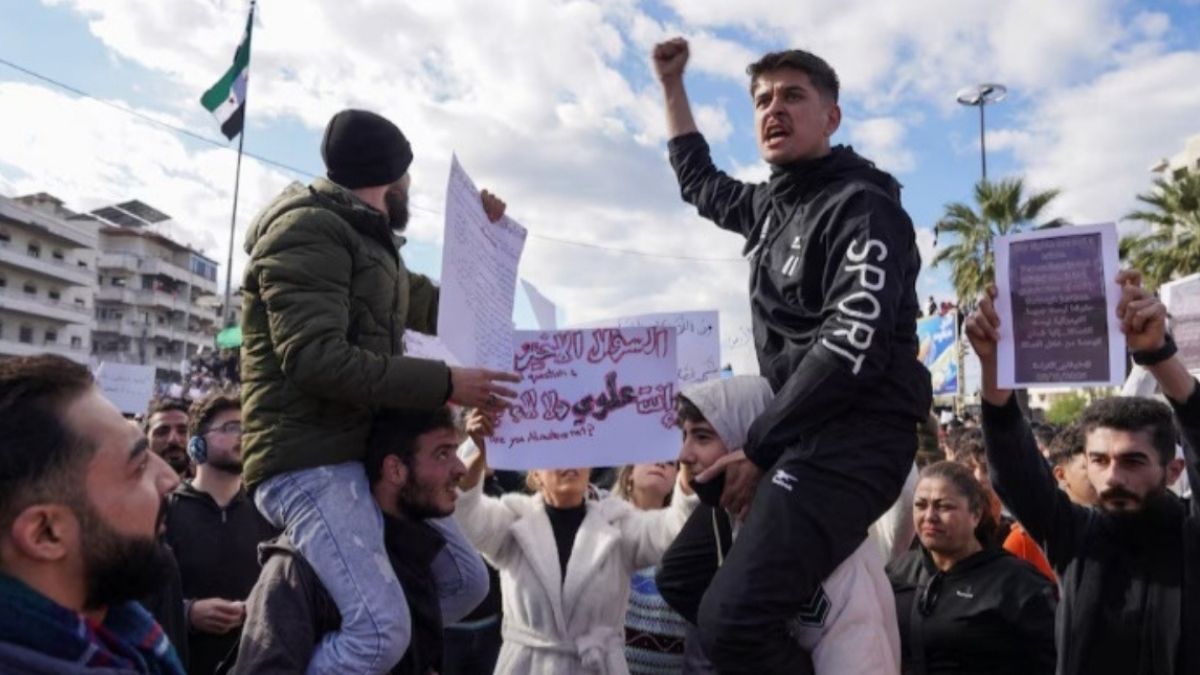
The fall of the Assad regime marked a political rupture for Syria as a whole, but for the country’s Alawite community it triggered one of the deepest social and psychological transformations in its modern history. Long embedded within the structures of the state—economically, administratively, and symbolically—Alawites found themselves abruptly exposed to a new reality: the collapse of the institutional frameworks that had long mediated their relationship with power, security, and citizenship.
This rupture did not merely reorder political allegiances. It destabilized social identities, eroded economic certainties, and reopened unresolved questions about belonging, representation, and the meaning of the state itself.
From State Integration to Institutional Vacuum
For decades, Alawite integration into Syria’s public sector was not simply a political choice but a structural condition. The state—through the military, civil service, and affiliated institutions—served as the primary vehicle for social mobility, economic stability, and political inclusion. With the dismantling of large parts of that apparatus after Assad’s fall, thousands of Alawites lost not only jobs but also the institutional grammar through which they understood their place in the country.
This sudden vacuum produced confusion rather than immediate radicalization. Initial reactions were marked by pragmatism: weapons were surrendered, military personnel sought legal settlements, and many attempted to adapt quietly to the new order. Yet as dismissals continued, security abuses persisted, and transitional justice appeared selective and uneven, fear replaced cautious optimism.
Identity Under Pressure
It is within this context that questions of identity resurfaced with unusual intensity. For much of the twentieth century, Alawite identity was rarely articulated as a political project. Secular ideologies, particularly Arab nationalism and leftist movements, provided broader frameworks of belonging. After the regime’s collapse, however, identity retreated inward, not as an ideological assertion but as a defensive response to perceived existential threat.
This shift did not occur in isolation. As political participation narrowed and civic institutions failed to emerge, religion became one of the few remaining languages through which collective demands could be expressed. The growing visibility of religious figures—most notably Sheikh Ghazal Ghazal—should therefore be understood less as a doctrinal turn than as a symptom of political absence. In the absence of trusted civil leadership, religious authority offered a provisional form of representation, capable of articulating grievance and mobilizing attention.
Crucially, this alignment remains unstable and contested. Many Alawites reject the notion that any religious figure can speak on behalf of the community as a whole, and there is no consensus around permanent religious leadership or sectarian mobilisation. What exists instead is a temporary convergence driven by fear, not conviction.
Fragmentation, Not Homogeneity
Contrary to common portrayals, the Alawite community today is neither unified nor moving in a single political direction. Internal divisions are pronounced. Some advocate accommodation with the authorities in the hope of restoring stability; others demand decentralization or federal arrangements as safeguards against renewed repression; a smaller and largely external current flirts with separatist ideas. Yet the dominant sentiment remains anchored to the idea of Syria as a shared state, not a fragmented one.
Even recent protests in coastal areas largely remained within the symbolic boundaries of the Syrian state. Their slogans invoked safety, dignity, and rights—not secession. This persistence of national attachment is one of the most significant, and often overlooked, features of the current moment.
The Role of Power in Producing Sectarianism
What emerges most clearly from the analyses is that sectarian identity is not an autonomous social force but a political product. Policies that rely on loyalty rather than competence, security rather than law, and selective justice rather than accountability actively manufacture sectarian consciousness. When violations go unaddressed, when dismissals disproportionately affect one group, and when public discourse tolerates incitement, identity hardens into a shield.
The irony is that practices justified in the name of stability may be doing precisely the opposite: entrenching mistrust, narrowing political imagination, and pushing communities toward inward-looking forms of self-definition. This dynamic is not unique to Alawites; it reflects a broader Syrian condition in which citizenship is steadily displaced by communal affiliation.
Representation and the Crisis of Politics
At the core of the Alawite question lies a political problem, not a theological one. The absence of licensed parties, credible local representation, and inclusive national frameworks leaves communities with few options other than informal leadership and symbolic mobilization. In such an environment, even deeply secular societies may temporarily lean on religious figures—not because they desire clerical rule, but because politics itself has been hollowed out.
The challenge, therefore, is not to suppress these expressions but to render them unnecessary. That requires reopening political space, institutionalizing participation, and rebuilding trust through transparent governance and genuine accountability.
Beyond the Alawite Question
Ultimately, the transformation of the Alawite community is a lens through which Syria’s broader dilemma becomes visible. The country stands at a crossroads between two models of order: one based on dominance, loyalty, and managed fear; the other on citizenship, law, and shared responsibility. The choices made in dealing with Alawite anxieties will reverberate far beyond one community, shaping the future of Syrian statehood itself.
The issue, then, is not whether Alawites will integrate into the new Syria, but whether Syria will succeed in becoming a state capable of integrating all its citizens. The answer to that question remains unresolved—and with it, the fate of the country’s fragile social fabric.
This article was translated and edited by The Syrian Observer. The Syrian Observer has not verified the content of this story. Responsibility for the information and views set out in this article lies entirely with the author.
