
One year into the seismic upheavals of the so-called “Liberation Phase”, Syria’s economy stands at a crossroads—caught between the lure of external revitalisation and the risk of internal stagnation. Financial lifelines from the Gulf—principally Saudi Arabia and Qatar—have proved vital, plugging holes in state coffers and sustaining the salaries of a strained civil service. Yet, as economist George Khazam warns, these generous injections risk morphing into a gilded trap: in the absence of structural reform, they may tie Damascus to the whims of far-off capitals, rather than empower self-reliance.
Gulf Aid: Lifesaver or Looming Liability?
In a sharp analysis of Syria’s post-liberation fiscal landscape, Khazam acknowledges the urgent necessity of Gulf support amid a near-bankrupt treasury. These injections—ranging from direct salary payments to debt relief and infrastructure pledges—embody both fraternal solidarity and strategic positioning, offering Riyadh and Doha leverage over a fledgling order unmoored from Iranian influence.
Qatar’s $87 million allocation to cover three months of public sector wages, alongside a joint Saudi-Qatari $89 million channel via the UNDP for essential services, helped stave off immediate fiscal collapse. Meanwhile, Saudi Arabia’s $2.9 billion infrastructure pledge, coupled with Qatar’s $7 billion energy deal, signals a tilt toward reconstruction. Their combined clearance of $15 million in legacy debt earlier this year could also unlock future World Bank loans.
Yet in a widely circulated Facebook post, Khazam cautioned that these stopgaps, lacking domestic policy anchors, risk deepening structural dependency. He accused the transitional authorities of pursuing a “destructive” economic agenda—dismantling a weakened public sector while flinging open the gates to imports, with little regard for local production. This liberalisation, he argued, has gutted domestic revenue streams, replacing them with unstable external flows.
Lax customs policies, he warned, have become a fiscal black hole: tariff reductions on goods that could be produced locally have crippled small-scale manufacturers, entrenching a consumption-driven model that undermines Syria’s industrial base. World Bank figures highlight the danger: GDP contracted by 1.2% in 2023 and is expected to shrink by another 1.5% in 2024. Residual sanctions—including frozen assets and banking restrictions—continue to hamper energy imports and trade recovery.
A Landscape of Economic Ruin
The consequences are already visible. Dozens of factories have shuttered in the face of cheaper imports, sending tax revenues from domestic business into freefall. A more protective industrial policy could have generated jobs, enhanced state bargaining power and increased sovereign revenues. Instead, Syria has become increasingly reliant on external assistance—an arrangement Khazam likens to economic vassalage.
He warns that any abrupt halt in aid—due to shifting geopolitics or donor fatigue—could expose the fragility beneath the surface. Without Gulf assistance, the state would struggle to pay public sector wages, weakening institutional credibility and fuelling social unrest.
The current aid model, he argues, offers little more than temporary relief—palliatives that defer crisis rather than address its root causes. Syria’s economy, Khazam insists, remains trapped in a rentier paradigm where dependency replaces productivity. Gulf donors, too, remain cautious: both Riyadh and Doha continue to calibrate their assistance carefully, wary of Hay’at Tahrir al-Sham’s Islamist lineage and Ankara’s expanding influence in northern Syria.
A Call for Strategic Protectionism
Khazam proposes an alternative path: “intelligent economic protectionism” that raises tariffs on imports competing with domestic production. He argues that such a shift—combined with renewed tax revenues from reactivated local industry—could surpass the financial value of Gulf grants, while laying the foundations for sustainable growth.
Beyond tariffs, Khazam points to Syria’s vast diaspora—estimated to hold $100 billion in overseas assets—as a potential source of investment, should a climate of stability and transparency take root.
This first year of liberation, he laments, should have laid the groundwork for a productive economy, not entrenched a rentier state beholden to external patrons. The path forward, he argues, lies in balancing foreign aid with domestic resurgence—channelling external funds into productive sectors, while shielding Syria’s industrial capacity from premature exposure.
Only by reclaiming its economic sovereignty, Khazam concludes, can Syria secure long-term stability—anchoring currency strength, wage integrity and state legitimacy not in foreign largesse, but in the engine of its own recovery.
Gulf Aid: Scope and Limits
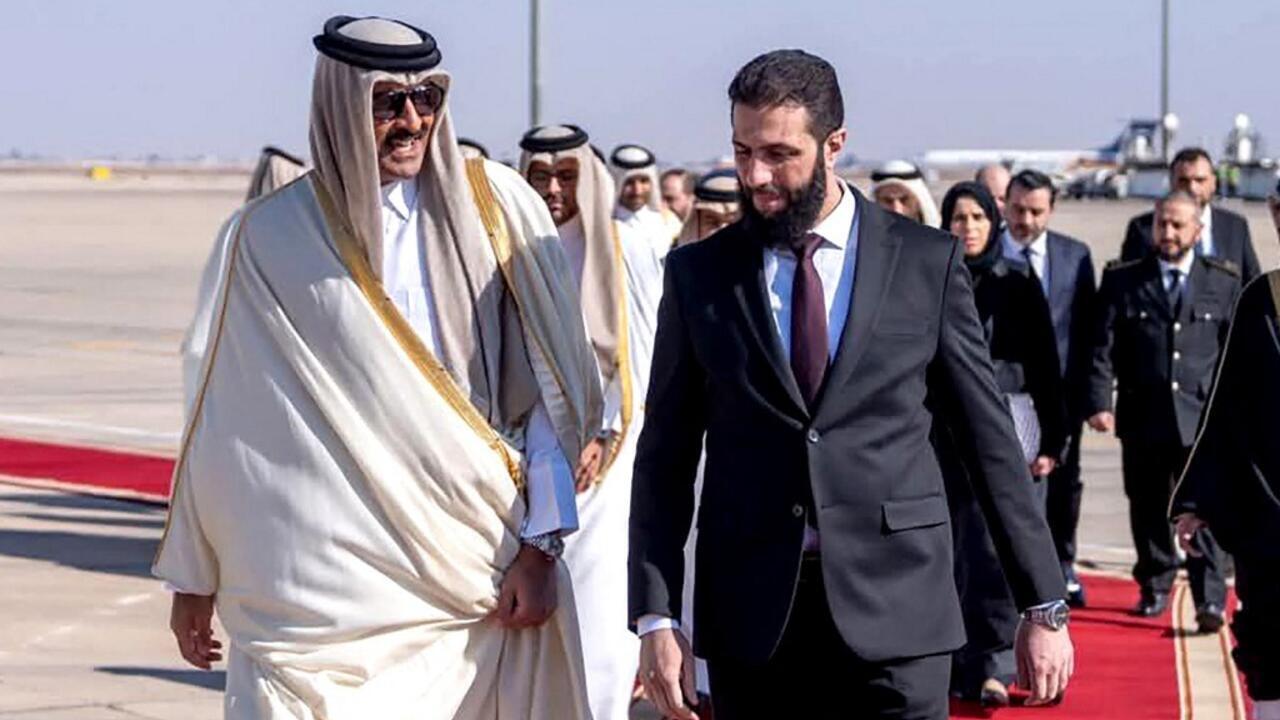
Since the outset of the Liberation Phase, Gulf contributions—concentrated on salaries and essential services—have totalled billions. Yet they remain dwarfed by the $250 billion estimated cost of reconstruction. Emir Tamim’s visit to Damascus heralded further Qatari infrastructure commitments, while the Saudi-Syrian Investment Forum in Riyadh has outlined potential projects valued between $4 billion and $6.4 billion.
Still, these efforts expose a central tension: between short-term liquidity and long-term transformation. Unless tempered by local strategy and institutional reform, openness to foreign aid may soon give way to economic submission.
In Syria’s recovery ledger, the line separating boon from bondage remains perilously thin.
This article was translated and edited by The Syrian Observer. The Syrian Observer has not verified the content of this story. Responsibility for the information and views set out in this article lies entirely with the author.
