
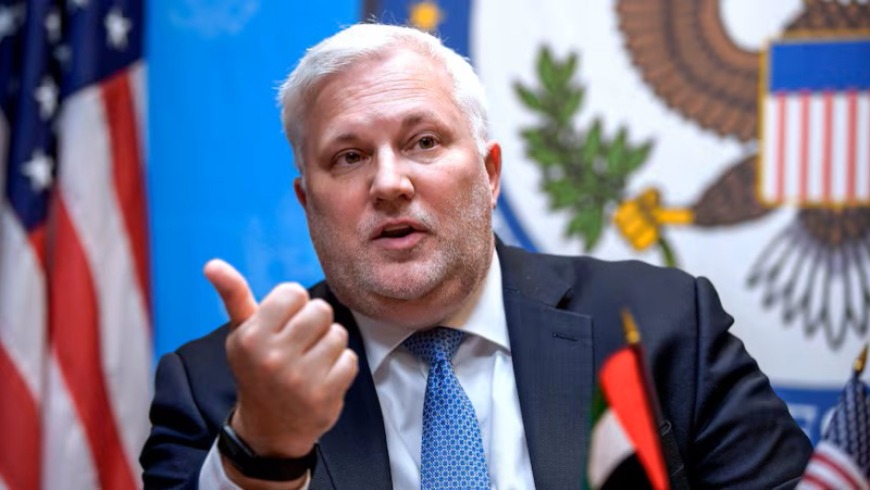
The U.S. Senate Foreign Relations Committee has approved the nomination of Joel Rayburn as Assistant Secretary of State for Near Eastern Affairs, marking a significant return for this seasoned officer and diplomat to a central role in shaping Middle East policy under the Trump administration, with a particular focus on Syria.
Rayburn’s nomination received 15 votes in favour and seven against, clearing the path for full Senate confirmation through a plenary vote.
The administration had initially endorsed Rayburn’s nomination on 11 February this year, referring it to the Foreign Relations Committee, which held a public hearing but delayed a final decision. The process faced repeated postponements due to internal opposition, leaving the nomination in limbo without progression to a Senate-wide vote.
Officer, Historian, and Diplomat
Joel Rayburn is a leading figure in the United States’ approach to Levantine affairs. He currently serves as a Senior Fellow at the Hudson Institute’s Centre for Peace and Security in the Middle East.
His previous roles span diplomatic, military, and academic fields. In early 2021, he advised Senator Bill Hagerty on Middle East affairs, following his tenure as U.S. Special Envoy to Syria from July 2018 to January 2021. He also served as Deputy Assistant Secretary of State for Levantine Affairs until November 2020.
During these appointments, Rayburn oversaw diplomatic teams across the Middle East and Europe and briefly led the U.S. Special Mission to Syria.
These roles followed a 26-year career in the U.S. Army, culminating in his service as senior director for Iran, Iraq, Syria, and Lebanon at the National Security Council from 2017 to 2018.
From 2002 to 2005, he taught history at West Point before advising U.S. Central Command (CENTCOM) leadership and joining the Joint Strategic Assessment Team in Baghdad in 2007.
Subsequently, he held intelligence and advisory roles in Iraq, CENTCOM, and Afghanistan, and served as principal military fellow at the National Strategic Studies Institute. Between 2013 and 2016, he led a team analysing Operation Iraqi Freedom and co-authored the two-volume reference work The U.S. Army in the Iraq War, published in 2018.
Rayburn holds a master’s degree in history from Texas A&M University and another in strategic studies from the National War College. Originally from Oklahoma, he resides in Washington, D.C.
He is also the author of the 2014 book Iraq After America: Strongmen, Sectarians, Resistance, which combines field experience with historical analysis.
This comprehensive background has positioned Rayburn as a key authority on U.S. engagement with Levantine affairs, particularly Syria, making him a central figure for both legislative and executive decision-makers in Washington.
Engagement with Syria and Past Roles in U.S. Administrations
Rayburn’s involvement with the Syrian dossier has been shaped through a succession of pivotal roles. He managed the Iran, Iraq, Syria, and Lebanon portfolios at the National Security Council from 2017 to 2018, during a period of intense military and political flux in Syria.
Upon joining the State Department in July 2018, he became Deputy Assistant Secretary for Levantine Affairs and was later appointed Special Envoy to Syria. In this capacity, he directly oversaw U.S. diplomatic engagement with the Syrian crisis, managing teams of over 100 diplomats and civilian staff across capitals in the Middle East and Europe.
From November 2020 to January 2021, Rayburn also served as head of the U.S. Special Mission to Syria during a politically sensitive transition period in Washington.
Rayburn’s approach to the Syrian file has consistently revolved around three core principles: applying economic and legal pressure on the Assad regime through the Caesar Syria Civilian Protection Act and sanctions; promoting accountability for war crimes and justice mechanisms; and resisting normalisation with the regime absent substantive behavioural change and compliance with UN resolutions.
He has testified before Congress on numerous occasions, offering analysis on the risks of a policy vacuum in Syria, and addressing concerns related to terrorism, refugees, chemical weapons, and the region’s expanding narcotics trade. He has also warned of Iranian and Russian exploitation of Syria as a platform to destabilise regional order and challenge U.S. interests.
Following his departure from government, Rayburn continued his policy and academic work at the Hudson Institute, contributing to initiatives focused on regional stability.
With his 2025 renomination, Rayburn has reasserted himself as a leading advocate for a recalibrated U.S. strategy in Syria and the wider Middle East, even as his confirmation remains pending in the Senate.
Congressional Testimony: Syria Policy and Strategic Lessons
On 18 April 2023, Joel Rayburn gave extensive testimony before the House Foreign Affairs Committee during a session titled 12 Years of Terror: Assad’s War Crimes and U.S. Policy Toward Accountability in Syria.
This testimony laid out a comprehensive framework combining deterrence and economic pressure with justice mechanisms, aimed at preventing a strategic vacuum exploitable by adversaries seeking to reshape regional dynamics.
The key pillars of Rayburn’s vision for U.S. Syria policy are summarised below:
Understanding the Syrian Threat and Its Cross-Border Implications
Rayburn emphasised that a minimalist approach to Syria is untenable, citing the threat of cross-border terrorism, the largest refugee crisis in decades, and the regime’s continued use of banned warfare tactics—all posing direct risks to the U.S. and its allies.
He viewed the expansion of Iranian proxies, Russia’s entrenched military presence, and the booming Captagon drug trade as indicators that inaction could trigger deeper instability.
Accountability and Reinforcement of Sanctions
Rayburn urged robust enforcement of the Caesar Act, including the expansion of its reach to regime-linked networks and their partners within and outside Syria—particularly Russian and Iranian entities and regional financial fronts. He criticised existing loopholes in temporary licenses that, in his view, have weakened pressure without delivering corresponding humanitarian or political returns.
He warned that unchecked aid flows through Damascus have entrenched the war economy. He also advocated for the creation of an international tribunal on Syrian war crimes, backed by enhanced international evidence-sharing.
Rejecting Unconditional Normalisation with Assad
Rayburn opposed any move to reintegrate the Assad regime into Arab or international circles without clear behavioral reforms and compliance with international legal norms. He warned that leniency undermines deterrence, disorients allies, and creates irreversible faits accomplis.
He called on Congress to pass legislation blocking institutional-level normalisation by introducing targeted sanctions, compelling the administration to pursue a coordinated anti-normalization strategy.
Integrating Syria into Broader Geostrategic Frameworks
Rayburn argued that Syria policy should be aligned with deterrence efforts targeting Russia and Iran, identifying the Syrian theatre as both a front line in great-power competition and a conduit for Tehran’s proxy influence.
He proposed using legal tools to penalize firms and individuals linked to Russia’s military operations in Syria, thereby applying indirect pressure on Moscow across multiple strategic arenas.
Rayburn’s testimony outlines a firm doctrine on Syria: combining escalated legal and economic pressure, dismantling financing and evasion networks, advancing judicial and diplomatic tracks, and denying legitimacy to unilateral actions unless accompanied by meaningful political cost.
This article was translated and edited by The Syrian Observer. The Syrian Observer has not verified the content of this story. Responsibility for the information and views set out in this article lies entirely with the author.