
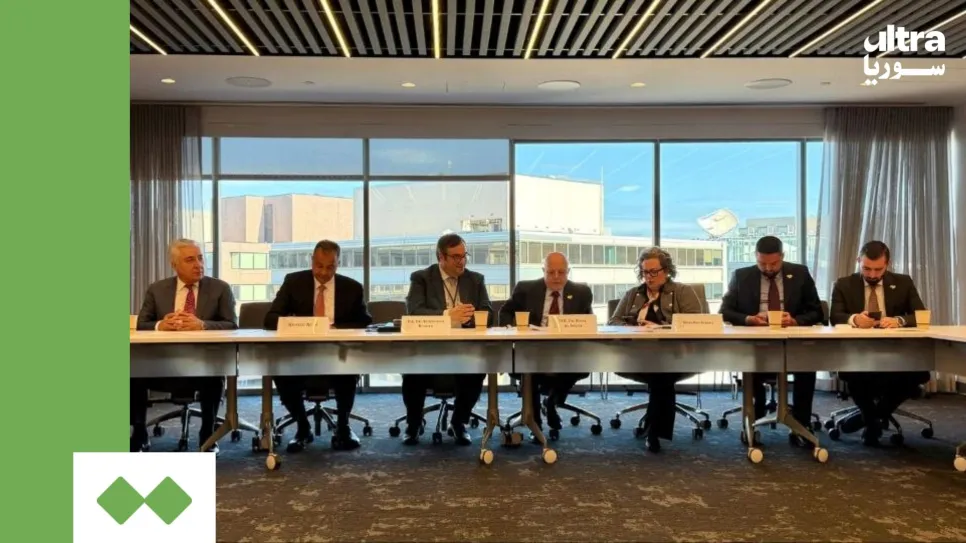
A senior Syrian delegation has visited Washington for high-level talks, marking a significant step in the country’s efforts to reintegrate into the global economy. The delegation included Economy and Industry Minister Muhammad Nidal al-Shaar, Finance Minister Muhammad Yasser Barniya, and Central Bank Governor Abdul Qader al-Husaria.
The visit aimed to engage with officials from the US Treasury Department and the World Bank to promote banking transparency, combat terrorism financing, and modernise Syria’s financial system in line with international standards. It is the first such initiative since sanctions were lifted in March 2025.
In efforts to rebuild international confidence, Governor Husaria held a series of meetings with US Treasury Assistant Secretary Anna Morris. Discussions focused on reforming Syria’s banking sector and fostering global partnerships. Husaria described the meetings as “fruitful”, noting US support for integrating Syria’s financial system into global markets.
“This step will bolster confidence in our economy and open new horizons for international cooperation,” he said, while acknowledging the deep economic challenges Syria continues to face after years of conflict and sanctions.
Simultaneously, Minister Barniya met with World Bank representatives to secure developmental funding for economic restructuring and financial stability.
“We are optimistic about increased US support to address the economic challenges facing our country,” Barniya stated. “Cooperation with the World Bank will soon begin through programmes that support reconstruction and enhance economic stability.”
A Series of High-Level Economic Engagements
The US-Syria Business Council, chaired by Syrian-American businessman and Damascus Chamber of Commerce President Issam Zuhair Ghreiwati, played a key role in organising the visit. The meetings aimed to strengthen economic partnerships and attract foreign investment as part of a broader strategy to position Syria as a regional trade hub.
In a statement to Enab Baladi, Ghreiwati said: “The US-Syria Business Council has played an active role in arranging a series of high-level economic meetings during the official visit of His Excellency Economy and Industry Minister Dr Nidal al-Shaar to the United States.”
He noted that the visit sought to “explore ways to bolster economic cooperation, rebuild international partnerships, and improve trade exchange in the post-sanctions era”. Expanded meetings, organised by the Council at the Middle East Institute in Washington, brought together representatives from investment banks and leading corporations.
Discussions focused on creating a sustainable economic model that positions Syria as a bridge between East and West, with an emphasis on technology transfer and attracting foreign capital.
The delegation also met with representatives from the Atlantic Council, the US Department of Commerce, the World Economic Forum, and several members of Congress. Talks addressed the easing of trade restrictions, stimulating US investment, and developing a business environment aligned with ongoing economic reforms.
Minister Shaar described the visit as a strategic step towards cementing economic partnerships with the United States. Ghreiwati expressed optimism that these efforts marked the beginning of Syria’s re-emergence in global markets.
Reshaping the Syrian Economy: A Comprehensive Vision
Economist Adham Qudaimati told Enab Baladi that Syria’s economy stands on the brink of structural transformation, driven by international cooperation and legal reforms designed to attract investment.
“Syria’s economy is entering a new phase marked by cooperation with states that hold significant global and regional economic influence,” he said, noting that the impact extends beyond the stability of the Syrian pound to the broader economic structure.
He explained that while the Syrian pound would not be pegged to the US dollar, the country’s reserves would be backed primarily by gold and precious metals. Syria is also working to create a diversified currency basket to reduce dependence on direct US financial support.
Qudaimati said the World Bank’s programmes and international agreements would be central to reforming investment regulations and diversifying the economy. These efforts, he added, would enhance transparency and competitiveness, making Syria more attractive to foreign investors.
He identified two key challenges: aligning domestic laws with international standards, and upgrading financial infrastructure to integrate with global systems.
“Economic growth rates depend on political stability, territorial unity, and the implementation of domestic political agreements,” he said. “Signed agreements between Syria, foreign governments, and international firms will contribute to reconstruction and genuine economic growth.”
Building Trust and Tackling Social Challenges
Dr Samer al-Safadi, a member of the Syrian-American Alliance, described the US Treasury talks as a turning point in Syrian-American relations. He said the Alliance is committed to advancing transparency and tackling the social challenges caused by years of war and sanctions.
“These discussions represent a qualitative leap in building trust between Syria and the United States after decades of isolation,” al-Safadi told Enab Baladi. “Syria aims to build a financial system inspired by the US model, adapted to local conditions, to enhance transparency and reduce terrorism financing risks.”
He added that the Syrian-American Alliance is working with the US Treasury to implement international standards for combating money laundering and terrorism financing. The goal is to restore Syria’s credibility following its removal from the US list of state sponsors of terrorism.
Safadi said NGOs like the Alliance are supporting World Bank programmes by contributing field reports, implementing small-scale projects, and training Syrian professionals in banking transparency. These efforts, he explained, turn security challenges into opportunities, particularly through digital finance and international partnerships.
However, he cautioned that Syria’s global reintegration must also address social and cultural obstacles, such as widespread poverty, deteriorating living conditions, and a psychologically scarred population.
He concluded: “Current cooperation with the US Treasury and the World Bank can help overcome these challenges by enabling unrestricted financial transfers, establishing vocational and language training programmes, and attracting American investment.” He emphasised the importance of improving financial literacy to support integration and long-term stability, pledging that the Alliance is dedicated to building an inclusive economy that benefits all segments of Syrian society.
This article was translated and edited by The Syrian Observer. The Syrian Observer has not verified the content of this story. Responsibility for the information and views set out in this article lies entirely with the author.
