
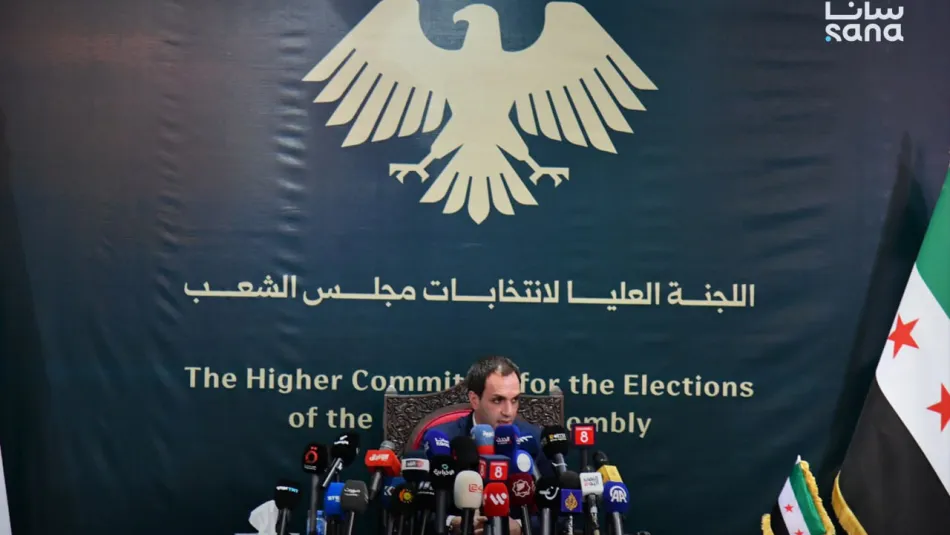
The spokesperson for the Higher Committee for People’s Assembly Elections, Nawar Najmeh, announced that the Christian community obtained only two seats among all the winning candidates in the parliamentary elections, stressing that President Ahmad al-Sharaa would take steps to address and rectify these shortcomings.
Najmeh made the remarks during a press conference on Monday, where he officially announced the final results of the Syrian parliamentary elections, held on Sunday.
War Wounded and Special Representation
Najmeh stated that the Parliament is the official platform for national dialogue among Syrians, and that free and fair elections reflect realism in political life. He noted that the Parliament’s essential role is to support the government and oversee its performance, adding:
“We are facing a critical and revolutionary Parliament that believes in the principles of the revolution.”
He explained that the committee had ensured that people with disabilities and those injured during the Syrian revolution were represented in the elections by 4 percent.
Najmeh admitted, however, that one of the main shortcomings of the electoral process was the unsatisfactory representation of Syrian women, and that the Christian community’s representation—limited to two seats—was weak compared to their population in Syria.
He expressed confidence that President al-Sharaa would take these shortcomings into account and compensate for them when appointing the final one-third of Parliament’s members.
Representation Ratios
Najmeh provided the following statistics on representation among the elected members:
-
96% men
-
4% women
-
83% technocrats / professionals
-
16% notables
-
17% from the medical sector
-
17% engineers
-
14% legal professionals
-
10% economists
-
10% academics
-
7% businessmen
-
7% religious figures
Underrepresented Regions
Najmeh acknowledged that some Syrian regions were “disadvantaged” due to the inability to accurately determine their populations, but said that, overall, representation was based on demographic fairness, with the number of seats allocated according to population size.
He clarified that the one-third of members appointed by the president are not linked to the electoral committees or constituencies.
Najmeh also described the delay in vote counting in Damascus as a positive sign, noting that the committee was committed to avoiding quota-based appointments.
He urged Syrians to work seriously in the next phase, affirming that the committee’s assessment of the elections was positive, having been conducted with “high transparency and integrity.”
“Each elected member of Parliament represents all Syrians, regardless of their affiliation,” he said.
For his part, Mohammad Taha al-Ahmad, the Chairman of the Higher Committee for Elections, stated that 119 Syrians were elected, emphasizing that what the country needs now is not quota-based representation, but people capable of working and building.
Background
The People’s Assembly elections were held on Sunday across 11 Syrian provinces, forming the first Parliament after the fall of the Assad regime.
A total of 1,578 candidates competed for 140 of the 210 parliamentary seats, while the remaining 70 members will be appointed by President Ahmad al-Sharaa.
This article was translated and edited by The Syrian Observer. The Syrian Observer has not verified the content of this story. Responsibility for the information and views set out in this article lies entirely with the author.