
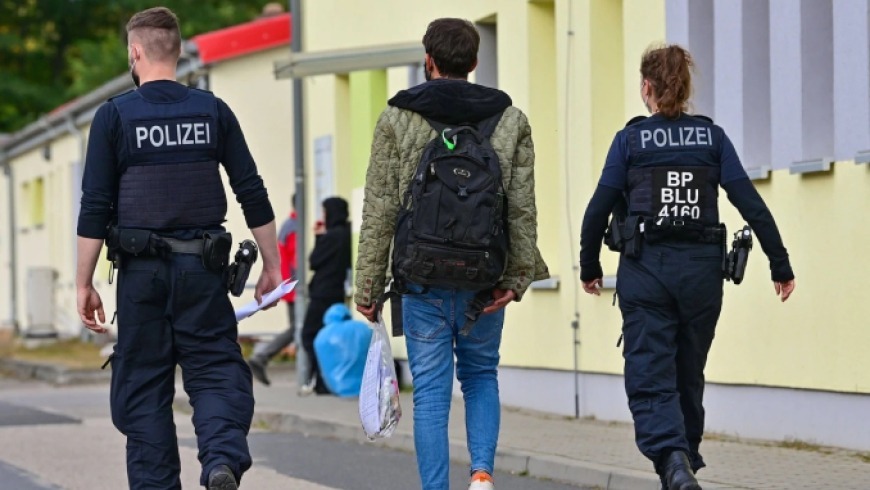
Germany has recorded a notable rise in the number of refugees voluntarily returning to their home countries—particularly Syria—amid shifting conditions on the ground and renewed government support programs offering financial and logistical assistance.
According to a spokesperson for the Federal Office for Migration and Refugees (BAMF), 16,576 refugees made use of state-funded return programs in 2025, whether to their countries of origin or to third countries. The spokesperson, speaking to the Funke media group, noted that this figure represents an increase of 6,218 people compared to 2024—a rise of roughly 60 percent.
She added that 10,358 asylum seekers left Germany voluntarily with government support in 2024, while the number in 2023 stood at approximately 10,762, indicating a similar level.
6,000 Applications to Return to Syria
Der Spiegel reports that one factor behind the overall increase may be a rise in travel to Syria. Since January 2025, BAMF has reinstated financial support for voluntary return to Syria—a program previously suspended due to the war.
By the end of December, 5,976 people had applied for voluntary return to Syria, and 3,678 had already departed. The spokesperson confirmed that the office is observing “significant interest,” particularly regarding Syria.
The number of Syrian asylum seekers in Germany has declined since the fall of the Assad regime in December 2024. In October, Foreign Minister Johann Wadephul (CDU) faced criticism from within his own party after he questioned, during a visit to Syria, the feasibility of large-scale voluntary returns.
Germany supports voluntary return through the REAG/GARP program, which covers travel costs and provides financial assistance of €1,000 per adult and €500 per child.
Austria Moves to Expand Deportations to Syria After Talks in Damascus
Austria, meanwhile, is taking a more assertive approach. Following official talks in Damascus, the Austrian government announced plans to expand deportations to Syria.
A high-level delegation led by Ambassador Arved Benko, the Foreign Ministry’s Special Envoy to the Middle East, met with Syrian Interior Minister Anas Khattab. According to the Austrian Foreign Ministry, discussions—also involving interior ministry officials—focused on the repatriation of asylum seekers with criminal convictions and on establishing practical cooperation mechanisms between the relevant authorities, as reported by the Austrian Press Agency.
Foreign Minister Beate Meinl-Reisinger (Neos) stated:
“We have agreed within the government to take a firm stance against anyone who does not have the right to stay in Austria or who abuses this right. Through such cooperation, we are establishing the necessary frameworks to achieve this.”
Austria Intensifies Deportations
Interior Minister Gerhard Karner (ÖVP) recently noted that Austria became the first EU country to resume deportations to Syria in 2025—an approach later adopted by several other European states.
According to a United Nations assessment, certain areas in Syria are now considered safe. Austria aims to intensify deportations to those regions while working to ensure adequate humanitarian support in designated “safe zones” through cooperation with local authorities.
EU Maintains a Cautious Position
In contrast, EU Commissioner Magnus Brunner told the German Press Agency that “Syria is still considered an unsafe country under EU rules.” He added:
“We are not yet at a stage of stability in Syria that would allow for large-scale deportations.”
Brunner clarified that, aside from individuals with criminal convictions, the current European approach remains limited to encouraging voluntary returns. He noted that Frontex has supported the voluntary return of thousands of Syrians and that the EU’s asylum agency has reported improvements in conditions inside Syria.
This article was translated and edited by The Syrian Observer. The Syrian Observer has not verified the content of this story. Responsibility for the information and views set out in this article lies entirely with the author.