
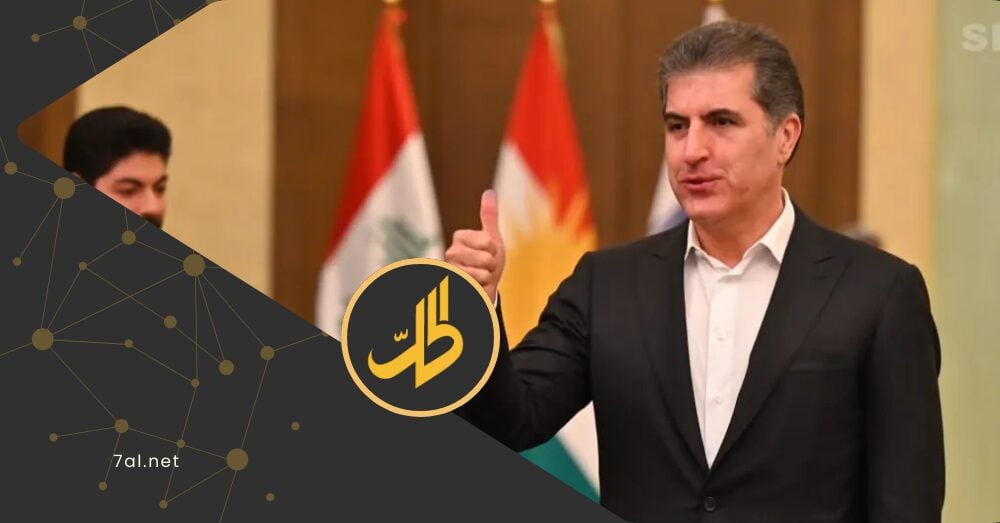
The French daily Le Monde has revealed that Nechirvan Barzani, President of the Kurdistan Region, played a decisive and central role in securing the ceasefire and political understanding between Syria’s transitional government and the Syrian Democratic Forces (SDF).
In a report published Saturday, the newspaper noted that the agreement signed on 30 January 2026 followed weeks of clashes and military tension in northeastern Syria. It helped avert the prospect of a broader confrontation that could have reshaped the military landscape at a moment when the country continues to struggle with deep security fragility and entrenched institutional division.
According to the report, the mediation effort was not unilateral. The United States and France worked alongside the Kurdistan Region to shape a negotiated track aimed at preventing further escalation and laying the foundation for a gradual integration of military and administrative structures into the Syrian state.
Barzani: A Unified Syria with Constitutional Guarantees
Le Monde quoted Nechirvan Barzani as saying that the agreement should serve as “an entry point to rebuilding a unified Syria, in which the rights of the Kurdish people and all other components are safeguarded within the forthcoming constitution.”
Ilham Ahmed, a senior figure in the Autonomous Administration, expressed gratitude to the international and regional mediators. She described the agreement as an opportunity to spare the region another internal war, according to the French report.
The newspaper assessed that the accord granted Damascus a clear sovereign advantage through the restoration of control over Arab-majority areas, oil fields, and key crossings. At the same time, it acknowledged political and cultural gains for the Kurds. These include recognition of the Kurdish language as a national language in schools, the designation of Nowruz as an official national holiday, resolution of the citizenship status of thousands of Kurds affected by the 1962 census, and the integration of SDF and Asayish forces into the Ministries of Defense and Interior within designated brigades.
From Paper to Practice
On the ground, the agreement has begun to translate into concrete steps. Al-Majalla reported that Syrian Public Security forces are set to enter the security perimeters in al-Hasakah and Qamishli beginning Monday as part of the first phase of implementation.
According to the report, fifteen Public Security vehicles will enter the two cities. A second phase, extending over one month, will cover Qamishli International Airport, the Semalka crossing, and the Rmeilan and Sweidiyeh oil fields, in preparation for the full integration of security and administrative institutions.
In parallel, a telephone call took place between Masoud Barzani and Mazloum Abdi, during which they discussed mechanisms for implementing the agreement, emphasized resolving disputes through dialogue, and reaffirmed the importance of stabilizing northeastern Syria.
President Ahmad al-Sharaa also held separate discussions with both Barzani and French President Emmanuel Macron regarding the agreement, reinforcing its political backing at regional and European levels.
Military and Administrative Arrangements
Militarily, the agreement provides for the formation of a new division composed of three SDF brigades, along with a special brigade drawn from the forces of Ayn al-Arab (Kobani) to be attached to a division within Aleppo province.
Administratively, the institutions of the Autonomous Administration will be integrated into state structures, with civil employees retained in their posts to ensure continuity of public services. This reflects an effort by Damascus to reassure the local population and avoid a sudden administrative vacuum.
Beyond the Agreement: Deferred Questions
Despite cautious international endorsement, observers note that the agreement opens a narrow political window rather than establishing a final settlement. Sensitive files remain unresolved, including the precise shape of decentralization, guarantees against a return to purely security-based governance, and the role of international actors in monitoring implementation.
In a country exhausted by successive experiments, Syrians appear less inclined toward optimism and more inclined toward testing realities. Recent history has taught them that agreements in Syria often begin with abundant ink and end with limited endurance.
This article was translated and edited by The Syrian Observer. The Syrian Observer has not verified the content of this story. Responsibility for the information and views set out in this article lies entirely with the author.