
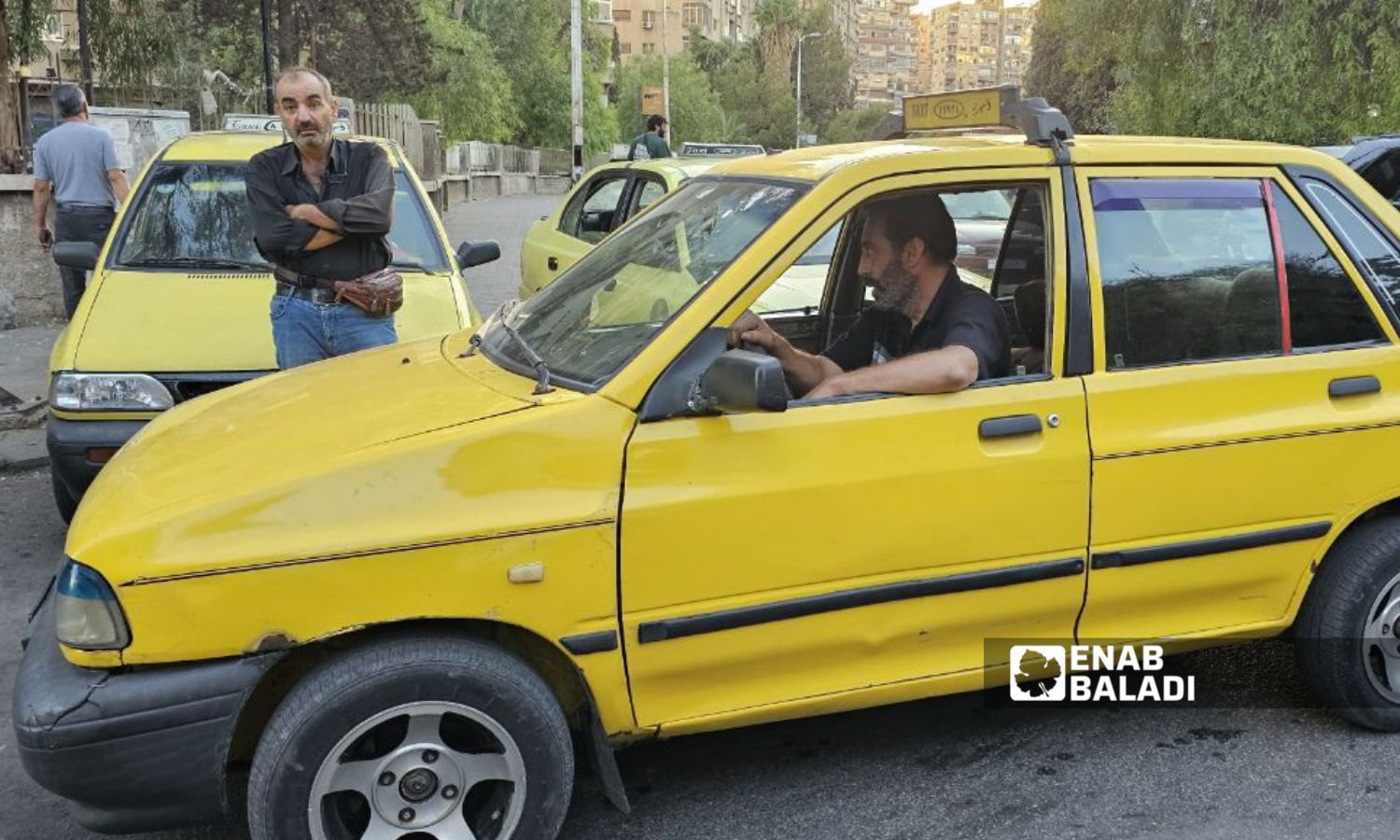
Taxi drivers in Damascus are facing a sharp decline in their work, as their profession no longer meets even the minimum of their daily needs. Most public taxis have long exceeded their operational lifespan and have become a constant financial burden due to frequent breakdowns and costly repairs. Drivers, meanwhile, are unable to replace or renew their vehicles.
Adding to these difficulties, drivers are also facing growing competition from private cars and ride-hailing apps, which attract passengers by offering more comfortable service and clearer pricing—leaving traditional taxi drivers with fewer customers.
Old Vehicles, Unbearable Burdens
Most taxis in Damascus have been in service for over 20 years, turning them into a liability both for their owners and for passengers.
Frequent breakdowns have become part of daily life for drivers, while repair costs continue to rise beyond their means.
“Every week, I have to fix something—one day it’s the engine, another the wiring, then the gearbox. I don’t work to feed my children anymore; I work to pay the repair shop,” said Mohammad Hussein, who has been a taxi driver in Damascus for 30 years.
Mohammad, who has no other source of income, is forced to work from early morning until sunset to complete at best three rides a day.
Even though car prices have slightly dropped in Syria since the fall of the previous regime, they remain far beyond drivers’ reach. Buying a used car in decent condition requires about 10 million Syrian pounds, an amount impossible for a driver whose daily earnings barely cover his family’s basic needs.
Another driver, Firas Dayoub, who has been in the profession for 18 years, summarized the collective suffering: the repeated maintenance costs, and the unaffordable price of even used cars in good condition. As a result, drivers are forced to keep using their aging vehicles, even when they can barely make it through Damascus’ crowded and deteriorating streets.
When Enab Baladi contacted the Syrian Ministry of Transport for clarification on whether new conditions would be imposed during the licensing inspection of public taxis, no response had been received at the time of publication.
Chaotic Fares and Missing Meters
What most frustrates passengers in Damascus is the chaos surrounding taxi fares. While a short trip may cost 30,000 pounds, the same route on a ride-hailing app may cost half that amount—around 15,000 pounds.
Worse still, each driver charges a different rate for the same distance. For example, a trip from Bab Sharqi to Mezzeh could cost 50,000 pounds with one driver and 60,000 with another.
Driver Firas Dayoub justified these inconsistencies by pointing to the economic situation and the soaring prices of spare parts, oil, and fuel, which rise daily. “We’re not exaggerating our prices,” he said. “We’re just trying to cover the basic running costs of the car.”
Driver Mazen Awad added that a trip costing the passenger 30,000 pounds might see half that amount spent on fuel alone. According to him, drivers have no choice but to set their own rates to stay afloat.
Omar Kattan, director of the Public Transport Authority, said in a previous statement to Enab Baladi that there is a systemic failure among taxi drivers to use their meters, mainly due to the lack of oversight by authorities during the former regime, which opened the door to widespread irregularities.
Drivers’ Demands
Taxi drivers have unified their demands, calling for strict enforcement of the law to prevent private cars from operating as taxis and for stronger monitoring of violations.
They say they are not opposed to a fair fare system, as long as it reflects fuel and maintenance costs.Their main demands include:
• Effective monitoring and enforcement: stopping unlicensed private cars from operating as taxis.
• Restricting out-of-town taxis: preventing cars from other provinces from working illegally in Damascus.
• Protecting livelihoods: ensuring the continuity of a profession that supports thousands of families.
Future Plans
Public Transport Authority Director Omar Kattan told Enab Baladi that a comprehensive plan is underway to regulate and modernize taxi operations, requiring drivers to activate their meters—or install them if absent—and prohibiting any fare that does not match the meter reading, under penalty of law.
He also urged citizens to report violations through the official complaint system, which now features QR codes on public transport vehicles allowing passengers to file complaints directly. These are handled by a specialized office that responds with results.
The Public Transport Authority is preparing a modernization plan for the entire transport network, introducing environmentally friendly vehicles and a unified electronic fare system through integrated digital applications. This system aims to ensure fair pricing, simplify digital transactions, and connect all transport modes through an advanced technological platform, according to Kattan.
This article was translated and edited by The Syrian Observer. The Syrian Observer has not verified the content of this story. Responsibility for the information and views set out in this article lies entirely with the author.