
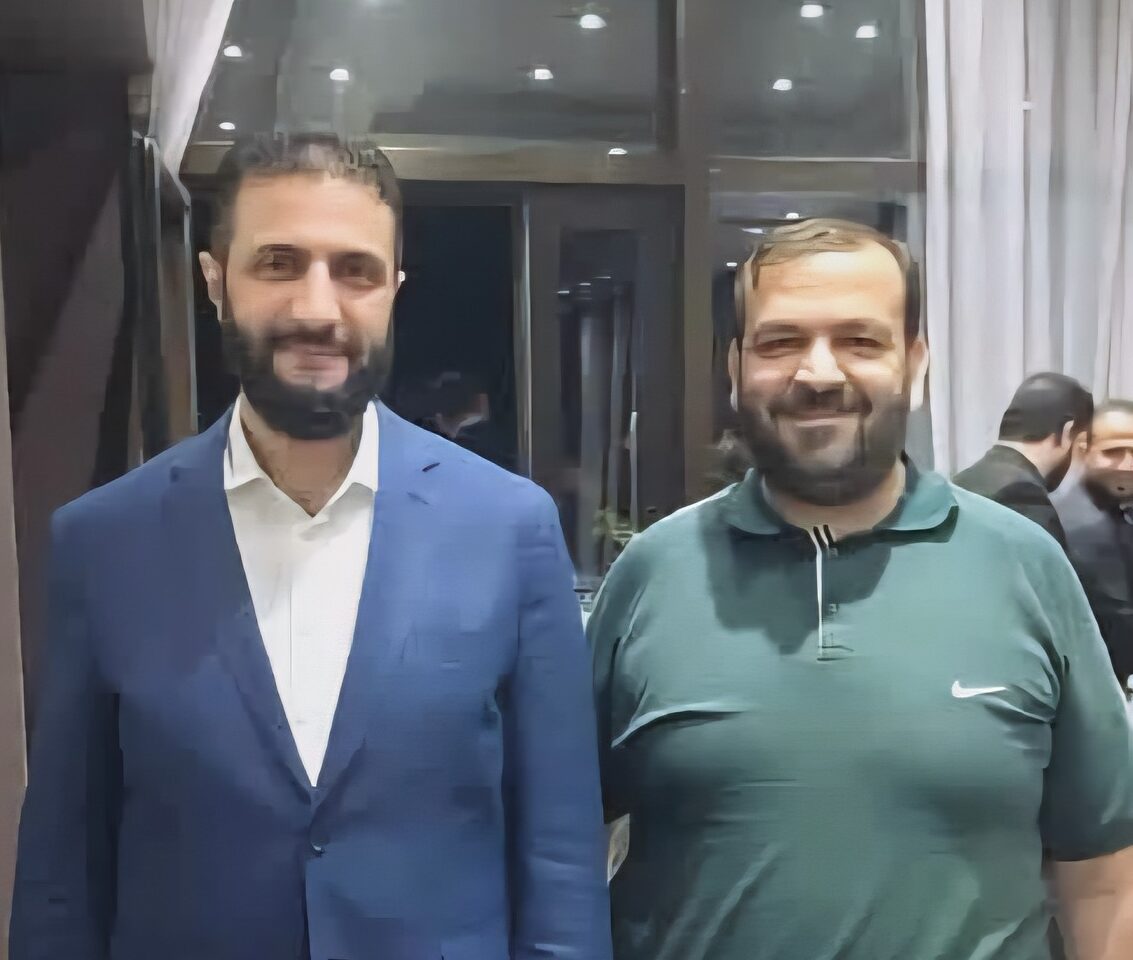
The Syrian arena witnessed a remarkable development with reports of a reconciliation between Syrian President Ahmad Al-Sharaa (formerly known as Abu Mohammad al-Jolani) and former senior Jabhat al-Nusra commander Jihad Issa al-Sheikh, known by his nom de guerre “Abu Ahmad Zukour.” Various sources circulated that the reconciliation included Zukour’s appointment to an official position as “Deputy to the President of the Republic,” a move that sparked widespread controversy among Syrians, particularly in Idlib and among Jolani’s former opponents.
Historical Background
Abu Ahmad Zukour is considered one of the original founders of Jabhat al-Nusra, alongside Jolani, Saleh al-Hamwi, Abu Maria al-Qahtani, and others. He was best known for his pivotal role in media operations through the platform Idlib Post, which published documents and audio recordings exposing the practices of Jolani’s “electronic army” and smear campaigns against his rivals. These leaks were at the time considered a serious threat to Jolani’s leadership and nearly undermined his position.
Zukour’s name also became tied to public criticism of Jolani’s policies, accusing him of monopolizing power, carrying out arbitrary arrests and torture, and maintaining questionable ties with foreign actors. On several occasions, Zukour declared that Jolani’s continued leadership of Hay’at Tahrir al-Sham posed a danger to the Syrian revolution and its achievements.
Rising Tensions
Tensions between the two men reached their peak in 2024, when Jolani arrested Zukour in a move that nearly ended in his elimination, before Turkish forces intervened to stop the operation, with the direct involvement of faction leaders including Abu Amsha. This intervention prevented his death but reinforced the perception among observers that Zukour still held sensitive leverage over Jolani due to his previous role and proximity to the leadership circle.
Implications of the Reconciliation
The renewal of ties between the two figures, at this particular moment, carries several implications:
- Domestically, it revives historic disputes within the structure of Jabhat al-Nusra and its offshoots, especially following the assassination of Abu Maria al-Qahtani and the departure of Saleh al-Hamwi.
- Politically, the reconciliation suggests that Syria’s new leadership seeks to contain former rivals and recycle some of them into the institutions of the emerging state.
- In the media, the development has stirred wide debate on social media, with opinions divided between those who view it as a pragmatic step to unify ranks and others who see it as a new scandal exposing the fragility of the former armed opposition’s internal structure.
The reconciliation between Sharaa and Zukour is not a passing incident but rather a milestone that reveals a reshaping of power balances in northern Syria, as well as the challenges facing the new government in Damascus in its pursuit of legitimacy. It also brings back to the forefront longstanding questions about the nature of relations within former jihadist currents, and the future of figures tied to a tumultuous stage of the Syrian conflict.
This article was translated and edited by The Syrian Observer. The Syrian Observer has not verified the content of this story. Responsibility for the information and views set out in this article lies entirely with the author.
