
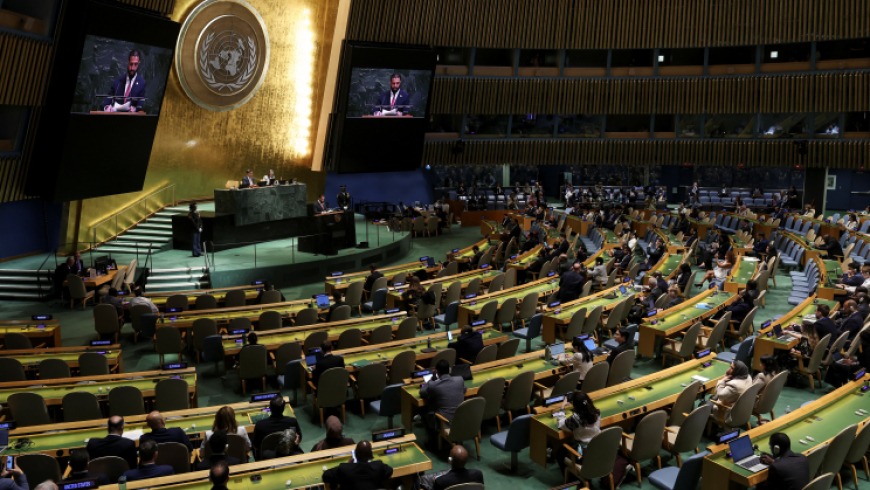
Syria’s Permanent Representative to the United Nations, Ibrahim al-Olabi, reaffirmed on Thursday that the Kurdish community and northeastern Syria are “an inseparable part” of the Syrian state, urging accelerated efforts to integrate the Syrian Democratic Forces (SDF) into the country’s governmental institutions. Speaking to Rudaw media network on the sidelines of the 80th UN General Assembly in New York, al-Olabi expressed frustration over the slow implementation of a landmark agreement signed earlier this year, warning that decentralized ambitions within certain organizations could lead to fragmentation.
Al-Olabi highlighted the historic significance of the March 10, 2025, agreement between Syrian President Ahmed Sharaa and SDF commander Mazloum Abdi, describing it as the first instance of a prominent Kurdish military leader visiting Damascus for formal talks, complete with photographs and a signed accord. The deal, mediated with U.S. and Turkish backing, aims to merge SDF-controlled civilian and military structures in northeastern Syria—including border crossings, airports, and oil and gas fields—into the central government’s framework, while guaranteeing Kurdish rights to representation and participation regardless of ethnicity or religion. It also stipulates a nationwide ceasefire and the return of displaced persons, with executive committees tasked to oversee implementation by year’s end.
However, al-Olabi voiced disappointment at the pace of progress, calling it “frustrating.” He noted that organizations like the SDF “cannot control all their members” and harbor “decentralized ambitions,” which he equated to internal divisions that threaten national cohesion. This comes amid ongoing challenges, including the integration of SDF fighters into the Syrian Arab Army and ensuring localized defense roles within a federal structure, as outlined in post-agreement talks. Experts have warned that delays could exacerbate regional tensions, particularly with Turkey viewing the SDF as an extension of the Kurdistan Workers’ Party (PKK), a designated terrorist group.
On the question of minority representation in Syria’s UN delegation, al-Olabi emphasized its diversity, selected not on sectarian lines but based on commitment to an “inclusive and diverse Syria.” As a human rights lawyer and former UK-based activist appointed in August 2025, al-Olabi himself symbolizes the transitional government’s push for inclusivity. Educated in Britain and called to the Bar in England and Wales, he has advocated for accountability on Syrian chemical weapons and provided legal training amid the conflict.
Diplomatic Outreach: Al-Shibani’s Washington Talks
In parallel efforts to bolster international ties, Syrian Foreign Minister Asaad al-Shibani met with U.S. Deputy Secretary of State Christopher Landau and Special Envoy for Syria Thomas Barrack in Washington on September 19, marking the first such visit by a Syrian foreign minister in over 25 years. The discussions focused on the future of Syria, bilateral relations, Israel-Syria dynamics, and—crucially—the implementation of the March 10 agreement with the SDF.
The U.S. State Department described the meeting as an opportunity to address Syria’s post-Assad transition, with emphasis on stabilizing the northeast and countering remnants of the former regime and ISIS threats. Al-Shibani’s trip, which included raising the new Syrian flag at the embassy in Washington, underscores Damascus’s renewed diplomatic push following the regime’s fall in December 2024. During the visit, al-Shibani also engaged with U.S. lawmakers and the U.S. Commission on International Religious Freedom, pledging cooperation on reforms and minority protections.
The timing of these engagements aligns with President al-Sharaa’s UN address on September 24, where he called for sanctions relief and international support for reconstruction, blending “pain with hope” in Syria’s journey toward unity. As al-Olabi navigates UN corridors, his Rudaw interview signals a delicate balancing act: fostering trust with Kurdish stakeholders while resisting centrifugal forces that could unravel the fragile March accord.
For Syria’s transitional authorities, these steps represent progress toward a decentralized yet unified state. Yet, as al-Olabi cautioned, realizing this vision demands swift action to bridge ambitions with national imperatives, lest divisions deepen in a nation still healing from over a decade of war.
This article was translated and edited by The Syrian Observer. The Syrian Observer has not verified the content of this story. Responsibility for the information and views set out in this article lies entirely with the author.