
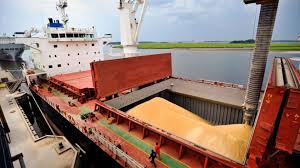
The Syrian General Organization for Maritime and Land Borders announced on Wednesday the arrival of the first direct shipment of agricultural commodities from Europe and South America at the port of Tartous. The development follows a major shift in US policy towards Syria earlier this week.
The vessel MJ Sofia docked in Tartous in the early hours of Wednesday carrying more than 19,000 metric tons of Romanian barley. According to the organisation’s statement, the shipment was supplied by US-based company AD and marks the first consignment to enter Syria directly without transiting through neighbouring countries such as Turkey or Lebanon.
Sanctions Relief but Policy Ambiguity
The arrival comes shortly after the US Department of the Treasury’s Office of Foreign Assets Control (OFAC) announced on Monday the comprehensive termination of the Syrian Sanctions Programme and its removal from the Code of Federal Regulations.
The decision, effective Tuesday, stems from Executive Order 14312 issued by President Donald Trump on 30 June 2025. The order ended the national emergency on Syria declared in 2004 and revoked all previous executive orders that had formed the legal foundation for sanctions.
Despite this move, Washington’s stance remains unclear. Secretary of State Marco Rubio stressed that while the administration would grant sanctions waivers, it did not intend to fully repeal the measures. He emphasised that the core restrictions stem from the Caesar Act, legislation passed by Congress, which remains in force.
These waivers are subject to renewal every 180 days, a stipulation that analysts say could deter investors. The risk of sanctions being reimposed twice a year is seen as a significant barrier to long-term investment and stable flows of commodities into Syria.
Claims of Illicit Grain Imports from Occupied Ukraine
In a parallel development, a Ukrainian investigation has alleged that Russia has resumed grain shipments to Syria, including grain taken from Ukrainian territories under Russian occupation.
Ukrainian platform Latifundist Media identified the dry cargo ship Damas Wave (IMO: 8915299), sailing under the Comoros flag, as having made several trips between the occupied Crimean port of Feodosia and Tartus.
Kateryna Yaresko, an investigative journalist with the SeaKrime project, said this marked the vessel’s third journey carrying Ukrainian grain from occupied regions, describing the practice as “illegal exploitation of agricultural resources.” Marine traffic data showed the ship’s route from Crimea through the Bosphorus Strait, with satellite imagery confirming its movements. The ship reportedly left Tartus for Feodosia on 31 July, loaded a fresh cargo and sailed again for Syria around 15–16 August, with an expected arrival on 22 August.
Earlier this year, Russia’s TASS news agency reported that Moscow had supplied Syria with a one-off shipment of 6,600 tons of wheat, the first since the collapse of the Bashar al-Assad government, in settlement of accumulated debts. That consignment arrived in Lattakia on 20 April aboard the Russian vessel Pola Marina.
Syria’s Worsening Food Security Crisis
These shipments highlight the growing strain on Syria’s food supply. The country is enduring its worst drought in 36 years, which has reduced domestic wheat production by about 40 per cent. The transitional government in Damascus, already short of liquidity, has struggled to secure large-scale imports.
According to Reuters, a Syrian government official confirmed that only 373,500 tons had been purchased from local farmers this season, roughly half of last year’s total. The government is expected to need about 2.55 million tons of imports this year but has yet to announce any major international deals. Instead, it has relied on smaller private shipments totalling around 200,000 tons, arranged through direct contracts with local importers.
The UN World Food Programme (WFP) warned that nearly 3 million Syrians could face severe hunger, noting that more than half of the country’s 25.6 million people are already food insecure. Emergency assistance has so far been limited, with Syria receiving 220,000 tons of wheat from Iraq and 500 tons of flour from Ukraine.
This article was translated and edited by The Syrian Observer. The Syrian Observer has not verified the content of this story. Responsibility for the information and views set out in this article lies entirely with the author.
