
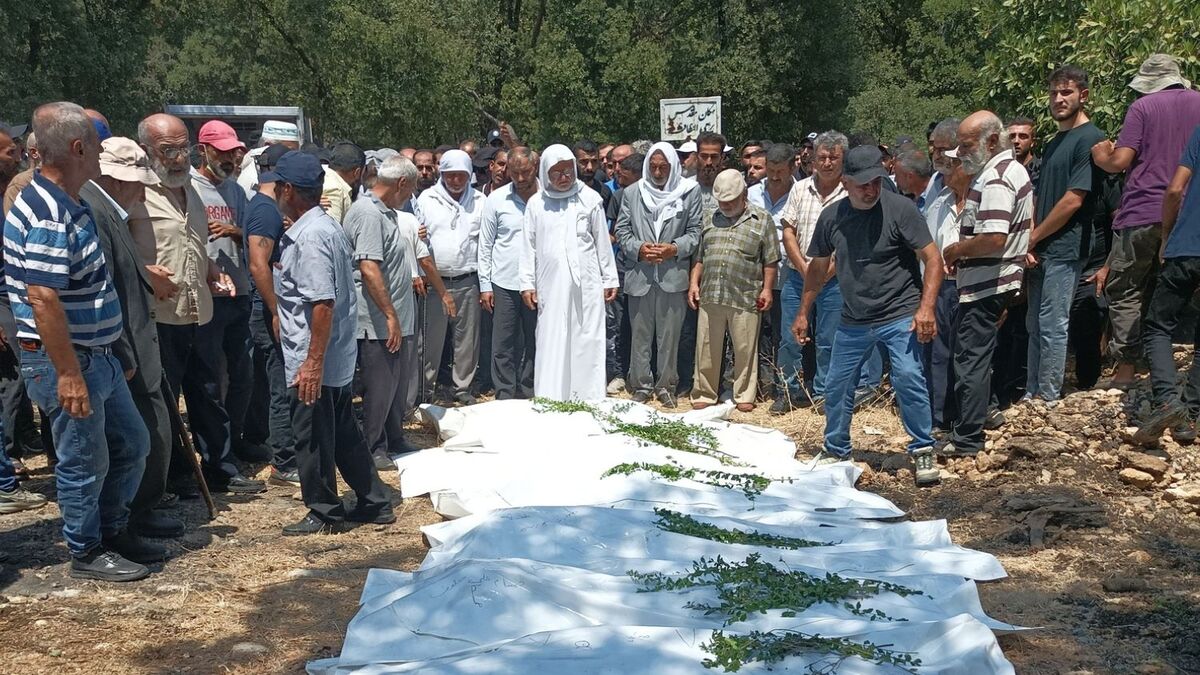
On the evening of 19 August, the Internal Security Branch in Latakia Governorate uncovered a mass grave containing nine bodies near the village of Bastan al-Basha, north of Jableh. The site—situated on farmland owned by Hassan Youssef Younis, a former brigadier pilot in the Assad regime—has been linked to the wave of violence that engulfed Syria’s coastal region in March 2025.
Two medical sources involved in the transfer and examination of the remains confirmed to Enab Baladi that the bodies were identified by local residents during a closed session attended by victims’ families, representatives from the General Security Service, and forensic experts. The victims were buried on 21 August following formal identification.
According to testimonies from family members, the deceased were civilians killed during the coastal unrest earlier this year. Some sources claimed that the farm served as a base for the Sultan Murad Division—a Syrian opposition group previously backed by Turkey in northern Aleppo—during the period in question.
Enab Baladi was unable to independently verify this information.
A judicial source in Jableh stated that the Public Prosecution Office is withholding further details about the victims’ identities and the circumstances surrounding their deaths, citing the “sensitivity of the case.” Meanwhile, the media office of Latakia Governorate referred all queries to the forensic department, declining to confirm which group, if any, controlled the site during the March events.
On 28 May, the European Union imposed sanctions on the Sultan Murad Division, led by Fahim Issa. The measures targeted the group itself but did not include its commander. Sanctions were also extended to the Sultan Suleiman Shah Brigade, led by Mohammad al-Jassem (“Abu Amsha”), and the Hamza Division, formerly commanded by Saif Abu Bakr.
Mohammad Reza Jalkhi, head of Syria’s National Commission for Missing Persons, reported that the commission has documented over 63 mass graves across the country. He estimated the number of missing persons to be between 120,000 and 300,000, noting that the actual figure may be significantly higher due to persistent challenges in documentation and access.
This article was translated and edited by The Syrian Observer. The Syrian Observer has not verified the content of this story. Responsibility for the information and views set out in this article lies entirely with the author.
