
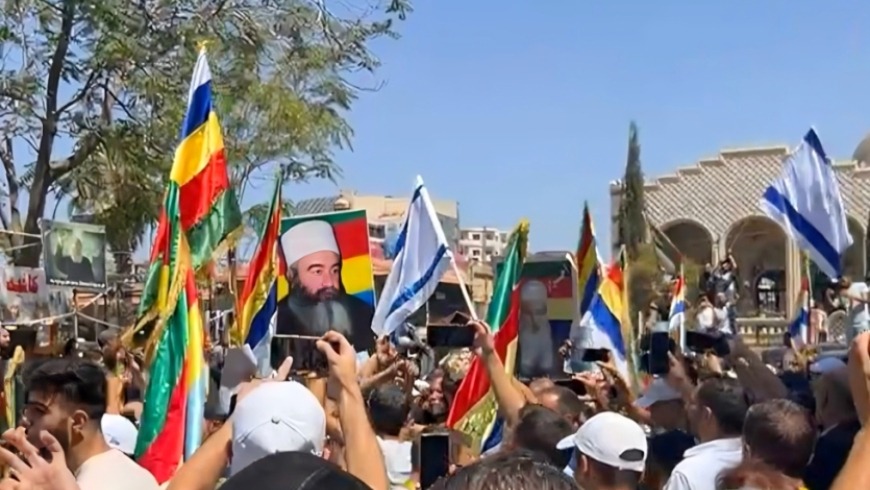
Syria’s southern Suwayda province is experiencing one of its most turbulent moments since the fall of the Assad regime and the formation of the new government. What began as protests for political participation and reform has now escalated into unprecedented calls for full separation from the Syrian state—accompanied by symbols and slogans that have sent shockwaves through the political landscape.
Israeli Flags and Calls for Independence
On Saturday, large crowds rallied in central Suwayda, waving Druze community banners alongside Israeli flags and chanting demands for independence, the expulsion of government forces, and the opening of border crossings. Analysts described the move as a “deliberate detonation” of earlier reconciliation efforts, crossing red lines not previously breached in Syria’s protest history.
The symbolism sparked immediate controversy. While some argued the raised flags reflected desperation and distrust in Damascus, others saw them as evidence of outside influence and separatist agendas.
Government Appeals for Calm
The Syrian government responded by announcing a fact-finding committee and pledging adherence to “diplomatic and conciliatory” solutions. Suwayda governor Mustafa al-Bakour urged dialogue, reconciliation initiatives, and the preservation of national unity, calling civil peace “not a choice, but a necessity.”
Yet demonstrators dismissed these appeals, demanding the complete withdrawal of state security forces and rejecting government-led investigations as biased.
Divided Reactions
In a televised debate on Syria Today, political analyst Hassan al-Daghim described the protests as “an overt separatist project supported by Israel,” accusing prominent Druze cleric Sheikh Hikmat al-Hijri of leading a faction tied to Captagon smuggling networks and remnants of the old regime.
By contrast, legal scholar Bassam al-Ismi argued the unrest reflected “decades of systemic discrimination,” blaming Damascus for deepening sectarian divides and failing to create a shared national identity.
Political commentator Rami Nakhla offered a middle ground, suggesting the protestors’ behavior reflected “fear for their survival and children’s future” more than separatist ambitions, while cautioning against constant accusations of treason that could drive the community further away.
Regional and International Dimensions
Regional actors are closely monitoring the crisis. Security expert Omar al-Raddad noted Jordan’s alarm but confirmed Amman had rejected Israeli mediation to open a humanitarian crossing from Israel into Suwayda. Reports by Axios suggested U.S. involvement in discussions over such a corridor, though Washington has not confirmed the claims.
Analysts warn that what began as a local crisis could quickly be elevated into a regional bargaining chip, with Israel, the United States, and Arab states all potentially drawn into the standoff.
Open Scenarios
Observers point to three possible trajectories: escalation if moderate voices are ignored, containment through genuine reconciliation and political inclusion, or internationalization if outside powers intervene.
For now, Suwayda stands at a crossroads. Whether the crisis leads to deeper fragmentation or paves the way for a new settlement, analysts agree it marks a decisive moment in Syria’s fragile transition.
This article was translated and edited by The Syrian Observer. The Syrian Observer has not verified the content of this story. Responsibility for the information and views set out in this article lies entirely with the author.
