
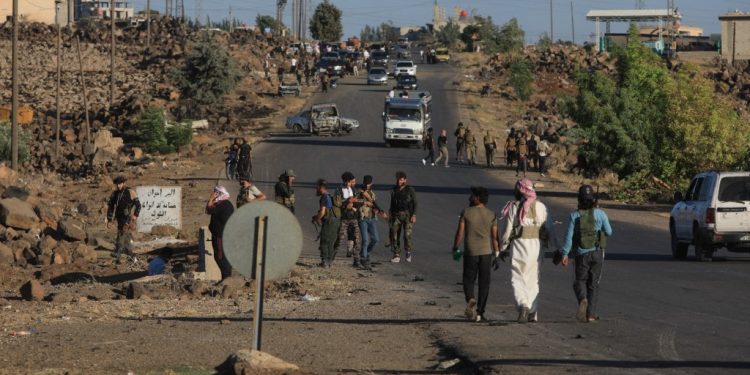
In a long-anticipated press conference held Tuesday in Damascus, Syria’s National Commission for Inquiry into the Coastal Events publicly released the results of its four-month investigation into the March 2025 violence that erupted in the coastal provinces of Lattakia, Tartous, and parts of Hama. The findings, presented by Commission Chairman Judge Jumaa Al-Anzi and spokesman Yasser Al-Farhan, paint a devastating picture of mass killings, widespread abuses, and a near-total breakdown of state authority.
Key Findings: A Massacre in Stages
The report confirms that 1,426 people were killed, including 90 women, with most of the victims being civilians. The Commission attributed the outbreak of violence to coordinated assaults by armed remnants of the former regime, known locally as the “Floul al-Assad”, who launched a broad offensive on March 6, targeting army and security posts, roadblocks, and civilian infrastructure using heavy weaponry. The attack reportedly left 238 members of the military and security forces dead, some of whom were killed after surrendering or while wounded.
Witnesses testified that the attackers committed atrocities such as summary executions, targeting hospitals (six of which were destroyed or disabled), and the murder of Sunni civilians, many of whose identities remain unverified.
Attempt to Partition Syria
According to the Commission, the Floul seized full or partial control of several cities, towns, and highways, laying siege to remaining government facilities. Their goal, the report says, was to “separate the coast from Syria and establish an Alawite state”, a plan allegedly backed by external financing and training.
In response, more than 200,000 pro-government fighters—including official forces, local militias, and unregulated volunteer groups—rushed to the frontlines. Chaos ensued, particularly on March 7, when the Floul ambushed the main convoy heading toward the region, resulting in further bloodshed and disorganization.
The commission verified that the majority of civilian casualties occurred after active combat had ceased, implying that many were killed in reprisal attacks, unauthorized raids, or opportunistic violence.
Criminal Suspects and Patterns of Abuse
The report names 265 individuals affiliated with the Floul as primary suspects in war crimes and serious human rights violations. An additional 298 individuals—members of various military factions that participated in the counteroffensive—are also suspected of crimes, including extrajudicial killings, armed robbery, looting, destruction of property, and torture.
These individuals were identified using a combination of digital evidence, eyewitness testimonies (938 collected in total), and cooperation with the Ministry of Defense, which helped verify images and footage. However, the Commission emphasized that these names were included based on “reasonable suspicion” rather than conclusive legal proof and were submitted confidentially to the public prosecutor.
The Commission found that the abuses were extensive but not systematically organized. Some forces behaved professionally, while others acted with impunity, driven by revenge, sectarian hatred, or criminal intent. Notably, some attackers impersonated security personnel, while others acted as freelance militias, motivated by fear of an Assadist resurgence or personal vendettas. A few suspects were linked to Gypsy clans previously allied with pro-Assad shabiha.
Government Accountability and Structural Weaknesses
The Commission acknowledged that the Syrian government did not directly orchestrate the violations, but noted that its control was either partial or non-existent throughout the events. State institutions failed to prevent atrocities or to restrain undisciplined fighters, exposing the fragility of post-Assad governance in sensitive regions.
The Commission called the March violence the gravest test yet for the transitional government of President Ahmad al-Sharaa, especially in the wake of other violent incidents in Alawite-majority areas such as the coast and Damascus suburbs.
Rebuttal of Kidnapping Claims
Judge Al-Anzi also denied rumors of mass abductions of coastal women, stating that no official complaints—verbal or written—were received. Spokesman Farhan acknowledged isolated cases of criminal kidnappings, noting that some women had since returned, but emphasized that these incidents fell outside the scope of the investigation.
Commission’s Methodology and Cooperation
The Commission visited 33 sites, surveyed mass graves, and engaged with hundreds of local stakeholders, including community leaders and religious figures. It included legal aides from the Alawite community and female relatives of victims to bolster credibility and local engagement. In total, 23 briefings were conducted with government officials, and several detainees were interrogated.
The Commission said it coordinated with international bodies including the UN Special Envoy’s office, OHCHR, Human Rights Watch, and Amnesty International, and operated under strict standards of impartiality, confidentiality, and legal neutrality.
Recommendations: From Disarmament to Transitional Justice
At the conclusion of the press conference, the Commission released a list of recommendations:
- Immediate judicial proceedings against all suspects based on the submitted lists.
- Full implementation of the Ministry of Defense’s May 30 Code of Conduct, stricter enforcement of military dress regulations, and the prohibition of unauthorized weapons sales.
- Launch of reparations programs for victims in accordance with national legal procedures.
- Creation of an independent National Human Rights Commission, alongside the modernization of Syria’s police, army, and judicial institutions.
- Reevaluation of past public-sector dismissals and unlawful appointments, to balance legal reform with social stability.
- Urgent advancement of transitional justice mechanisms, particularly the pursuit of fugitive Assad-era commanders who pose a danger to reconciliation and public order.
- Alignment of Syrian law with international treaties, particularly regarding forced disappearance and protection of human rights.
- Promotion of intercommunal dialogue and civil peace programs, and legislative measures to curb sectarian incitement and hate speech in traditional and social media.
Next Steps
With its mandate concluded, the Commission has handed its findings to President Ahmad al-Sharaa and the Syrian public prosecutor. The burden now shifts to the judiciary and executive to ensure accountability, deliver justice, and restore public trust—especially in communities still reeling from the violence.
Whether the Sharaa government can act decisively on these recommendations without deepening sectarian fractures or losing control of armed factions remains to be seen. But one message rang clear from Tuesday’s press conference: impunity is no longer an option.