
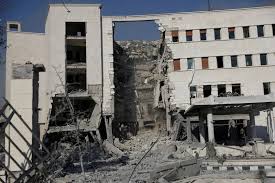
A wave of unprecedented Israeli airstrikes on Damascus late Wednesday night left widespread destruction across the Syrian capital, targeting both military and civilian infrastructure. The General Staff Headquarters suffered the heaviest damage after sustaining a direct hit, but surrounding areas were not spared.
Photos obtained by Syria TV from the scene reveal the extent of the destruction. The glass facade of the National Library was shattered, as were the windows of the nearby Damascus Opera House and neighbouring residential buildings on Qutli Street. The iconic Damascus Sword monument in Umayyad Square was damaged, with its colourful mosaic tiles cracked and nearby billboard panels destroyed. Trees and streetlights lining the roads leading to the square were also impacted by flying shrapnel.
The airstrikes were part of a broader Israeli offensive that struck multiple cities including Suweida and Daraa. The attacks, which continued into the early hours of Thursday with a raid on a military site in Jableh, left dozens of civilians and security personnel dead or wounded.
A Capital Under Attack
Witnesses described a scene of chaos and fear, with sirens blaring and emergency crews struggling to respond. The strikes appeared to coincide with escalating tensions in southern Syria, where violent clashes between government forces and armed groups in Suweida had already gripped the country for days.
The Israeli government justified the attacks as part of a broader campaign to “disarm the entire area stretching from the Golan Heights to the Druze Mountains in southern Syria,” according to Israeli Prime Minister Benjamin Netanyahu. He emphasized that the ceasefire in Suweida was achieved “through force, not requests,” and claimed that the initiative came at the request of Druze leaders inside Israel.
Mounting Diplomatic Fallout
The Syrian government swiftly condemned the airstrikes, accusing Israel of deliberately sabotaging efforts to stabilize Suweida following a fragile ceasefire deal brokered with local Druze leaders. In response, Syria called for an emergency session at the United Nations Security Council, holding Israel fully responsible for the escalation and vowing to defend its sovereignty.
Meanwhile, U.S. President Donald Trump and Secretary of State Marco Rubio launched a high-level diplomatic effort to de-escalate the crisis. Rubio announced that Washington had brokered a multi-party agreement to contain the violence in Suweida, emphasizing that all parties must uphold their commitments to prevent further deterioration of the security situation.
In a statement posted to the platform X, Rubio said the agreement includes “specific steps to contain the deteriorating security conditions and put an end to the alarming and terrifying situation.” He also acknowledged the challenges posed by miscommunication, misinformation, and diverging agendas, calling for greater coordination and information-sharing.
Regional and International Reactions
Turkey also weighed in. President Recep Tayyip Erdogan held a phone call with Syrian President Ahmad al-Sharaa, expressing strong opposition to the Israeli strikes and welcoming the ceasefire as a “positive step toward stability.” The Turkish Foreign Ministry issued a separate statement condemning the Israeli bombardment as a blatant attempt to derail peace efforts.
Across the region, condemnation poured in from Arab and regional capitals, with many characterizing the Israeli airstrikes as violations of international law and Syria’s territorial sovereignty.
A Precarious Ceasefire
Despite the ceasefire announced in Suweida, the situation remains tense. Religious leaders from the Druze community have issued conflicting statements, with some denying the existence of any formal agreement and pledging continued resistance against what they called “violations and aggression.”
The Israeli strikes appear to have exacerbated the fragility of the truce, fueling uncertainty about whether peace can take hold amid external intervention and deep-rooted local grievances.
The destruction left behind in Damascus is a stark reminder of the growing volatility in the region. While diplomatic efforts are underway to prevent further escalation, the damage has already taken its toll—not just on buildings, but on the hope for a peaceful and inclusive transition in Syria. Whether this moment marks the beginning of a larger regional confrontation or a turning point toward de-escalation will depend on the actions of the days ahead.
This article was translated and edited by The Syrian Observer. The Syrian Observer has not verified the content of this story. Responsibility for the information and views set out in this article lies entirely with the author.