
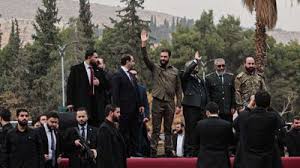
A year after Syria’s transitional government was formed, the central debate has shifted. The question is no longer how the new authority is structured, but whether it can govern, and what its first year reveals about the method and mindset guiding its work.
The government, made up of twenty-three ministers and no prime minister, presented itself as a blend of technocrats and political figures. It promised to fight corruption, rebuild institutions, stabilize the economy, and improve essential services. It spoke of monetary reform, support for production, and an investment-friendly environment.
Twelve months later, the gap between ambition and achievement remains wide. The country is left to ask whether these difficulties reflect the natural burdens of transition or a deeper flaw in the structure of governance.
Decision-Making in Narrow Circles
What once appeared to be a balanced composition has revealed its limits. Researchers and experts point to a decision-making process shaped by personal networks, familial proximity, and informal mediation. Competence often yields to connection.
As these circles expanded, the quality of decisions declined. Management styles rooted in small, localized environments migrated into national governance, making the shift to a larger and more complex state profoundly difficult. Diversity within the cabinet has become largely symbolic, since real authority remains concentrated in a narrow ambit.
Collective performance reflects the same pattern. There is no evidence that the government held regular full-cabinet meetings during its first year. Coordination appears fragmented, while official media presents routine bilateral meetings as proof of institutional coherence. The result is a public narrative that masks the absence of structured collective governance.
Economic and Administrative Strains
Living conditions continue to deteriorate. Inflation persists, prices remain high, and government agreements have not translated into improved purchasing power. Electricity, fuel, and healthcare remain unreliable, exposing the state’s limited administrative and security control.
The old bureaucracy remains largely intact. Coordination is weak, and the absence of a prime minister complicates the work of an apparatus still in formation. International support has not yet moved from political and humanitarian commitments to economic flows capable of producing real change.
The government stands between two phases: consolidating authority, where it has made progress, and building the state, where challenges remain unresolved.
Who Governs, and Through What Mechanisms?
Researcher Abdul Rahman al-Haj notes that the government’s early months saw important steps: a national dialogue, a constitutional declaration, the formation of the transitional cabinet, and the unification of most Syrian territory. Yet governance remains weak, institutional performance sluggish, and the vision of the state’s future unsettled.
Researcher Abdul Wahab Assi argues that the government has moved from a de facto authority to a recognized state authority, aided by diplomatic breakthroughs and political recognition. Even so, the transformation is incomplete. Legislative authority remains unbuilt, institutional reform is slow, and transitional justice has not advanced.
Assi stresses the structural consequences of operating without a prime minister. Executive files, from restructuring ministries to reforming the judiciary, require a central coordinating figure. The absence of this office stands among the most significant weaknesses of the first year.
Researcher Ahmad Qasim al-Hussein sees partial progress toward national-scale governance. Diplomatic channels have reopened, and institutions from different regions are being integrated. Yet uneven security control and persistent local crises show that the state has not yet monopolized decision-making or security. Institutions exist in form, but real authority remains concentrated at the top.
Law: Built or Managed?
Judge Mohammad al-Harbalia notes that most decrees issued during the first year were implemented because they addressed urgent matters. Yet speed does not equal coherence. Ambiguous laws, weak enforcement mechanisms, and inherited bureaucracy continue to slow performance and create openings for administrative corruption.
The absence of a legislative authority has produced a significant vacuum at a moment that requires laws governing transitional justice, reconstruction, and public life. This vacuum limits the state’s ability to move from provisional management to a stable legal framework.
Security: Reactive More Than Preventive
Security expert Nawar Shaaban sees improvement in operations against terrorist cells and criminal networks. Yet the security approach remains largely reactive. A more effective system requires early information gathering, analysis, and preemptive intervention.
The spread of unregulated weapons compounds the challenge. Poverty, unemployment, and weak transitional justice create environments that organized crime and extremist groups can exploit. Shaaban describes the security landscape as a web of interconnected threats that demand a comprehensive approach linking security to economic and institutional reform.
An Economy Under Pressure
Researcher Yahya al-Sayyid Omar argues that government efforts to curb inflation produced only partial results. Price stability at high levels freezes hardship in place. Domestic production remains weak, industry and agriculture have declined, and dependence on imports has deepened. Attempts to stabilize the currency were temporary and quickly eroded.
Investment agreements remain preliminary, and the investment environment suffers from legal instability, unclear policies, insufficient energy supplies, and complex procedures. Regional tensions, including the war in Iran, have raised fuel prices and disrupted projects.
The economy lives in a fragile equilibrium, with no real improvement in citizens’ daily lives.
Representation: Symbolic or Real?
Experts interviewed for this report describe representation inside the government as largely symbolic. Influence remains concentrated within limited circles. Figures with genuine social standing are often absent, replaced by appointees selected through narrow networks.
Inherited bureaucracy persists, and figures associated with the former regime remain in place. The result is a hybrid administrative structure where attempts to build a new model are entangled with a heavy institutional legacy.
Legitimacy Under Strain
The transitional government possesses political, popular, and international legitimacy, yet all remain fragile. Support is conditional and vulnerable to erosion amid economic hardship, security concerns, and uneven satisfaction among different groups.
Diplomat Bassam Barabandi notes that the government has succeeded in securing international recognition and retaining a measure of popular hope. Yet this legitimacy has not translated into improved services or a stronger relationship between state and society.
Structural barriers remain: centralized decision-making, weak institutional balance, incomplete security control, economic deterioration, and an ambiguous constitutional path.
Restoring trust requires more than rhetoric. It demands the entrenchment of the rule of law, judicial independence, transparent accountability, genuine political participation, and tangible improvement in services and the economy.
In the Final Analysis
A year after its formation, Syria’s transitional government has consolidated its presence and opened a political window. It has not yet turned that opening into a stable model of governance. The gap between legitimacy and performance persists, and in some areas it is widening.
The government now faces a decisive test. It can move toward a legitimacy grounded in achievement and institutions, or remain suspended in a grey zone where promises accumulate without becoming a reality Syrians can feel in their daily lives.
This article was translated and edited by The Syrian Observer. The Syrian Observer has not verified the content of this story. Responsibility for the information and views set out in this article lies entirely with the author.