
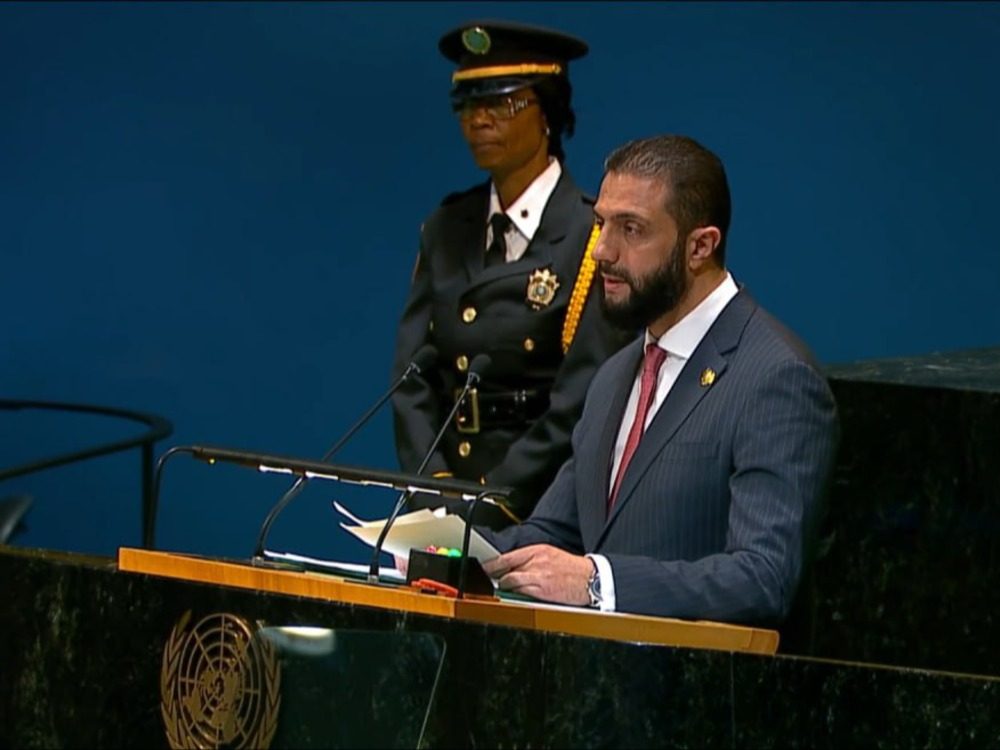
Syrian President Ahmad al-Sharaa has made a notable impact at the 80th session of the United Nations General Assembly in New York, spearheading a series of high-level diplomatic and economic engagements aimed at advancing Syria’s reintegration into the international community and revitalising its economy.
Participation in the General Assembly
On Tuesday, 23 September, President Sharaa attended the opening session of the General Debate at UN headquarters, accompanied by Foreign Minister Asaad al-Shibani and Syria’s Permanent Representative to the United Nations, Ibrahim Albi. His presence signalled Syria’s renewed commitment to engaging with the international community on key global challenges.
Economic Outreach at the Concordia Summit
Alongside the General Assembly, President Sharaa led a comprehensive economic agenda, including his participation in the Concordia Summit—an annual event held in tandem with the UN session. On Monday, 22 September, he met with prominent investors and economic analysts to discuss Syria’s investment potential across the energy, infrastructure, technology, and healthcare sectors.
A central event was a roundtable convened by the U.S. Chamber of Commerce, where President Sharaa held discussions with representatives from 39 major global corporations. Among them were Google, Microsoft, Chevron, Bechtel, Boeing, Mastercard, Citi, Visa, Motorola, Abbott, PepsiCo, Shell, TotalEnergies, and Uber. Talks focused on Syria’s sustainable development vision and highlighted investment opportunities, reflecting a significant shift towards economic openness.
In a separate session at the Concordia Summit, President Sharaa held a dialogue with former CIA Director General David Petraeus, where he stressed Syria’s strategic priorities of security, stability, and national unity. He underscored the importance of public-private partnerships in driving the country’s recovery. His forthcoming address at the summit will be the first by a Syrian president since 1967, setting out a vision for Syria’s international economic engagement.
Bilateral Diplomatic Engagements
President Sharaa’s visit was marked by a flurry of high-level meetings. On 22 September, he met U.S. Secretary of State Marco Rubio to discuss mutual priorities for a stable and sovereign Syria. The U.S. State Department described the meeting as a key opportunity to advance shared goals, including the implementation of President Donald Trump’s recent decision to ease sanctions on Syria. In a prior interview with 60 Minutes, President Sharaa described the move as “historic, courageous, and swift”, expressing hope for further dialogue to restore bilateral relations.
On 23 September, President Sharaa held talks with Jordan’s King Abdullah II, Yemen’s Presidential Leadership Council President Rashad al-Alimi, Pakistan’s Foreign Minister Mohammad Ishaq, and Kuwait’s Crown Prince Sheikh Sabah Khaled al-Hamad al-Sabah. Foreign Minister al-Shibani joined the meetings, which focused on regional dynamics and strengthening bilateral ties. According to the Kuwait News Agency (KUNA), the meeting with Sheikh Sabah highlighted the depth of relations between Syria and Kuwait and explored avenues for enhanced cooperation.
President Sharaa also held meetings with European Council President António Costa and European Commission President Ursula von der Leyen, both of whom reaffirmed the EU’s commitment to expanding political dialogue, addressing humanitarian concerns, and supporting Syria’s economic and social recovery.
Later that day, he met Italian Prime Minister Giorgia Meloni at Italy’s UN mission. Meloni reiterated Italy’s support for a stable Syria through economic investment, while stressing the need to protect all segments of Syrian society, including religious minorities such as Christians, and to ensure the safe and voluntary return of Syrian refugees.
Further discussions were held with Czech President Petr Pavel, Norwegian Prime Minister Jonas Gahr Støre, and members of the U.S. Congress. President Sharaa also took part in a conference at UN headquarters on the two-state solution.
Renewed Optimism for Sanctions Relief
The Syrian delegation expressed growing optimism about the potential lifting of sanctions, particularly the Caesar Act. Foreign Minister Shibani pointed to the symbolic raising of the Syrian flag at the reopened Syrian Embassy in Washington, D.C., on 19 September as a key development. Both U.S. and European officials, including Senator Rubio and members of Congress, voiced support for relaxing sanctions to help foster stability and economic recovery.
Political economist Mohammad al-Moussa described the visit as a pivotal moment, noting it was the first time Syria had been positioned as an investment destination to such a broad international corporate audience. He added that resolving political issues would directly boost investor confidence and economic growth.
Strategic Implications
President Sharaa’s multifaceted agenda in New York reflects a strategic effort to reposition Syria on the global stage. His blend of diplomatic and economic initiatives underscores a commitment to rebuilding a unified, stable, and prosperous Syria through international cooperation. The outcomes of these engagements are expected to play a decisive role in shaping Syria’s recovery and reintegration into the global order.
This article was translated and edited by The Syrian Observer. The Syrian Observer has not verified the content of this story. Responsibility for the information and views set out in this article lies entirely with the author.