
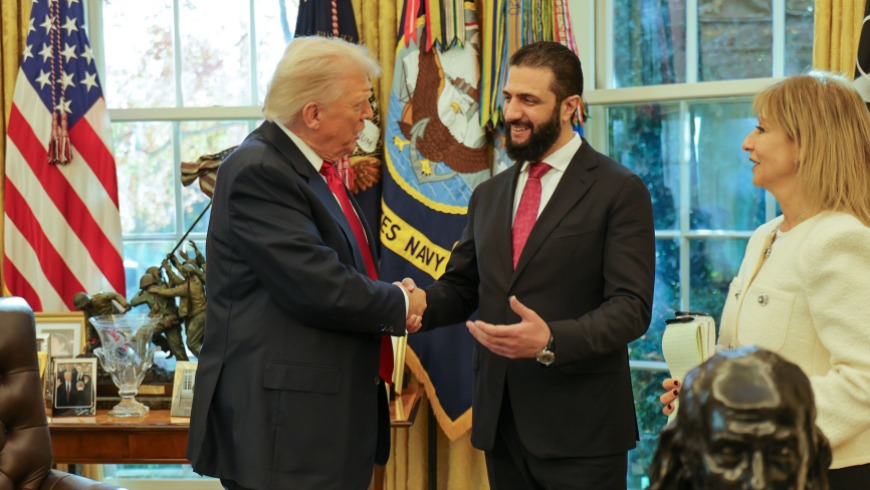
In a meeting described by observers as both “symbolic” and “strategically cautious,” U.S. President Donald Trump welcomed Syrian President Ahmad Sharaa to the White House on Monday, marking the first official visit by a Syrian head of state to Washington in decades. The encounter, which lasted nearly three hours, comes less than a year after the fall of Bashar al-Assad’s regime and signals a potential shift in Syria’s international posture.
President Trump expressed confidence in Sharaa’s leadership, telling reporters, “I’m in accord with President Sharaa, and I believe he’s capable of leading Syria toward success.” He emphasized Syria’s strategic importance in the Middle East and affirmed that the U.S. administration would “do everything it can to help Syria succeed.” Trump also hinted at upcoming announcements regarding Syria, noting that cooperation with Israel on regional alignment was “going well.”
The meeting, however, was notably devoid of traditional diplomatic ceremony. Sharaa entered through a side entrance, with no press coverage, no flags, and no Marine band—an absence that sparked commentary in American media. Reuters described the reception as “unusually quiet,” while ABC News confirmed that no journalists or cameras were permitted inside. The New York Times reported that the meeting was classified as a “private bilateral session,” not a formal state visit.
Despite the subdued optics, the talks were substantive. According to official statements, the two presidents discussed bilateral relations, regional security, and economic cooperation. Syrian Foreign Minister Assaad al-Shibani and U.S. Secretary of State Marco Rubio were present.
In an interview with Fox News, President Sharaa said the visit “ushers Syria into a new phase of international relations,” adding that “for over sixty years, Syria was isolated from Washington. This is the first time in decades a Syrian president enters the White House.”
Sharaa emphasized Syria’s transformation from a perceived security threat to a potential economic partner, particularly in energy and gas exploration. He called for direct U.S.–Syrian dialogue on counterterrorism, especially regarding ISIS, and reiterated that Syria should be seen as a destination for investment, not conflict.
Abraham Accords
On the Israeli front, Sharaa confirmed that negotiations were ongoing but difficult. Speaking to The Washington Post, he ruled out joining the Abraham Accords, citing Israel’s continued occupation of Syrian territory since 1967. “The Syrian case is fundamentally different,” he said, “and direct talks are not currently on the table.” He did, however, leave open the possibility of future U.S. mediation.
Sharaa also addressed transitional justice, stating that reconciliation with Syria must include accountability. He confirmed the establishment of an independent national commission for transitional justice, tasked with investigating crimes committed during the war—including those attributed to Bashar al-Assad. “Russia has its own view,” Sharaa noted, “but accountability is a non-negotiable principle.”
On humanitarian issues, Sharaa pledged to assist in locating missing American citizens, including journalist Austin Tice. “There are around 250,000 missing persons in Syria,” he said, “and we will do everything we can to uncover their fate.”
180-day waiver
The meeting concluded with a partial 180-day waiver of U.S. sanctions on Syria, according to the White House. However, officials stressed that Syria’s designation as a state sponsor of terrorism remains unchanged.
As Syria enters a new diplomatic chapter, the cautious tone of the visit suggests that while Washington is willing to engage, full normalization remains contingent on deeper reforms and regional stability.
This article was translated and edited by The Syrian Observer. The Syrian Observer has not verified the content of this story. Responsibility for the information and views set out in this article lies entirely with the author.