
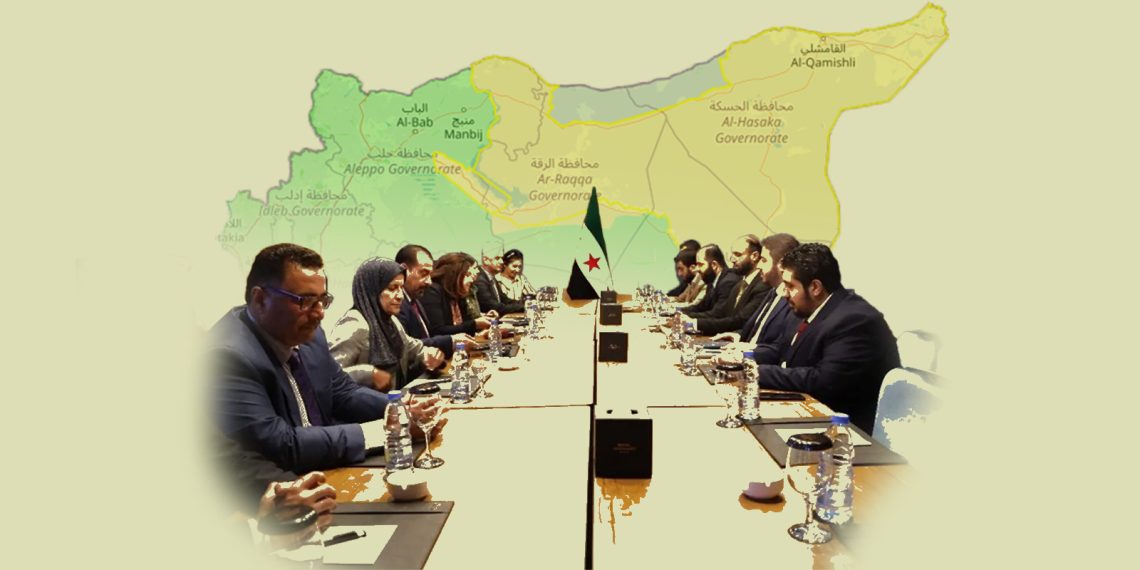
The 10 March Agreement between Syrian President Ahmad Al-Sharaa and Syrian Democratic Forces (SDF) commander Mazloum Abdi appears increasingly frozen, though no party has yet declared it void. Developments on the ground—most notably the Syrian Army’s takeover of the Sheikh Maqsoud and Al-Ashrafiyah neighborhoods in Aleppo—have fundamentally altered the balance of power, diminishing the SDF’s leverage while strengthening Damascus’s negotiating position.
What has emerged is a dual-track reality: a political agreement that formally remains in place, and a military confrontation that continues to expand, particularly in the eastern Aleppo countryside.
A Shifting Balance After Aleppo
The Syrian Army’s entry into Sheikh Maqsoud and Al-Ashrafiyah deprived the SDF of one of its most significant pressure points. These neighborhoods had long afforded the SDF influence within Aleppo, Syria’s economic capital and a vital artery for national recovery. Their loss has reshaped both the military map and the political calculus.
From Damascus’s perspective, the operation restored state authority over key urban areas and reduced what it considers a destabilizing armed presence within Aleppo. For the SDF, it represented a breach of the March Agreement and an act of unilateral escalation.
Ilham Ahmed, a senior figure in the Autonomous Administration, accused the Syrian government of violating the agreement by launching military operations in Aleppo, even as she reaffirmed the SDF’s willingness to return to negotiations within the same framework. She warned that renewed fighting risked regional destabilization, increased foreign intervention, and the re-export of terrorism from Syria—placing primary responsibility on the transitional Syrian government.
Damascus: Military Momentum, Political Reserve
The Syrian government appears determined to pursue both military and political tracks, though clearly prioritising the former.
As clashes intensified in the eastern Aleppo countryside, the Syrian Army’s Military Operations Directorate declared the area between Deir Hafer and Maskanah a closed military zone, citing what it described as significant SDF troop build-ups. The Directorate stated that it would take all necessary measures to prevent the area being used as a launchpad for hostile operations.
Ankara offered clear political support for Damascus’s recent moves. Turkish President Recep Tayyip Erdoğan described the Syrian Army’s control of Sheikh Maqsoud and Al-Ashrafiyah as an “important gain for peace and stability” and a “historic opportunity” to implement the March Agreement. He argued that the government’s actions reflected a comprehensive strategy that combined military force with political negotiation.
An Agreement Hollowed Out on the Ground
Many analysts contend that the March Agreement has already lost much of its substance. Turkish affairs researcher Dr Muhannad Hafez Oglu argues that the agreement is effectively defunct, rendered inoperative by what he describes as SDF efforts to impose alternative realities through security disruption in government-held areas.
According to Hafez Oglu, Damascus has refrained from formally cancelling the agreement in order to preserve it as a political reference for future talks—even as it becomes a burden for both sides. He suggests that key decisions within the SDF are made outside Syrian territory, limiting its capacity or willingness to honour its commitments in Damascus.
He also notes that following the battle for Sheikh Maqsoud, the SDF attempted to construct a narrative of grievance but failed to gain significant traction. This, he claims, was due to effective psychological pressure applied by the Syrian government. In such an environment, he warns, the situation remains volatile, with the potential for major confrontation at any moment.
Military Escalation and the Civilian Dimension
As front lines moved eastward towards Deir Hafer and Maskanah, reports surfaced of worsening humanitarian conditions. Syrian state media accused the SDF of preventing civilians from using a government-established humanitarian corridor through the village of Hamimah on the M15 highway.
Aleppo Governor Azzam Al-Ghuraib condemned what he described as SDF efforts to block civilian movement using concrete barriers and warning fire. He labelled these actions a flagrant violation of international law. In anticipation of population displacement, authorities in the Manbij region announced the opening of three shelter centers to receive civilians fleeing expected military operations.
The SDF, for its part, accused government-aligned factions of launching suicide drone attacks on villages near the Tishreen Dam—highlighting the risk of further escalation along the Deir Hafer–Maskanah axis.
Al-Sharaa: Integration or Clarity
In a state media interview, President Al-Sharaa placed responsibility for the Aleppo escalation squarely on the SDF. He accused its forces of initiating hostilities by shelling residential areas and deploying drones. He insisted that the Syrian Army entered Sheikh Maqsoud and Al-Ashrafiyah only after the majority of civilians had evacuated.
Al-Sharaa revealed that several mediators, including French President Emmanuel Macron and U.S. officials, had proposed plans for a peaceful SDF withdrawal. According to him, these efforts failed after the SDF rejected all proposals, allegedly under directives from Qandil.
He stressed that Kurdish rights were not the issue at stake. Kurdish citizens, he asserted, already enjoy constitutionally guaranteed rights to citizenship, parliamentary participation, and access to sovereign positions—based on merit rather than quotas. He rejected the notion that the SDF represents Syria’s Kurds, instead calling for integration into national institutions, including the army.
Al-Sharaa also questioned the rationale of maintaining a cross-border armed entity that controls roughly a quarter of Syrian territory, much of it inhabited by Arab tribes, under the pretext of protecting a Kurdish population that constitutes a minority even in the northeast.
Between Incremental War and Conditional Talks
Political analyst Firas Allawi argues that the conditions underpinning the March Agreement no longer exist. With the loss of Sheikh Maqsoud and Al-Ashrafiyah, the SDF has forfeited a key source of leverage, leaving Damascus in a stronger position for any future negotiations.
Although the agreement remains technically in effect—partly due to American calls for its revival—Allawi expects any resumed dialogue to take place on revised terms that favor the Syrian government. He anticipates a strategy of gradual military gains west of the Euphrates, combined with political outreach to the east, thereby maintaining consistent pressure on the SDF.
A Frozen Agreement, an Open Battlefield
The result is a paradox: a political agreement that remains on paper, and a battlefield that continues to grow. Military and political tracks are no longer sequential but concurrent, each shaping the other in real time.
Whether the March Agreement can be revived in a modified form—or is ultimately rendered obsolete by continued escalation—will depend not only on negotiations in Damascus, but on developments along the Deir Hafer–Maskanah axis. At present, Syria stands at a critical juncture where diplomacy is still possible, but the prospect of war looms larger than ever.
This article was translated and edited by The Syrian Observer. The Syrian Observer has not verified the content of this story. Responsibility for the information and views set out in this article lies entirely with the author.