
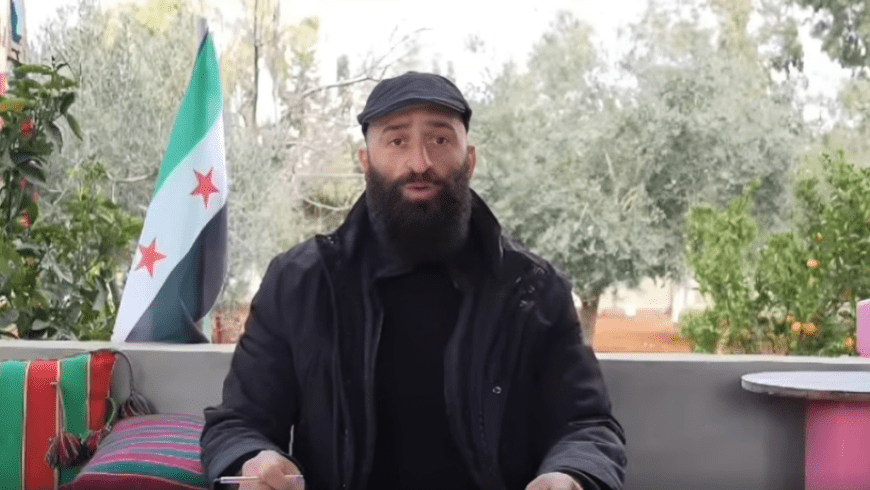
In a major development aimed at containing escalating tensions in the eastern Daraa countryside, former Eighth Brigade commander Ahmad al-Awda has surrendered himself to Syrian Military Police and formally placed his fate in the hands of state authorities. At the same time, a prominent local clan has declared his permanent expulsion from his hometown of Busra al-Sham.
According to sources familiar with the matter, al-Awda left Busra al-Sham for Damascus on Sunday under the escort of Military Police personnel, effectively submitting to the authority of Defense Minister Murhaf Abu Qasra and President Ahmad al-Sharaa.
In a video message recorded before his departure, al-Awda outlined the circumstances that led to his decision. He said he had previously entered into an agreement with the former regime—under Russian sponsorship—to prevent further bloodshed in Daraa. He claimed that his group worked to protect officers facing execution threats and helped secure the release of detainees from regime prisons.
Al-Awda reiterated his opposition to both the former regime and extremist factions, adding that after the fall of the Assad government, his group refused to become a proxy for any foreign actor. He emphasized that his faction was among the first to dissolve and place itself at the disposal of the state, calling for an end to factionalism and armed fragmentation.
Miqdad Clan Declares Permanent Expulsion
The situation in Busra al-Sham deteriorated sharply on Friday after an armed attack on al-Awda’s farm left Seif al-Din Ahmad al-Miqdad dead and two others wounded. The incident triggered armed clashes and prompted the Internal Security Forces to impose a temporary curfew.
In response, the Shura Council of the Miqdad clan issued a video statement on Sunday announcing a decisive measure: the complete and permanent expulsion of Ahmad al-Awda from Busra al-Sham. The council said the decision was made in coordination with state authorities and aimed at “averting sedition and containing tension in the city.”
The statement warned that if al-Awda were to return to Busra al-Sham, the clan would revert to its previous position and demand his accountability—potentially leading to his execution. The council urged its members and the youth of the city to exercise “maximum restraint,” avoid individual acts of retaliation, and proceed swiftly with the burial of the slain clan member.
Background: A Region on Edge
The recent events highlight the persistent fragility of security in Daraa province, even after the collapse of the former regime. The Eighth Brigade—formed in 2018 with Russian backing—once counted roughly 1,500 fighters under al-Awda’s command. The brigade formally dissolved in April 2025, transferring its assets and personnel to the Ministry of Defense.
Analysts attribute the ongoing volatility to the widespread availability of weapons and the legacy of armed groups, some of which were reportedly supported by the former regime’s security services. This environment has left the region vulnerable to localized conflicts and rapid escalations.
A Coordinated Attempt at Stabilization
The simultaneous surrender of al-Awda to state authorities and his banishment by the Miqdad clan appears to reflect a coordinated effort to defuse tensions by shifting responsibility from communal actors to official state institutions. Whether this move will restore stability in Busra al-Sham—and more broadly in Daraa—remains to be seen, but it marks one of the most consequential developments in the province in recent months.
This article was translated and edited by The Syrian Observer. The Syrian Observer has not verified the content of this story. Responsibility for the information and views set out in this article lies entirely with the author.