
No seasoned political analyst or former Syrian opposition figure—whether in Istanbul, Riyadh, Doha, or the many capitals of Europe—could have imagined, before 8 December 2024, that the jihadi commander Abu Mohammad al-Julani would don a shirt and tie, assume a formal name and lineage, and sit shoulder to shoulder with U.S. President Donald Trump as Syria’s transitional president. Nor could even the sharpest observers have predicted that, within mere months, Trump would move to lift a ten-million-dollar bounty once placed on the head of a man who had fought alongside al-Baghdadi in the Islamic State, only to break away and form an al-Qaeda affiliate in Syria—before narrowly escaping its grip to forge a broader alliance, open covert channels with the British and Americans, and fundamentally reshape the Syrian equation.
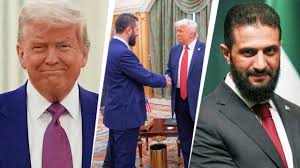
As is often the case, events seem clearer in hindsight, and puzzles appear almost self-evident once resolved. A reflective examination of the natures of Presidents Donald Trump and Ahmad al-Sharaa reveals what binds these two figures. Before writing this essay, I studied a photograph capturing the two leaders with Saudi Crown Prince Mohammed bin Salman in Riyadh last May, each standing beneath his nation’s flag. I sought to decipher the gazes and expressions of Trump and Sharaa.
In the image, Trump flashes a broad, rehearsed smile—lips parted, teeth visible, cheeks lifted so that the corners of his eyes crinkle. This expression, common among politicians, is designed to project ease, confidence and warmth. Al-Sharaa, by contrast, adopts a neutral, reserved posture. His lips remain firmly closed, though his eyes betray a subdued joy, as if suppressing the ghost of a smile. This restraint may be read as formality, caution, or a reflection of the moment’s gravity. In diplomacy, eschewing a smile can underscore seriousness or avert misinterpretation; it also conveys composure, self-control and authority, presenting Sharaa as a statesman focused on substance rather than spectacle.
The contrast is symbolic: Trump leans toward the performative, public-relations side of diplomacy, while Sharaa underscores formality and gravity. Such visual contradictions often serve domestic audiences—one leader signalling harmony, the other restraint.
The Businessman and the Pragmatist Strike a Deal
Trump entered the talks with the instincts of a businessman, whose language, experience and worldview are built on transactions. His objectives were straightforward: extract concessions, secure visible victories, and present the outcome as a “win.” He treated the Syrian file like a real estate negotiation—demanding clear terms and swift execution. For Trump, value lay in immediate returns: easing tensions, tightening ties with Saudi Arabia and other Gulf states, unlocking opportunities, and creating a platform for declaring success. Lurking in the background of his mercantile imagination were prospects of Mediterranean gas, Levantine oil and the technological wealth of the Syrian desert.
Sharaa, by contrast, conducted the dialogue with the realism of a leader forged by war. His demands were modest: recognition and a commitment to lift sanctions. He arrived in Riyadh backed by broad Arab patronage and a domestic base mobilised by slogans, fervour and Sunni grievances. Yet he came also wounded—his fledgling government tainted by atrocities on the coast only weeks earlier. Behind him stood fragile institutions, wary allies and wide segments of society who viewed him with suspicion. His priority was not headlines but survival, managing regional pressures carefully, and keeping the state intact. For him, compromise was both acceptable and strategic—a step toward long-term stability rather than a fleeting triumph.
The negotiations became a study in contradiction: Trump’s gaze was fixed on the Gulf, the Gulf’s on Sharaa, and Sharaa’s on holding power. Yet the differences proved complementary. The businessman’s hunger for achievement converged with the pragmatist’s quest for continuity. The result was recognition and a pledge to lift sanctions—though, despite the presidential signature, this remains ink on paper. Like many others, I still cannot send a hundred dollars to my family in Syria through official banks, forced instead to rely on informal channels.
Even so, the deal deserves acknowledgment, less for its immediate content than for its extraordinary nature. Trump’s boldness, perhaps recklessness, lent the process a daring edge; Sharaa’s cautious realism ensured it did not collapse. Each claimed success on his own terms: Trump, ever the dealmaker, could boast of “closing” another deal; Sharaa could reassure Syrians that he secured concessions without compromising sovereignty.
Diplomacy, like commerce, thrives when interests align—even if methods diverge. Here, the salesman and the strategist, the dealmaker and the pragmatist, found common ground. Their alliance may be fragile, but it illustrates how contradictory styles can, paradoxically, converge toward a shared outcome.
Yet what ultimately bound the agreement together was the peculiar similarity in the personalities of Trump and Sharaa. What, then, unites these two men?
Populist Magnetism and the Stranger’s Aura
Both leaders harnessed a populist allure rooted in the archetype of the outsider—the stranger who storms entrenched systems, purges corruption, and restores justice. This figure finds its origins in the mythology of the American Western: a mysterious, skilled man arrives in a lawless town to set things right. Often burdened by a hidden past and operating alone, he is unencumbered by local ties, allowing him to confront systemic rot with decisive force. Anyone who has seen Clint Eastwood’s Man with No Name understands the symbolic power of this trope—an emblem of hope and the individual’s capacity to effect change, often at great personal cost.
Trump’s slogan, “Make America Great Again,” resonated deeply with working-class Americans weary of corruption and institutional failure. He cast himself as an anti-elite businessman determined to “drain the swamp.” His background as a real estate mogul and reality TV star reinforced his image as a political outsider poised to disrupt Washington’s status quo. In parallel, Ahmad al-Sharaa—a former leader of a group linked to al-Qaeda—rebranded himself as Syria’s national savior. While Trump’s slogan was blunt and direct, Sharaa invoked the grandeur of the Umayyad era, when Damascus stood as the capital of a third of the ancient world. He promised to restore the dignity of the state and reclaim its stature after collapse. This rhetoric appealed to broad swaths of the Sunni public, long starved for stability after decades of Assadist tyranny and fragmentation. His military campaigns in 2024 became a direct investment in anti-regime sentiment, presenting him as a revolutionary untainted by the failures of traditional Syrian politics.
As political “strangers,” both men promised rupture over continuity, upheaval over inertia. Trump’s victories in 2016 and 2024 were fueled by voters disillusioned with globalization and “political correctness,” while Sharaa’s ascent in Idlib and beyond drew momentum from Sunni grievance and a war-weary populace. Yet this shared magnetism often oversimplified complex realities: Trump’s economic promises glossed over structural challenges (as evidenced by the current economic downturn), and Sharaa’s vision of a unified, economically resurgent Syria ignored deep sectarian and ethnic fissures, as well as the entrenched economic decay that no amount of soaring rhetoric could reverse. Though their anti-establishment discourse struck a chord, it frequently sowed division rather than cohesion, and exacerbated inequality rather than fostering national unity.
It is no surprise that opportunists flock to victors—success, by nature, attracts new adherents as honey draws flies. Sharaa has labored tirelessly to entrench his presence in the Sunni Arab imagination. While Western analysts dissect his pragmatism and weigh the lifting of sanctions in hopes of reconstruction windfalls, a parallel narrative is being carefully cultivated within Syria—one that grants him uncontested legitimacy in the Sunni street: the Umayyad revival.
Yet this initial populist appeal does not stop at mere seduction; it paves the way for a deeper transformation in the relationship between leader and followers, where loyalty transcends programs and becomes personal. This is the hallmark of what might be called “loyalty cults.”
Loyalty Cults: Trump and Sharaa
Donald Trump’s political project has gradually morphed into what a growing body of scholars describe as a “cult of loyalty,” anchored in the charismatic authority of the leader himself. Rather than diminishing his stature, Trump’s repeated breaches of political norms, his mockery of elites, and his defiance of established conventions have become the very source of his appeal. His supporters interpret these transgressions as proof of authenticity, courage, and resolve—a signal that he alone can confront “the system” on their behalf. This dynamic has taken on a near-ecstatic fervor, as witnessed during the storming of the Capitol on January 6, 2021. The subversion of norms, the embrace of collective identity through demonizing enemies, and the prioritization of personal loyalty over institutional allegiance have become normalized. Politics, in this context, transforms into ritual: chants at rallies, symbols and slogans, all coalescing into a Trumpian cult bound more to the man than to any coherent ideology or policy platform.
A similar, though less overt, phenomenon is unfolding in Syria. Sharaa’s rise has sparked comparable debates. Critics warn that his efforts to build a new Syrian army rooted in religious mobilization may entrench loyalty to his person rather than to the state. His push to unify disparate militias under centralized command risks forming a “cult” around his authority within Sunni circles, potentially marginalizing minorities. Signs of a growing personality cult are already visible: he is celebrated in wide segments of the Sunni community as a liberator following Assad’s fall—a mirror image of the Assad family’s cult of personality, albeit with a different sectarian logic. “Assad’s Syria” is giving way to “Sharaa’s Syria.” While most sources avoid labeling his project explicitly as a cult, the contours are unmistakable: a personalized, authoritarian mode of governance, rooted in reconfigured jihadist origins and a pan-Sunni narrative of exclusive loyalty.
The cases of Trump and Sharaa illustrate how charismatic authority, when fused with populist style or sectarian mobilization, can give rise to movements that transcend conventional politics and take on the shape of loyalty cults. In both instances, allegiance to the leader—not to institutions or programs—becomes the primary bond. This raises profound questions about the sustainability and scope of such political models.
Centralization of Power
Both leaders exhibit a marked tendency toward centralizing authority, privileging personal loyalty over institutional norms. Trump sidelined experts, institutions, and even his own party, appointing family members and close confidants to key positions, turning the White House into a stage for his performative persona. His prolific use of executive orders—nearly 200 by mid-2025 in his second term—reflects a desire for direct control over policy, bypassing Congress and the bureaucratic apparatus.
In parallel fashion, Sharaa consolidated his power by transplanting the model of Syria’s Salvation Government from Idlib to Damascus, relying on loyalists from Hay’at Tahrir al-Sham, members of his own family, and a provisional constitution that grants him unchecked authority without accountability. Yet in Syria’s institutional vacuum, Sharaa’s dependence on kin, confidants, and former jihadist allies risks producing hollow structures of governance. Unlike the United States, where constitutional checks—though strained—still impose limits on Trump’s centralization of power, Sharaa faces no such constraints. He now presides over both the executive and judicial branches, and exercises legislative authority either through presidential decrees or by handpicking members of the forthcoming parliament. In a historic first for modern Syria, he abolished the office of prime minister altogether, unwilling to share power with any rival.
Such concentration of authority enables swift decision-making but undermines checks and balances. Trump’s purge of officials deemed insufficiently loyal—derided as “Republicans in name only”—mirrors Sharaa’s exclusion of opposition figures and civil society leaders who played roles in the uprising against Bashar al-Assad. Both frame their consolidation as a prerequisite for radical reform: Trump claims to be dismantling a “corrupt system,” while Sharaa presents himself as rebuilding a shattered nation. Yet this approach courts authoritarianism and institutional fragility, as evidenced by Trump’s legal battles over executive overreach and Sharaa’s restrictions on civil liberties, which have drawn accusations of replicating Assad’s methods. Without robust institutions, their reliance on personal networks threatens long-term stability.
The Strongman Rhetoric
Trump and Sharaa both embrace the rhetoric of the “strongman,” projecting resolve and decisiveness. Trump employs blunt, mocking language, branding his opponents as “weak” or “losers,” and openly admires authoritarian figures like Vladimir Putin, Xi Jinping, and Kim Jong Un, praising their personal ability to impose order and enforce law. His promises on what he dubbed “Liberation Day” (April 2, 2025), including mass deportation plans, reinforced his image as a man of unyielding will.
Sharaa, drawing from his jihadist roots, adopts a similarly hard-edged discourse centered on security and national revival. This is reflected in his stringent security policies and the harsh rule he imposed in Idlib—later transplanted to Damascus after 2024—embodying the archetype of the leader who governs with an iron fist. He has cultivated the narrative that he and his movement “liberated” Syrians from Assad’s rule, and thus sees no contradiction in proclaiming, “He who liberates decides.”
The convergence of their rhetoric was most evident in Trump’s praise of Sharaa during their May 2025 meeting, where he described him as a “strong man” with a “resilient past.” Both men seek to cement the image of the invincible leader—Trump in domestic politics, Sharaa in post-Assad Syria. Yet while this posture appeals to fervent supporters, it also provokes deep unease among broader constituencies. Trump’s incendiary remarks have exacerbated partisan divisions in the United States, while Sharaa’s past calls for implementing “God’s rule” and his current policies—including massacres targeting minorities such as Alawites in the coastal region and Druze in Sweida—have alarmed key Syrian communities.
Thus, the strongman figure, though magnetic to loyalists, may become a source of escalating tension with adversaries and international actors wary of authoritarian drift.
The Pragmatic Approach to Foreign Policy
Both leaders pursue a foreign policy rooted in pragmatism—one that treats diplomacy as a series of transactional exchanges, where ideological commitments are secondary to strategic gain. Trump’s “America First” doctrine placed national (and corporate) interests at the forefront, manifesting in deals such as the US–Mexico–Canada Agreement and the Abraham Accords, which accelerated Arab–Israeli normalization while largely sidelining international institutions. His second term has continued in the same vein, marked by punitive tariffs and migration deals designed to yield immediate economic dividends.
Sharaa, meanwhile, in his bid to legitimize Syria’s new government under his leadership, has carefully projected an image of combating ISIS and extremism, while simultaneously opening discreet channels with Israel and the Gulf states. This dual-track approach is aimed at securing the lifting of international sanctions and gaining regional and global recognition. His repeated gestures toward Israel—whether through border de-escalation or hints at future security arrangements—suggest a calculated use of the Israeli file as a central bargaining chip. Like Trump, Sharaa privileges tactical survival and negotiating leverage over the construction of a coherent ideological framework.
Yet each man operates within the bounds of his scale and capacity. Trump, at the helm of the world’s most powerful state, issues pronouncements commensurate with its stature—floating ideas of annexing Canada, absorbing parts of Mexico, or purchasing Greenland from the Danish crown. These proposals, however fantastical, speak to his domestic base and reinforce his image as a leader who refuses to be constrained by inherited borders.
Sharaa, by contrast, works on a far smaller canvas. His rhetoric of annexing Tripoli into Syria evokes the old dream of “Greater Syria,” a motif historically deployed to stir nationalist sentiment. He finds resonance in statements by Trump’s envoy Tom Barrack, who told NTV that “all these borders go back to Sykes-Picot and the Treaty of Sèvres—failed borders. It’s time to redraw them and reach a new agreement.” Though modest compared to Trump’s ambitions, this posture serves a similar function: it casts Sharaa as a leader with a vision that transcends the confines of the post-Assad state, granting him a symbolic stature beyond the day-to-day mechanics of governance.
Where Western observers see imperial overreach in Trump’s declarations, Syrians and Arabs read in Sharaa’s speeches an attempt to revive an old idea—more symbolic than actionable—that frames him as a nationalist figurehead. Not merely a steward of survival, but a man with a larger project in mind.
Not a Mirror Image
Yet it would be a stretch—and indeed unfair—to overstate the resemblance between the two men, or to suggest that their similarities amount to equivalence. Trump operates within the framework of a well-established democracy that imposes limits on his authority, despite his electoral victories in 2016 and 2024. Sharaa, by contrast, moves through the vacuum of post-conflict Syria, buoyed by a revolutionary triumph and tenuous external support.
Trump’s background as a businessman endowed him with media savvy and a transactional instinct, while Sharaa’s jihadist past reflects a forced pragmatism, devoid of institutional experience. On the global stage, Trump crafts the policies of a superpower; Sharaa, meanwhile, is preoccupied with survival and international legitimacy. These distinctions explain why Trump remains subject to legal constraints, while Sharaa is exposed to the perils of unchecked authoritarianism.
Both men are intelligent, but their intelligence manifests differently. Trump’s intellect leans toward a mischievous, almost juvenile cunning, while Sharaa’s is that of a seasoned and disciplined tactician. Opinions on Trump’s intelligence vary sharply, mirroring the political and media polarization in the United States. Some see him as possessing practical acumen and strategic intuition; others argue that his success stems more from media manipulation than intellectual depth, pointing to his contradictory statements and frequent blunders as evidence of limited capacity.
Sharaa, on the other hand, is widely regarded by analysts as possessing a striking degree of political intelligence—evident in his ability to adapt to seismic shifts and transition from a jihadist figure to a post-conflict leader. His supporters cite his pragmatism and flexibility in dealing with regional and international powers as signs of political maturity that may help reshape Syria’s role. Even his critics do not deny his intelligence; rather, they view it with suspicion, suggesting it may serve to mask ideological rigidity or to repackage authoritarian tendencies in new garb. In either case, his intelligence is acknowledged—but whether it signals a path toward stability or a risk of personalized rule rooted in militant origins remains a matter of debate.
In the end, the convergence between Donald Trump and Ahmad al-Sharaa illustrates how charismatic figures can redraw the trajectories of nations, relying on political acumen and pragmatism—though often at a steep cost. While both men share populist appeal, a drive to centralize power, and a transactional approach to leadership, the differences between them are telling: Trump operates within a state of enduring institutions, while Sharaa seeks to consolidate authority in a fractured land.
This resemblance, however uncanny, reveals a deeper truth: politics, at its core, is a game of interests that transcends borders and ideologies. The lingering question is whether such leaders—armed with cunning and charisma—can truly deliver lasting stability, or whether they remain captive to their own contradictions, stirring fervor and fear in equal measure. For Syrians and Americans alike, each in their own context, the challenge is to reflect carefully on this equation—for the leader who promises salvation may well be a gambler leading the nation somewhere it never intended to go.