
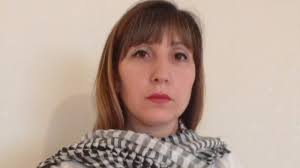
In a voice trembling with grief yet steadfast in defiance, Syrian activist Hanadi Zahlout addressed the United Nations Human Rights Council last week, transforming its sterile chamber into a courtroom for the forgotten victims of her nation’s enduring turmoil.
Her speech, delivered on 20 September during the council’s 57th session, was more than testimony—it was a scathing indictment of the massacres that have scarred Syria’s coastal regions since the collapse of Bashar al-Assad’s regime earlier this year. A survivor of the revolution’s darkest chapters, Zahlout called for a process of transitional justice that spares no perpetrator—neither the Assad-era torturers nor the post-revolutionary militias accused of sectarian reprisals. She urged the international community to stand with the dead before more graves are filled.
Zahlout’s words echoed the raw agony of a woman who has embodied Syria’s fractured soul for over a decade. Born and raised in the coastal city of Latakia within an Alawite family, the 40-year-old activist has long been a fierce advocate for equality and human rights—well before the 2011 uprising. A writer and campaigner for women’s and children’s rights, she operated in underground circles, publishing essays under pseudonyms to evade the regime’s suffocating censorship in a country bereft of independent media.
Her activism came at a steep cost. On 4 August 2011, security forces arrested her during a casual gathering at a restaurant in Jaramana near Damascus. What followed were months of solitary confinement and brutal interrogations. She was coerced into “confessing” to protest involvement after being forced to witness the torture of fellow detainees. Denied legal representation and never formally charged, Zahlout’s ordeal drew global attention from organizations such as Amnesty International and Alkarama, which highlighted the regime’s systematic use of fear to silence dissent.
Though eventually released, Zahlout fled into exile in southern France. There, she continued to document the revolution’s human toll through digital platforms and projects such as 100 Faces of the Syrian Revolution. Her Facebook page, followed by over 32,000 people, became a beacon of personal testimony amid collective trauma.
Yet the revolution’s early promise of dignity dissolved into renewed nightmares in March 2025, when insurgent groups—including Hay’at Tahrir al-Sham (HTS, also known as “Amshat”)—clashed with Assad loyalists along the coast. In the village of Al-Sanawbar near Jableh, Zahlout’s world collapsed. On 7 March, militants stormed homes, targeting residents based on their Alawite identity. Among the more than 1,400 civilians executed in field killings—without trial or mercy—were her three brothers: Ahmad, Abdelmohsen, and Ali. Also killed was her Arabic literature teacher, Anan Khair Bek.
“Those who taught me the alphabet are the ones I stand here today to honour,” she said, her words laden with poignant irony.
In her address to the UN, Zahlout painted a harrowing portrait of that “cursed morning,” when, in her words, “the gates of hell opened for six days and nights.” Militants ransacked thousands of homes, executing families solely for their sect and leaving behind a trail of destruction. Forty homes were set ablaze in Al-Sanawbar alone. Shops were looted, and walls once emblematic of village serenity were defaced with sectarian slurs and death threats.
Syria’s UN Ambassador Stresses Kurdish Integration as Inseparable Part of National Unity
Her mother, like thousands of grieving women, stood vigil over her sons’ bodies for three days, shielding them from the elements before they were buried in a mass grave—denied even the basic solace of funerals or condolences.
“Our villages, like all the plundered and devastated neighbourhoods, remain stripped of basic necessities,” Zahlout recounted, describing a reign of terror that endures. Sporadic killings, heavy gunfire, and artillery barrages—euphemistically labelled “training exercises”—continue to turn the nights into voids of dread.
The exodus that followed was as harrowing as the violence itself. Thousands fled barefoot towards neighboring Lebanon, only to face a different inferno: denied refugee status, stripped of aid, and left vulnerable to exploitation. Women, Zahlout stressed, endure isolation amid dire health and economic hardship, with no access to employment, scant medical care, and widespread abuse.
“Thousands of refugee families in Lebanon are left to a fate of death after surviving the massacres,” she lamented, accusing even Syrian civil society—including feminist and revolutionary circles—of abandoning them. For Alawites, she warned, this amounts to “a slow genocide of another kind, happening openly”: forced displacement, stripped rights, women abducted and assaulted under threat of death, their stories buried by fear.
Zahlout’s testimony extended beyond her personal ordeal, linking it to a broader pattern of impunity that now shadows Syria’s fragile rebirth. She denounced the repetition of coastal atrocities in Suwayda, where Druze communities have faced similar reprisals, extinguishing any remaining hope for a unified nation. Since Assad’s ousting, she argued, the revolution’s promise to end authoritarianism has faltered in the face of unchecked atrocities—victims of the old regime ignored, while vengeance under the new order goes unpunished.
“Settlements with killers cannot birth peace; they breed instability and tension, making massacres possible every day,” she declared. Her proposed solution: a genuine national conference where Syrians, across all divides, can voice their fears at one table. She called for the establishment of a transitional governing body and a unified military council to consolidate arms under a national army.
She outlined a clear vision: the return of displaced citizens, the prosecution of all perpetrators—both pre- and post-Assad—the protection of women from abduction and coercive dress codes, and security for farmers to cultivate their land without fear. These, she said, are the bare minimum for rebuilding Syria.
Zahlout’s address, charged with the unyielding spirit of a survivor, closed with a call for universal solidarity. “I stand before you with a wounded heart and a steadfast mind, demanding justice for all Syrian victims, from every sect and stripe,” she said, aligning herself with former cellmates and neighbours—those scarred by Assad’s prisons and those shattered by the chaos that followed.
To the council, she issued a solemn imperative: “Stand with the victims today, and make justice the path to a new Syria.” Her words, met with muted but respectful applause, underscored a grim reality: in Syria’s post-Assad dawn, the spectre of vengeance looms large, and only true accountability can dispel it.
In a symbolic gesture of reconciliation, interim leader Ahmad al-Sharaa—formerly of HTS—personally called Zahlout in March to offer condolences for her slain brothers. Her appearance at the UN now signals a growing international demand for scrutiny. Rights organizations, including Human Rights Watch, have echoed her appeals, documenting over 1,400 civilian deaths in coastal areas and calling for UN sanctions against those responsible.
For Zahlout, whose body still bears the scars of Assad’s jails, this is no abstract plea. It is the unfinished verse of a revolution she helped to author—demanding an ending that honors its martyrs.
This article was translated and edited by The Syrian Observer. The Syrian Observer has not verified the content of this story. Responsibility for the information and views set out in this article lies entirely with the author.