
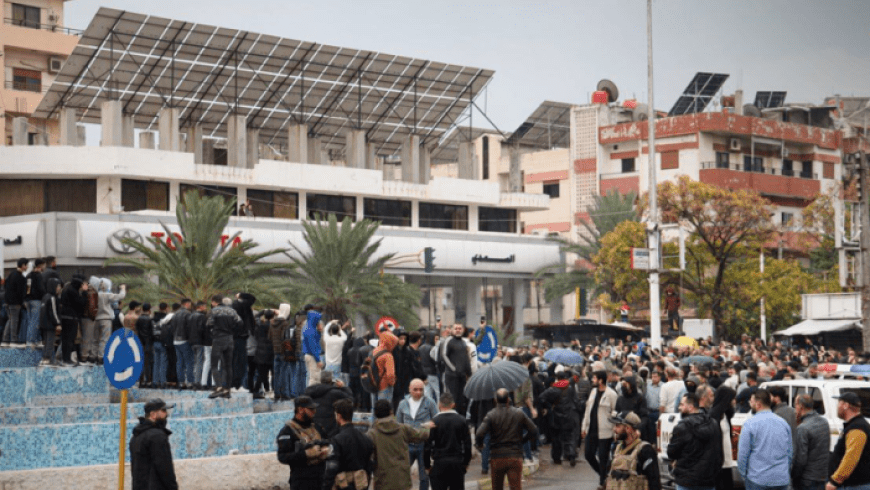
In the shadowed valleys of Syria’s heartland, where the scars of revolution and tyranny intersect like fault lines in parched earth, the city of Homs has once again become a crucible of communal anguish. What began as a grisly double murder in the rural hamlet of Zaidal—a Bedouin couple slain in their home, the husband’s body stoned, his wife’s charred, and the walls daubed with bloodied sectarian epithets—ignited a conflagration that threatened to engulf the nation’s fragile mosaic. By Tuesday evening, the embers of this inferno had spread to the Mediterranean coast, where tens of thousands rallied in a symphony of defiance, demanding not vengeance but a federal reckoning. Amid the acrid smoke of torched vehicles and the echo of gunfire, Syria’s transitional government and its people confronted a sobering truth: survival depends on learning from calamity, or the republic risks disintegrating into the very sectarian maelstrom it was meant to resist.
The Zaidal atrocity, discovered on a crisp Sunday morning, was no ordinary crime but a meticulously staged provocation. Its perpetrators left a trail of incendiary graffiti designed to inflame sectarian tensions. Major General Murhaf al-Naasan, Homs’ internal security chief, condemned the act as a calculated attempt “to fuel sectarian divisions and undermine regional stability”—a view echoed by Interior Ministry spokesman Noureddine al-Baba, who stated that early investigations uncovered no conclusive sectarian motive. Yet scepticism persists; whispers in Homs’ labyrinthine alleys suggest the involvement of shadowy actors—possibly regime remnants or opportunistic provocateurs—intent on exploiting the Bedouin Bani Khaled tribe’s grief, redirecting it against the city’s Alawite-majority enclaves.
Retribution came swiftly. Armed elements from Bani Khaled stormed the Al-Muhajirin neighbourhood, unleashing indiscriminate gunfire, ransacking homes, and setting fire to 19 residences, 29 vehicles, and 21 shops. Remarkably, no lives were lost—a reprieve credited to the rapid deployment of Syrian army units and internal security forces, who swiftly cordoned off volatile zones and arrested several assailants. A curfew descended on Homs, schools closed for a day, and a heavy silence gripped the city. By Tuesday morning, restrictions were lifted, classes resumed, and al-Baba visited the protests in Al-Zahra, microphone in hand, pledging impartial justice and the right to dissent. “The ministry stands equidistant from all communities,” he declared, as he convened tribal elders, victims’ relatives, and local leaders to forge a pact of restraint.
This choreography of containment signals a break from Syria’s blood-soaked past. Political analyst Ammar Jallou hailed the government’s “firm stance against vengeful impulses and tribal forays” as a sign of mature governance—far removed from the state’s faltering response to unrest in Suwayda, where Damascus was accused of complicity. Under President Ahmed al-Sharaa, the transitional regime has adopted a markedly different approach, forming ad hoc peace councils and defusing crises before they metastasise. Homs Justice Chief Judge Hassan al-Aqra reinforced this resolve in a stark video address, vowing to deliver justice: “Justice shall run its course, rights restored, criminals pursued.” Activists like Zaki al-Daroubi of the Democratic Left Party praised the “rapid encirclement of disorder,” attributing the prevention of wider violence to political mobilisation and tribal diplomacy.
Yet Homs’ fragile calm remains tenuous. The city’s social fabric—woven of Sunni, Alawite, Christian and Ismaili communities—bears the deep scars of sectarian fragmentation, worsened under Assad’s rule when militias terrorised civilians and the state turned a blind eye. Al-Daroubi, himself from the Alawite community and no stranger to the regime’s repression, spoke of the quiet desperation now afflicting his people: “Alawites seek nothing more than the peace every Syrian craves. We suffered under Assad, and now we suffer under his shadows—militias pursuing personal gain, sowing fear, resorting to retaliatory killings against those who resist them.” Recent footage of Muqdad Ftiha, former commander of the “Coastal Shield” brigade, re-emerging with threats of renewed assaults, has reignited fears and prompted fresh calls to halt the incitement against communities already reeling.
As Homs smouldered, the coastal region responded to a different call—one not of retribution, but of civic resistance. Sheikh Ghazal Ghazal, head of the Supreme Islamic Alawite Council in Syria and the Diaspora, issued a rousing video message on Monday, denouncing the nation’s descent into “an arena for sectarian score-settling” and urging all sects—Sunni, Alawite, Christian, Druze, Ismaili—to unite in peaceful protest against “the machinery of killing” and the many faces of terror. “There is no existential war between Alawites and Sunnis,” he declared, rejecting the lure of what he called a “Daesh swamp” and proposing federalism as a remedy for systemic exclusion. His appeal struck a chord.
By dawn, patrols from Tartous’ hinterlands and Latakia’s urban quarters had converged on key landmarks—Saadoun Circles, Azhari and Agriculture roundabouts, Jableh’s Emara Square—carrying banners demanding decentralization, detainee releases, and the end of uncontrolled weapons. “No to Terrorism, No to Stray Weapons,” read their placards.
The protests were visually arresting: thousands bearing Syrian tricolors, chanting in unity across sectarian divides. Alawites denounced abductions; Christians invoked the defense of dignity. Security forces, encircling the assemblies, insisted their role was not to suppress but to protect. Still, tensions flared. In Latakia’s Agriculture Square, gunfire erupted—security forces fired warning shots, locals alleged, while unidentified gunmen opened fire into the crowd. One protester suffered a fatal head wound; dozens more were injured. In Homs’ Al-Zahra, arrests and beatings marred a sit-in. Jableh and Baniyas saw rival demonstrations: pro-government motorcades extolling al-Sharaa clashed verbally with federalist marchers. By nightfall, most gatherings dispersed peacefully, though the Syrian Observatory for Human Rights recorded injuries and confrontations, branding the day a potential prelude to escalation.
Amid the unrest, a geopolitical undertow surfaced. Political commentator Basil Murawi pointed to “hidden hands” aiming to stoke ethnic tension and derail Syria’s nascent diplomatic reengagement. The timing of the Zaidal killings—coinciding with a U.S. delegation’s visit, rumors of a Trump-led mediation mission to address sensitive issues like SDF integration and Israeli security coordination, and Moscow’s hints at winding down support for Assad-era elements—has raised suspicions. Murawi implicates Iran and Hezbollah, citing the graffiti’s Ja’fari overtones as an invitation for Tehran’s proxies to intervene and escalate a local conflict into a broader confrontation. “This would be Trump’s fourth meeting with al-Sharaa in under a year,” Murawi noted, “and some actors would rather plunge Syria into chaos than see it emerge as a reliable U.S. partner.”
Jallou, however, sees reason for cautious optimism amid the discord. Assad’s former strongholds, once unquestioningly loyal, now appear increasingly resistant to a return of autocracy. Even Ghazal’s traditional base of support in the coastal Alawite heartlands is fracturing, with civil actors stepping in where clerics have lost credibility. In Tartous’ Christian neighbourhoods, where Islamist banners briefly appeared—a grotesque contradiction during calls for federalism—pragmatism appears to be prevailing over panic.
As the sun sets over Homs’ battered skyline and Latakia’s shores tremble under a rising tide of uncertainty, Syria stands at a decisive juncture. Transitional justice must replace revenge. Reconstruction must supplant ruin. The government’s success in averting a coastal repeat of March’s carnage—which claimed 1,662 lives and now fuels war crimes proceedings in Aleppo—is fragile, contingent on continued restraint and genuine reform.
In this land of ancient olive groves and unhealed wounds, the lesson from Homs is clear: only a state that upholds equity as its guiding principle can extinguish the embers of sectarianism. Anything less invites not discord—but disintegration.
This article was translated and edited by The Syrian Observer. The Syrian Observer has not verified the content of this story. Responsibility for the information and views set out in this article lies entirely with the author.