
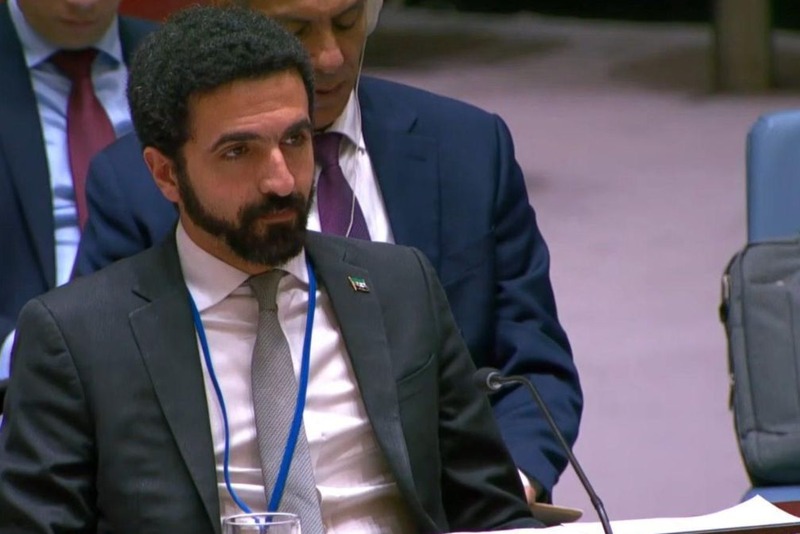
Syria’s Permanent Representative to the United Nations, Ibrahim Olabi, affirmed today that Syria’s adherence to the Chemical Weapons Convention rises far above the realm of legal obligation. He described it as a moral and humanitarian duty anchored in the Syrian people’s own suffering as victims of these weapons. He stressed that eliminating every possible remnant of the chemical program inherited from the former regime has become a national charge, essential for protecting Syrians and reinforcing stability across the region.
Addressing the UN Security Council on Tuesday, Alibi observed that spring evokes open skies and gentle breezes for much of the world, yet these same months in Syria once carried the choking fumes of chemical attacks that claimed the lives of children. He stated that the truth, long obscured, is now emerging with clarity, and Syria is determined to reveal it fully, secure justice, and prevent any repetition of such crimes.
Sustained Collaboration with the OPCW
Alibi underscored Syria’s continued cooperation with the Technical Secretariat of the Organisation for the Prohibition of Chemical Weapons. This cooperation endures despite a landscape marked by severe and intricate challenges: fragile security conditions, the covert nature of the former regime’s chemical program, the near absence of institutional memory, the heavy imprint of fourteen years of conflict, and the economic depletion that has weakened technical and institutional capacities.
Within this demanding context, Syria has taken practical steps to strengthen coordination with the OPCW. Alibi highlighted the creation of a national working group and the regular submission of monthly reports, measures intended to deepen transparency and reinforce technical and institutional communication.
Field Operations to Identify Sites and Documents
Alibi explained that the Syrian government has facilitated visits to more than twenty-five suspected sites, including declared locations and others believed to be linked to past activities. During these missions, environmental samples were collected, documents examined, and logistical and security arrangements provided. In several areas, engineering surveys and mine-clearance operations were completed before international teams began their work.
He added that the Syrian government has granted the Technical Secretariat access to over ten thousand official documents and records. OPCW teams also interviewed nineteen witnesses, including individuals who had worked within the chemical program during the former regime’s era.
International Report on the Kafr Zita Attack
Alibi referred to the OPCW Investigation and Identification Team’s fifth report, which concluded that the air force of the former regime carried out the chlorine gas attack on Kafr Zita in rural Hama in October 2016. The assault injured thirty-five people and harmed dozens more.
Discovery of Cylinders at an Abandoned Site
Alibi also drew attention to the Syrian National Committee’s immediate notification to the OPCW after discovering seventy-five old, empty cylinders suspected of having contained chemical agents at an abandoned military site. He affirmed Syria’s readiness to provide all necessary facilities for their safe handling. A lapse in coordination, however, resulted in the cylinders being removed and dismantled as scrap metal outside the site, exposing workers to health risks. The Syrian government, working with the OPCW, responded swiftly by launching an investigation and providing all required information, documents, and samples.
He noted that the incident illustrates the urgent need for international support and capacity building to ensure rapid and safe responses whenever materials or information related to the chemical legacy are uncovered. Several friendly nations have already assisted Syria in addressing this legacy since the fall of the former regime, and efforts are underway to formalize this cooperation within a comprehensive coordinating framework that will soon be announced in New York.
Closing the Chapter on the Chemical Legacy and the Captagon File
Alibi stated that the chemical dossier, once a source of global alarm, is evolving into a field of international cooperation and partnership. This collective effort aims to confront challenges and reinforce the security of Syrians and the wider region. He added that Syria is simultaneously working to close another chapter inherited from the former regime, the Captagon file, in order to lift this burden from Syria, the region, and the world.
International Support for Concluding the File
The UK Representative to the Security Council reaffirmed her country’s steadfast commitment to eliminating the threat posed by chemical weapons in Syria. She welcomed the Investigation and Identification Team’s report attributing the 2016 Kafr Zita chlorine attack to the former regime’s air force. She noted that the progress achieved by the Syrian government and the OPCW offers a timely opportunity to neutralize this threat once and for all, provided that international support continues.
The Greek Representative praised the constructive cooperation between the OPCW Technical Secretariat and the Syrian government in dismantling the chemical weapons program inherited from the Assad regime. She indicated that Greece is working closely with Syrian authorities to provide further assistance, particularly in training.
Regional and International Calls for Strengthened Collective Security
The Bahraini Representative emphasized the strategic importance of establishing the Middle East as a region free of weapons of mass destruction without exception. He described this as a cornerstone for collective security and a foundation for a future built on development and peace.
He pointed to the challenges facing the region, including Iranian aggression that has targeted Bahrain and several Gulf and Arab states. He stressed the need to uphold the principles of good neighborliness, respect national sovereignty, and intensify international efforts to prevent the proliferation of weapons of mass destruction.
The Pakistani Representative reiterated his country’s support for Syria’s unity, sovereignty, and territorial integrity. He commended Syria’s commitment to implementing the Chemical Weapons Convention and its cooperation with the OPCW, calling for enhanced support to strengthen the Syrian government’s capabilities in this field.
European Support for Accountability
The French Representative affirmed that his country fully supports the Syrian government’s efforts to build a society that respects all its components. He recalled that the Assad regime used chemical weapons against the Syrian people, and the memory of the victims obliges the international community to pursue the elimination of these weapons and ensure accountability for those responsible.
The Latvian Representative stressed that chemical weapons constitute a threat to global security and stability and urged support for Syria in its efforts to eradicate them.
The Danish Representative expressed her country’s support for closing the chemical weapons file in Syria. She noted that the destruction of these weapons is a complex undertaking, particularly in light of the activities of the terrorist organization ISIS, and she called for sustained support to Damascus and the OPCW to complete this essential mission.
This article was translated and edited by The Syrian Observer. The Syrian Observer has not verified the content of this story. Responsibility for the information and views set out in this article lies entirely with the author.