
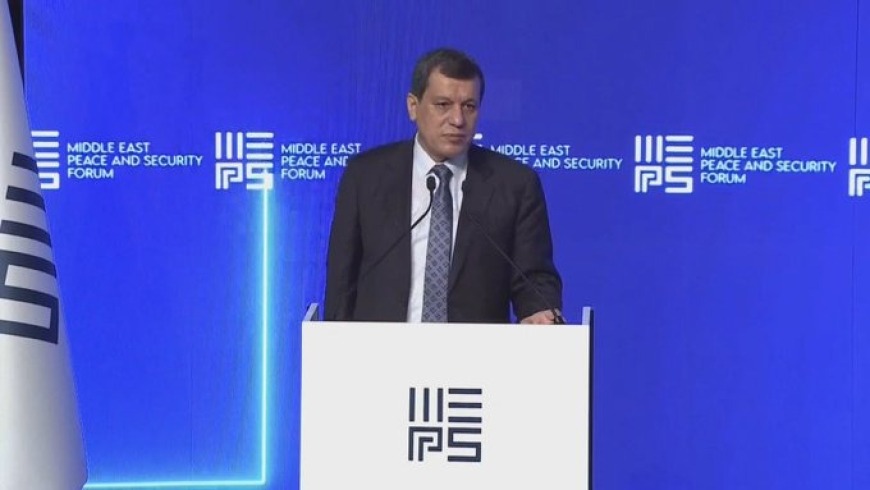
General Commander of the Syrian Democratic Forces (SDF), Mazloum Abdi, along with Ilham Ahmed, Co-President of the Foreign Relations Department in the Autonomous Administration of North and East Syria, took part in the Middle East Peace and Security Forum (MEPS), hosted by the American University in Duhok in the Kurdistan Region of Iraq.
In his address, Abdi expressed optimism that the March 10 agreement, signed with the Transitional Syrian Government, would be finalised before the end of the year. He firmly asserted that Syria would not return to the centralised model of governance that prevailed under the previous Assad regime.
Abdi emphasized that a resolution in Syria could only be achieved through dialogue. He also stressed that his forces posed no threat to Turkey, portraying them instead as a pillar of regional stability, according to the Rudaw media network.
Abdi: We Aim to Implement the March Agreement by Year’s End
Abdi described the March 10 agreement with the Transitional Syrian Government as a significant turning point. It, he said, thwarted attempts to fragment the nation and averted a potentially devastating conflict.
He noted that the accord represented the first formal recognition of Kurdish rights in Syria and committed the country to enshrining these rights, along with those of all communities, in the future Syrian constitution.
According to Abdi, substantial progress had been made in harmonizing security and military matters between the parties, with only “final details” remaining before the agreement could be announced in its complete and final form. However, discussions on governance and political structures are ongoing.
He stressed that the regions of North and East Syria are fully committed to implementing the March agreement and urged the Transitional Government to demonstrate similar determination.
Abdi: Syria Will Not Return to a Centralized State
Abdi acknowledged that the current phase of dialogue faced serious challenges, chief among them a lack of mutual trust between negotiating parties. He also cited ongoing dangers in the Sheikh Maqsoud and Ashrafieh districts in Aleppo and government measures that have excluded various factions, heightening concerns. In addition, the return of displaced persons, particularly those from Afrin, has yet to be realized.
Barzani: A Golden Opportunity for Syria to Resolve the Kurdish Issue Peacefully and Democratically
Abdi reaffirmed that, after fifteen years of conflict, Syria could not revert to the model of a centralised state, describing this as an irreversible position for the peoples of North and East Syria.
He called on Turkey to cease viewing the Autonomous Administration and his forces as threats to its national security. Instead, he described them as guarantors of peace and security within Syrian borders. He stated that the international community is increasingly supportive of giving Syria a new opportunity for dialogue and said the Autonomous Administration is ready to pursue this opportunity to its fullest. He appealed to all parties, particularly Turkey, to provide the same space for talks between North and East Syria and the Transitional Government so that disputes might be resolved through negotiation.
Abdi also argued that the lack of dialogue was a primary reason for the collapse of the former regime. He remarked that the SDF and the Autonomous Administration never chose war, but were forced into it.
Support from the Kurdistan Region for Syria
Abdi expressed appreciation for the steadfast support provided by the Kurdistan Region of Iraq to North and East Syria over the past fifteen years. He acknowledged the key role played by the region’s political leadership, led by President Masoud Barzani, in supporting the peace process and political reconciliation.
He recalled that the Kurdish forces had been at the forefront in the fight against Daesh, working in coordination with Peshmerga forces and international allies. He affirmed that they continue to lead peace efforts and pledged the SDF’s readiness to support any regional peace initiative, including that proposed by Abdullah Öcalan, leader of the Kurdistan Workers’ Party (PKK).
Abdi called on Kurds in the Kurdistan Region, North and East Syria, and across the diaspora to actively participate in Syria’s reconstruction. He stated that Kurds hold a vital role in ensuring the region’s peace and stability.
For his part, Masoud Barzani, President of the Kurdistan Democratic Party in Iraq’s Kurdistan Region, told the forum on Tuesday that Syria now has a “golden opportunity” to address the Kurdish issue and internal governance disputes through peaceful and democratic means. He said this process could lead to a national agreement that upholds dignity for all citizens.
The Syrian Dossier Returns to the Security Council
Nechirvan Barzani, President of Iraq’s Kurdistan Region, also praised the SDF’s role in combating terrorism.
He argued that a rigid centralised model no longer suits Syria, given its ethnic, religious, and cultural diversity, as reported by Kurdistan 24.
He added that a new model of governance must be introduced to guide Syria forward, lamenting that the current government remains entrenched in rigid centralism. He described this approach as incapable of bringing about a better future for the country.
Barzani concluded that the Syrian people deserve a far better quality of life and that the rise of President Sharaa presents a critical opportunity to usher in peace and stability across the nation.
This article was translated and edited by The Syrian Observer. The Syrian Observer has not verified the content of this story. Responsibility for the information and views set out in this article lies entirely with the author.