
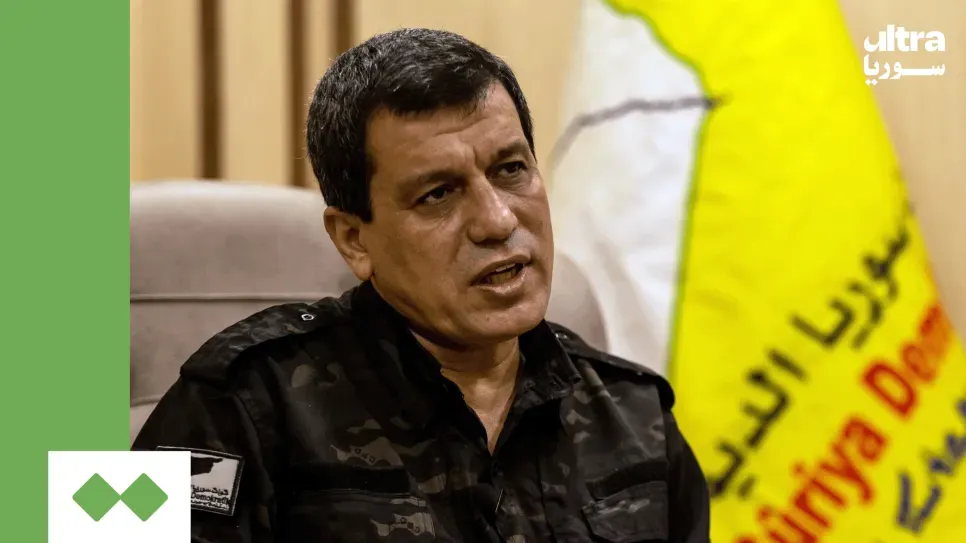
The commander of the Syrian Democratic Forces (SDF), Mazloum Abdi, announced that a preliminary agreement had been reached with the Syrian government on a mechanism for integrating SDF forces into the Syrian army as a cohesive unit, rather than on an individual basis.
In an interview with the Associated Press, Abdi explained that the SDF includes tens of thousands of fighters, in addition to internal security forces, making individual enlistment impractical. Instead, integration would have to occur through large military formations compatible with the Ministry of Defense’s structure.
He revealed that a joint committee has been formed to work with the Minister of Defense and other military officials to determine the most suitable mechanisms for integration. Abdi expects that SDF members and leaders will receive prominent positions within the Ministry of Defense and the army’s command, citing their extensive experience that would contribute to strengthening the Syrian army.
Abdi noted that his recent meetings included discussions with President Ahmad al-Sharaa and several other senior officials, including the ministers of Foreign Affairs and Defense. He stressed that implementing this agreement would help resolve many other problems in a Syria emerging from a 14-year war.
Commenting on the challenges facing implementation, Abdi said that sectarian incidents in the coastal and Suweida regions had caused fears among residents in northeastern Syria, contributing to delays in the execution of the March agreement. He emphasized that progress in implementing the accord would prevent the recurrence of such incidents and called for a settlement that guarantees equal rights for all Syrians.
Abdi also addressed the issue of decentralized governance, which the SDF advocates within a unified Syrian state. He said that the central government in Damascus fears that decentralization could lead to a de facto partition of Syria.
He affirmed that implementing the March agreement means integrating all civil, economic, and military institutions in northeastern Syria into the central authority.
Abdi added that putting the agreement into effect would deprive Turkey of any pretext for intervention inside Syrian territory, noting that he had observed some flexibility in Ankara’s stance regarding the SDF’s integration into the Syrian army.
A few days earlier, in an interview with Agence France-Presse (AFP), Abdi said that during his meeting with President Sharaa in Damascus, they discussed ways to implement the March agreement, particularly the mechanism for integrating the SDF and its affiliated internal security forces, known as Asayish, into the Ministries of Defense and Interior.
He explained that a preliminary understanding had been reached on the integration mechanism, adding that talks between the two sides are continuing in Damascus, where two SDF delegations are currently present.
“What is new in our recent discussions in Damascus,” Abdi concluded, “is the shared determination and strong will to accelerate the implementation of the agreement’s provisions.”
This article was translated and edited by The Syrian Observer. The Syrian Observer has not verified the content of this story. Responsibility for the information and views set out in this article lies entirely with the author.