
The current crisis did not arise from a passing confrontation in the street. Its roots stretch back to the decree issued by the Governor of Damascus regulating the sale of alcohol. What might have been treated as a routine administrative measure was swiftly recast by extremist groups as an invitation to impose their own social order. In an already polarized environment, the decision became the spark that emboldened these actors to test the limits of the state.
The Distortion of Protest
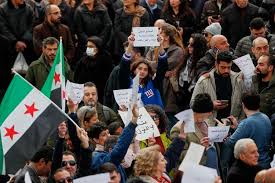
Demonstrations soon emerged in the Bab Touma neighborhood. Far from being mere “protests for alcohol,” they represented a defense of personal freedoms and the right to diverse ways of life. Yet the narrative was deliberately twisted. Protesters were caricatured as “drunkards,” a label designed to delegitimize their demands and turn them into targets of sectarian and moral agitation.
This manipulation marked a decisive turning point. It triggered counter-mobilizations wrapped in religious slogans, calling not only for support of the Governor’s decree but for its expansion across the country. What began as a civic dispute was transformed into a broad wave of polarization, driven by emotional incitement and sectarian rhetoric.
The Al-Suqaylabiyah Incident: From Local Friction to Organized Violence
The accumulated tension reached its breaking point in the city of Al-Suqaylabiyah. A local altercation, in which residents expelled an outsider who had harassed a young woman, should have remained an isolated incident. Instead, the harasser rallied extremist groups and used the dispute as a pretext for a coordinated assault. Armed formations moved openly through the streets, attacking the peaceful city, destroying private property and firing live ammunition without hesitation.
These events expose a troubling paradox. While the authorities have taken forceful measures to disarm certain factions, the extremist groups involved in these attacks continue to move freely and wield weapons without legal restraint. This is not merely a double standard. It strikes at the heart of the state’s legitimacy. A sovereign authority must maintain exclusive control over the use of force and ensure that arms do not remain in civilian hands, regardless of the justification offered.
This article was translated and edited by The Syrian Observer. The Syrian Observer has not verified the content of this story. Responsibility for the information and views set out in this article lies entirely with the author.