
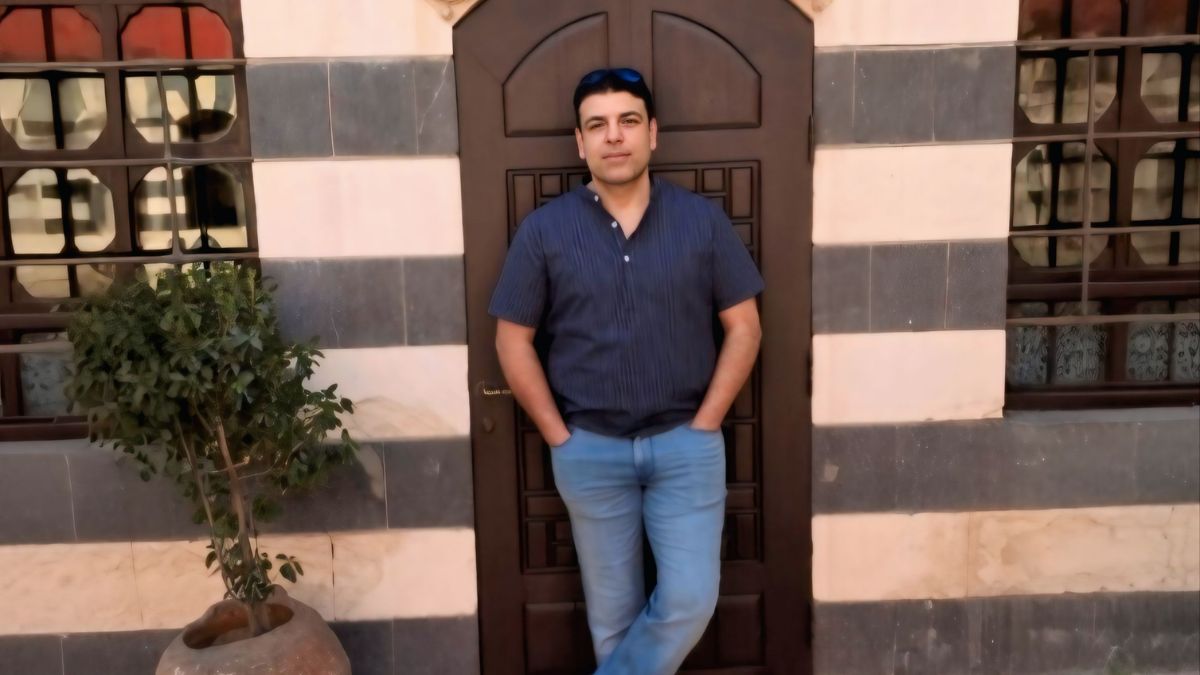
On Monday 15 December, the Solicitor General in Damascus ordered the release of Syrian journalist Iyad Sharbaji, following a 24-hour detention in the capital. His arrest stemmed from a complaint accusing him of inciting sectarian strife.
Sharbaji, in a Facebook post, stated he would later provide a detailed account of the circumstances surrounding his detention. He noted that the prosecutor had dismissed the charges as baseless and without merit. According to Sharbaji, the detention might have been extended by another day had he not presented compelling arguments and evidence during a one-hour confrontation with the Solicitor General. He also remarked that the legal framework governing such proceedings remains largely unchanged from the era of Bashar al-Assad.
Syrian security forces detained Sharbaji on Sunday 14 December, after he appeared for questioning at the Criminal Security Department in Damascus. The arrest followed a lawsuit filed by lawyer Rashid Abdul Jalil, who accused Sharbaji—alongside actor Jalal Shamout—of defamation, slander, inciting sectarian tensions, and threatening national unity, according to information obtained by Enab Baladi.
The lawsuit was triggered by Sharbaji’s publication of a video that the complainant claimed constituted a direct and explicit attack on a segment of the Syrian population, particularly the generation that came of age in Idlib Governorate during the years of the revolution.
Sharbaji firmly denied these allegations. He clarified that his remarks were not directed at Idlib or its residents, but rather at a generation raised there—comprising individuals from various Syrian provinces—who matured in extraordinary circumstances. His comments, he argued, were intended to prompt discussion on the long-term effects of that environment.
Lawyer Rashid Abdul Jalil maintained that Sharbaji’s statements, made by a public figure of influence, amounted to an unjustified insult to Syrian citizens and a disregard for the context in which they were raised. He called for Sharbaji’s referral to the judiciary and the opening of a public security case against him.
Iyad Sharbaji, who resides in the United States, is known for his opposition to the former Syrian government and his criticisms of religiously framed state structures. He recently returned to Syria to mark the first anniversary of the country’s liberation. Just days prior to his detention, he appeared on Syria TV’s On the Table programme, where he praised the emerging space for freedom of expression.
Sharbaji was a founding member of the Syrian Journalists Association in 2012 and played a key role in launching The New Syrian website in 2015, where he served as editor-in-chief, according to the Syrian Memory Institute. Before the revolution, he led the editorial team at Shabablik magazine from its inception in 2004 until it was suspended in 2009 following repeated harassment by the previous regime, which obstructed the publication of several issues.
At the Direction of the Bar Association President
Muhammad Ali al-Tawil, President of the Syrian Bar Association, told Enab Baladi in a previous statement that on 23 November, he had commissioned lawyer Rashid Abdul Jalil to file a formal complaint with the Damascus Solicitor General against both Jalal Shamout and Iyad Sharbaji.
This directive coincided with similar assignments issued to several other lawyers to submit reports against a number of public figures, including Wiam Wahab, Ghada al-Shaarani, Agnès Mariam de la Croix, Ghassan bin Jiddo, Hikmat al-Hijri, Maher Sharaf al-Din, and Nidal Maalouf.
Al-Tawil stated: “In matters concerning state security or its symbols, the Bar Association is obliged to act against transgressions—not only in our professional capacity, but also as citizens and revolutionaries. We cannot allow any infringement upon the state.”
This article was translated and edited by The Syrian Observer. The Syrian Observer has not verified the content of this story. Responsibility for the information and views set out in this article lies entirely with the author.